Showing posts with label Trouble Shooter. Show all posts

Little Things: Whip Rush

What follows is my attempt to talk about Whip Rush and only Whip Rush. I will deliberately avoid mentioning its connections to Trouble Shooter. Instead I’ll just focus on Whip Rush, the 1990 Sega Genesis shooter developed by Vic Tokai. This isn’t an easy task. 

That’s because there isn’t much to say about Whip Rush. It’s not a terrible game, but it’s very much a middle-grade shooter from an age when its kind swarmed the market. Notably reminiscent of Irem’s R-Type, this is a standard side-scrolling affair (with occasional vertical interludes) where the player controls a cute little spaceship called Whip Rush and two accompanying weapon pods. There are lasers, missiles, fireballs, cityscapes, enemy bases, organically pulsating tunnels, and all the other expected sights of nearly every shooter from the early 1990s.


You’ll see glimmers of invention in a few boss battles, yet there is no elevating Whip Rush. It’s an unremarkable specimen of its day, harsh in the least compelling fashion. Surviving the levels depends entirely on powering up your weapons and keeping them: one hit demotes you to a pea-shooter and all but seals your fate. Perhaps an easier game would have gone down better, or perhaps that would have given it even less staying power. 

Is that all there is to Whip Rush? Hmm...well, there’s something I like about the opening.

One cliché that I always enjoy at least a little is the mysterious disappearance of some exploratory vessel, whether it’s a high-seas clipper or, as Whip Rush introduces, a trio of deep-space ships dispatched to discover new worlds. The mission is deemed “missing and presumed lost” five years into their journey, and their last transmission sees them approaching the planet Voltegus.

But hang on a second. The game then tells us that “less than a week after the incident” an ominous alien force arrives to attack Earth. So those three ships were listed as MIA within a week of losing contact? That seems hasty. What if their communication relays shorted out? What if their lone tech-department wizard was on vacation? What if they just got lazy and didn’t feel like sending those control freaks back at Earth updates about every incremental piece of their voyage? 

Anyway, this is as much storyline as Whip Rush gets. It doesn’t even show an anime pilot at the controls of its ship. Even so, it's a shooter that's worth trying for a few minutes, I guess. Maybe you'll even stick with until the second stage, when you get to that underwater part where everything slows down. That's where it gets dull. 

Okay, fine. I’ll talk about Trouble Shooter. Whip Rush is notable for me only because of its connections to Vic Tokai’s next offering in the genre, known as Trouble Shooter in North America and Battle Mania in Japan. Whip Rush’s staff included Fujito Takada, a.k.a. Takayan the Barbarian, and in a Shmuplations-translated interview he mentions how he was the programmer for Whip Rush while the design was handled by someone else. 

It’s not hard to see Trouble Shooter growing out of Whip Rush. They’re similar in their approaches, mixing horizontal and vertical scrolling, and the available weapons and sound effects all seem from a similar source. 

Yet they’re exceedingly different where it counts. Whip Rush is unobtrusive and mediocre in appearances, while Trouble Shooter has personality at every turn, peppering widespread anime-heroine hyperdestruction with all sorts of tidbit references from whatever Takayan happened to like. It’s also a much easier game, more concerned with colorful details and large characters than it is with how long it might take the average player to reach the ending. 

The Whip Rush ship appears in Trouble Shooter, toting power-ups for protagonists Madison and Crystal (or Mania and Maria) to collect. It’s entirely appropriate for a spacecraft that always looked a little too compact and cuddly for a blistering space shooter. I like to think that Madison and Crystal adopted it as a pet, much like Nanmo from Dirty Pair. I have to mention Dirty Pair at least once in my Trouble Shooter writeups, lest anime fans think me ignorant of the debt that just about everything with futuristic gun-slinging women and copious explosions owes to Kei and Yuri. 

Battle Mania Daiginjoh, sequel to Trouble Shooter, goes with a sleeker ship for its power-up deliveries. Is it a guest star from another Vic Tokai game, or perhaps a reference to another shooter from a rival company, like Technosoft’s Thunder Force? Or is it just a glimpse of how the Whip Rush ship might have been upgraded for a sequel it never had? 

No Vic Tokai game is getting a sequel these days. While Tokai Communications still exists, they’ve long since left the game industry, and their catalog seems off-limits for reissues and new creations. If that ever changes, Whip Rush would not be my first choice for a follow-up, but perhaps its ship could sneak into a third Trouble Shooter game.

Little Things: Fire Shark

I admit it: I neglected Fire Shark for a long while. You can’t blame me that much. It seemed mundane when I sampled it during my trips through Sega Genesis shooters, and even the label for the North American version of Fire Shark is a boring black-and-white deal without illustrations, apparently due to someone’s desperate attempt to trim costs. So the game was easily overlooked amid the throng of M.U.S.H.A., Gaiares, the Thunder Forces, Phelios, Grind Stormer, Sol-Feace, Wings of Wor, Dangerous Seed, Forgotten Worlds, Arrow Flash, Hellfire, Vapor Trail, After Burner II, Zero Wing, Bio-Hazard Battle, Insector X, Gleylancer, Atomic Robo-Kid, Whip Rush, Burning Force, Steel Empire, Truxton, Panorama Cotton, Galaxy Force II, Eliminate Down, Sagaia, Curse, Elemental Master, Task Force Harrier, Air Diver, Air Buster, and, of course, my beloved Trouble Shooter series.


Sorry, Fire Shark, but you didn’t wink at me like Trouble Shooter did.   

I’ll still acknowledge that Fire Shark doesn’t look like much at first: you pilot an ordinary biplane into an oncoming force of tanks and aircraft, also of mediocre appearance. Yet things perk up very soon. Enemy fire constantly forces you to dodge and destroy as quick as you can, and the weapons gradually change from a routine spread shot to a twirling spiral green laser and a screen-filling octopus of a flamethrower. The opposition also gets more impressive, growing into more stylish assault vehicles and immense stage bosses. It’s a fantastic workhorse of a shooter. It’s not always pretty, but it’s constantly challenging you, leaving you wanting more at your inevitable defeat and even dropping small details for you to appreciate when you're not weaving through certain destruction. 

When it comes to those details, my favorite is the ground crew that awaits at the end of each stage. They’re tiny green figures that scamper across the curiously friendly airfield where your plane lands, somehow in the middle of hostile territory, and those mechanics are usually up to something. At the game’s start they’ll form an encouraging arrow for you. On another level one of them will try to fly a plane like yours, only to crash it and apparently survive. 

The best ground-crew routine appears at the end of stage four, when they’ll rush toward the landing strip and line up…except for one crew member, who trips over the barrier.

Whoops! Quick, get up and get in line before someone notices!

Uh-oh. Your boss saw you, and you’re getting chewed out.

But it’s okay, because now you’re back with the others…only you’re just a little out of step with the rest of the crew. That’s really a nice touch.   

Toaplan went on to make more complex shooters with more complex background details, perhaps reaching their apex with that gorgeous spread of ocean life in Batsugun’s first stage. I think that Fire Shark was the start of that. There’s a certain care to it that isn’t really apparent in earlier works like Tiger-Heli, and it set a lot of standards for shooters both inside Toaplan and out of it. For example, Seibu Kaihatsu's original Raiden has a lot in common with Fire Shark, from the round, bullet-spraying tank turrets to the overall intensity of it. So when people talk up Raiden, you can mention that it swiped a lot from Fire Shark. You’ll be the old-school shooter version of those people who won’t let anyone mention the Ramones without bringing up MC5 or the Dictators or the New York Dolls.  

There are several ways to enjoy Fire Shark, including a recent port of the original arcade game for the Toaplan Arcade Garage. Yet the Genesis version, which Toaplan themselves programmed, is hardly irrelevant, and I actually prefer it in many ways. The soundtrack has more impact there, and a special code lets you max out your weapons at any time. This fixes one of the game’s few general flaws: power-ups are a little too infrequent in the face of the opposition. So don’t feel guilty about pumping up that  fire cannon and filling the screen like some b-movie giant spider. 

So now I appreciate Fire Shark. I don’t like it quite as much as I do M.U.S.H.A or the Trouble Shooter titles (did I mention those?), but I think Fire Shark places in the top five shooters on the Sega Genesis. And on a system so full of them, that’s saying an awful lot.

Trouble Shooter: Behind the Scenes

Hey, I haven’t written about Trouble Shooter lately! I should, because this little two-game carnival of side-scrolling action and heavily armed anime heroines is one of my favorite series. I really don’t need a valid reason to cover it on a website bound by no professional strictures, but this time I have several good reasons for bringing up Trouble Shooter yet again.


(For those of you unacquainted, the original Trouble Shooter came out for the Sega Genesis in 1991 and was known as Battle Mania for its 1992 release in Japan. The 1993 Japan-only sequel is Battle Mania Daiginjou. The heroines are called Madison and Crystal in America and Mania Ohtori and Maria Haneda, respectively, in Japan. There. Now I don’t have to explain this further down the page.)

The first reason is an amazing interview with Trouble Shooter series creator Takayan the Barbarian. Recently translated by shmuplations, it covers plenty of interesting ground. Takayan discusses the history of Vic Tokai, a game company that has long fascinated me, and the inspirations behind the Trouble Shooter titles. He also confirms something I suspected and wrote about a while ago: he’s the butler in Kid Kool.

It’s essential reading for any fan of Trouble Shooter or Vic Tokai or the game-development climate of the 1990s. Among the revelations: Trouble Shooter started off as a prototype arcade game, heroines Madison and Crystal (or Mania and Maria) originally had a weirdo weapons-dealer sidekick named Fugu, and the games are of course littered with references to everything from fantasy novels to the train stops for Sega’s Japanese headquarters.


Takayan comes off as a delightful renaissance nerd creating a game he truly wanted to make and defying all marketing logic and company disapproval along the way. He even named Battle Mania Daiginjou after his favorite sake and commissioned his own highly limited run of model kits! You can buy a set on Yahoo Japan for only $300! And if that seems expensive, you don’t want to know how much the actual game goes for these days.

Takayan also mentions some minor censorship during the development of Battle Mania Daiginjou. The continue screen originally showed Crystal/Maria disrobing in a shower while the villainous Morgstein leered in the background, his sinful habits stymied by a falling bucket when the counter hit zero. Sega caught wind of this scene and demanded its removal, so the final game’s continue screen merely shows giant numbers formed from cute little Madison and Crystal portraits.

Trouble Shooter Travails and Game Collecting

Buying old video games is ridiculous in this day and age. It wasn’t so long ago that cheap, unwanted cartridges littered garage sales, thrift shops, and any retro-game store brave enough to exist. Yet video games fell into the deep and inescapable swamp of being collectible, and anything less common than a Sega Genesis sports title spiked in price. Ten years back, NES games like Metal Storm and Kick Master might have sat in flea markets bin with a “$5 EACH OR THREE FOR $12” sign protruding from rows of obsolete plastic. Today they’re considered bargains if they stay under a hundred bucks for just the bare cartridge. And if you want the box and instructions, I have some bad news for you.

I considered myself lucky, however. I collected old games in the late 1990s and early 2000s, when Goodwill sold NES cartridges for two bucks apiece and people would throw 32X systems in the garbage when Electronics Boutique refused to take them in trade. I sold most of my library when prices reached absurd levels, and I told myself that I’d done well and stayed sensible. I’d never paid more than $100 for a game, provided I didn't adjust old RPGs for inflation. More importantly, I got everything I wanted before the collecting scene turned psychotic.

Well, almost everything.

Trouble Shooter, aka Battle Mania, is one of my favorite series, if two games constitute a series. I’ve written about their appeal several times before, how their mix of solid side-view shooting and stylish comedy captures everything I like about silly ’80s anime. I bought the original Trouble Shooter when it was cheap, but I never could bring myself to pick up its Japan-only sequel, Battle Mania Daiginjou.


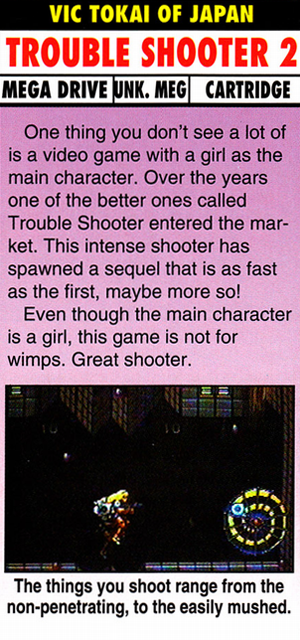
I wanted Daiginjou ever since a 1993 issue of EGM introduced it as Trouble Shooter 2 in a sexist writeup, but it was too expensive. By the time I started collecting games, Daiginjou went for over $150 on eBay, and I refused to spend that much on a single Genesis title (not even if I could call it a Mega Drive title, since it was from Japan). Of course, that was fifteen years ago, and like every other game more popular than Cyberball, it more than tripled in price. Buying Battle Mania Daiginjou is even dumber today than it was back in 2003.

So I bought it.

Trouble Shooter's Third Strike

It’s a good time to be a fan of Trouble Shooter. Or Battle Mania. Or whatever you might call the two comedic Sega Genesis shooters that put heavily armed heroines named Madison and Crystal in a blend of Forgotten Worlds and Dirty Pair. I am a fan, because I know of no other game that drops you into a giant claw machine so you can fight a farting pig robot.


Hardcore Gaming 101 recently put up an entry on the series, and it covers the first game, which we knew here as Trouble Shooter, and the second game, which we never saw here and thus knew only by its Japanese title, Battle Mania Daiginjou. The article also mentions Madison and Crystal’s cameo in Segagaga. Of course, they would go by their Japanese names, Mania Ohtorii and Maria Haneda, respectively. I would be annoyed at having to explain that every time I talk about Trouble Shooter, but I like talking about Trouble Shooter too much.

The big attraction in the article is a set of design documents for the never-made third game in the series, Battle Mania N.Y. Gankutsujou. The scans come from the fourth volume of Nazo no Game Makyou, which printed them small and in black-and-white. I bought this very issue about a month ago, but I dragged my feet on scanning it, restrained by that new-purchase aura that congeals when you spend twenty bucks on a little book about old video games. Fortunately, Hardcore Gaming 101 stepped up and scanned them as nicely as possible, considering that the original images were only slightly larger than Wheat Thins.

Those design documents show what could’ve been an amazing game. You can check out the entire set at Hardcore Gaming 101, but I picked out my favorite things from this game that never was.


Trouble Shooter Trivia

I admit that I’m lazy when it comes to investigating games. I'm willing to poke through old magazines in search of screenshots that differ from the actual released titles, but I rarely notice any changes unless it’s a game I really like. For example, I found something irrelevant about Trouble Shooter, which I enjoy and write about more than it probably merits.

Trouble Shooter, known as Battle Mania in Japan, is a charming Sega Genesis side-scrolling shooter, stitched together from two obvious sources. One is Capcom’s macho arcade fantasy-blaster Forgotten Worlds, and the other is Haruka Takachiho’s Dirty Pair line of novels and anime about bikini-clad interplanetary operatives Kei and Yuri blowing up a good chunk of space-faring civilization. Many people imitated both of these things to drab effect, but Trouble Shooter found its own identity. It’s colorful and competently made even if the gameplay is simple, and its sequel, Battle Mania Daiginjoh, is downright amazing. At the risk of perturbing Capcom diehards and the fansub kingpins of Reagan-era college anime clubs, I like Trouble Shooter more than Forgotten Worlds or any Dirty Pair adventure.


Most importantly, Trouble Shooter and Battle Mania Daiginjoh have genuine affection at their cores. It’s common for fans to declare their favorite games earnest labors of love regardless of how bland they may be, but the Trouble Shooter series truly seems to exist just because some staffers at Vic Tokai and Seibu Lease really, really wanted to make them. Rather than Xerox Kei and Yuri, they established heroine Madison (Mania in Japan) as a cranky, genre-wise mercenary and, in the American version, a slumming debutante with feminist quips. Along with her more placid and fun-loving roommate Crystal (a.k.a. Maria), she rescues a kidnapped prince who says things like “Coolness,” defeats a supervillain who turns into a giant buglike demon, and goes to even stranger places in the sequel.

Trouble Shooter: Nintendo Haters at Heart

The Sega-Nintendo War of the early 1990s may go down in history as yet another small-scale market squabble, but it left an impression. Uncouth as it is to compare trivial game-industry rivalries to real life, Sega and Nintendo fought a World War, polarizing the masses and reducing NEC’s TurboGrafx-16 to a cringing pocket of irrelevance. It was a momentous age, with every young nerd sifting magazines and playground rumors for the latest revelation that would see Sega or Nintendo triumphant. Friendships were tested, lifelong biases were forged, and at least one person claimed that Eternal Champions was better than Street Fighter II Turbo. And it all happened without widespread Internet access to feed the bonfires.

Yet the battle rarely bled into the games themselves. For the most part, Sega and Nintendo avoided attacking each other in their creations. Sega originally named a mustachioed boss “Mari-Oh” in Alex Kidd in Shinobi World, then changed it for the final version. Nintendo took the high road until the last years of the war, and their most savage blow had Uniracers telling players that names like "Sonic" and "Sega" were, in fact, not cool enough.

The majority of third-party developers avoided taking sides, but some couldn’t help it. Naxat buried an exploding “S?GA” logo in the code of their awesome NES shooter Recca, even though that barb went undiscovered for decades. Bart’s Nightmare, a horrible 1992 Super NES treatment of The Simpsons, snipes at Sega in mini-game where skyscraper residents toss things from windows. Among the items rained down on Bartzilla are cats, TVs, fire extinguishers…and what looks like a Genesis.


On the other side of the conflict, one game bluntly targets Nintendo and the Super Famicom. That game is Vic Tokai’s Trouble Shooter.


Trouble Shooter was never a classic of the Sega Genesis library. It’s basic and slow-paced, though strangely charming in its fusion of the free-floating gameplay of Forgotten Worlds, the humorous tones of Parodius, and the destructive heroines-for-hire of The Dirty Pair. The game sends heavily armed bounty hunters Madison and Crystal (Mania and Maria in Japan) floating through levels and gunning down all sorts of slightly bizarre machines. It has the affectionate, in-jokey air of a pet project, crafted by a Vic Tokai team called Studio Uchuu Tetsujin, or Studio Space Iron Men. Reportedly irked by Vic Tokai’s support of Super Famicom games, Studio Space Iron Men hit Nintendo with a stunning assault. They stepped on the Super Famicom.