Showing posts with label Merchandise. Show all posts

The Way of Wall Scrolls

I became an anime nerd in the late 1990s, and it wasn't a bad time for that. There's a lot to analyze there: the rise of manga and anime as a mass-market export from Japan, the expensive or haphazard ways fans acquired it, and the backlash from more entrenched geek circles. Yet if I had to describe my young and silly anime-fan period in one phrase, I'd refer to that time as My Wall Scroll Years. 

Wall scrolls are still a popular chunk of the anime merchandise market, but I remember them looming largest around the turn of the century, if you can call it that without sounding ancient and weird. As the 1990s drew to a close, fans snapped up all sorts of products based on their favorite anime, even when those products were overpriced or unlicensed or not even visually comprehensible.


In many respects, wall scrolls of that period were questionable purchases. The quality of the print on fabric was rarely as nice as an actual poster, and their appeal was mostly in how easily they could hang on a wall. I had a bunch of them for a while, but in time I realized that if I was going to display my nerd proclivities so readily, I should at least use framed posters. Before that revelation dawned, however, I was perfectly willing to decorate with wall scrolls of my favorite anime or video games. I recall three of them most vividly, along with the reactions they received...or didn’t. 


AN EVANGELION FAMILY PHOTO 
I suspect that most of the wall scrolls I owned were not officially licensed products, but one was the real deal: a Neon Genesis Evangelion scroll that I bought during a college trip to Japan. The art was the same as the image below, but the design I had featured the show’s title instead of the odd photo-negative of the characters.


I liked the simplicity of it, how it made Evangelion look like some legal drama or a mystery anthology about a teenage detective. Evangelion was, I reasoned, all about the characters, and I preferred how this piece was free of EVA Units, plugsuits, or any bizarre imagery. This was a time when festooning your wall with any nerd décor was asking for trouble, but I found this Evangelion spread tasteful. I approved of how Shinji looms largest, how Misato is lost in thought, and how Asuka, the abusive time bomb who livens up the show, looks completely happy. 

Notable Reaction: 
One of my housemates looked at Misato and, noticing her cross necklace, asked “Is she a nurse?” 

I could have pointed out that Misato Katsuragi is not in fact a nurse but rather an officer of NERV, a mysterious organization whose clandestine, world-altering machinations she gradually deduces as she struggles to protect the mentally unstable teenage pilots under her charge while reconnecting with her openly double-agent college boyfriend and awkwardly reconciling the survivor’s guilt she has from witnessing the horrific Second Impact that killed her scientist father and billions of other people. 

But I just said, “Nah, she’s a military commander.” 

DARKSTALKERS 
It took me a while to properly appreciate Darkstalkers, but I was hooked by the time Vampire Savior (aka Darkstalkers 3) arrived on home systems in 1998. I decided to get the superior Sega Saturn version, and I noticed that Game Cave, which by then was filling a dozen pages in every issue of GameFan, offered the game with a wall scroll showing art from the Darkstalkers anime series. So I called them up and ordered it, which was actually what you often did before you decided that credit cards were safe on the Internet.


I suspect that this wall scroll was not officially licensed, given that Game Cave had no scruples about selling those ubiquitous Son May anime CD bootlegs alongside legitimate goods. Yet I didn’t care when I could play Vampire Savior on my Saturn and hang Morrigan and Demitri on my wall. It made up for the Darkstalkers anime series and the Darkstalkers cartoon being disappointments in completely different ways. 

Notable Reaction: 
It wasn’t long before my relentlessly Catholic mother walked into my room, saw that giant illustration of Morrigan in all her bat-winged succubus splendor, and gasped in surprise. I rolled my eyes and prepared for criticism. 

“Look what he put on his wall!” She said, clearly elated. “He’s not gay after all!” 

My mother left the room, rapt as a pilgrim at Lourdes, before I could ask any questions or vent any admonitions about her prejudices. She was correct in her assumptions, but I was shocked that she’d needed an anime wall scroll as proof. Even so, it was rare that my parents showed any interest, much less any approval, toward my anime or video game habits, so I decided to count this as a small victory.


If only that Darkstalkers wall scroll had featured Felicia, the series mainstay who usually wears nothing but very selective fur. I’m sure my mother would have been glad to learn that the nearly naked cat-woman on my wall was, judging by Vampire Savior’s endings, also a nun and therefore a Nice Catholic Girl.

SATOSHI URUSHIHARA’S CHUN-LI 
I always liked Chun-Li. It was less an awkward preteen crush and more of a fondness for her as a character, a resilient woman who held her own in Street Fighter and the frequently male-dominated realm of fighting games. Yes, Chun-Li was designed and marketed to entice an equally male-dominated market, but I sought the higher ground. That extended to a wall scroll.


This art is the work of Satoshi Urushihara, who is hardly a Puritan when it comes to drawing women for games like Growlanser and Langrisser or his original creations like Plastic Little and Legend of Lemnear. He made several illustrations of Chun-Li, and this was the one I liked best. I enjoyed the contrast between her tearful background expression and her more confident foreground pose, and I preferred her Street Fighter Alpha outfit to her less practical original acrobat costume. I even appreciated that while Chun-Li is often rendered with large thighs and skinny arms, Urushihara allowed her a bulkier upper body and thus a more balanced physique, portraying an image of strength layered atop vulnerability. 

Yes, I had thought about this wall scroll. I had analyzed it. I was prepared to defend it and extol its artistic merits to anyone who noticed and remarked on it. 

Notable Reaction: 
No one noticed or remarked, actually. All my rationalizations went to waste, probably because Chun-Li wasn’t on my wall for long. 

You see, I was a weird contradiction of a nerd. I was willing to wallpaper my dorm room with Masamune Shirow art and RPG posters, yet I would never, ever actually discuss anime or video games with others unless I was rock-certain that they were as into it as I was. It's not as though I would raise my hand in my History of Art class and announce that I had an artistically semi-nude Chun-Li on my wall. This was many years before Nicki Minaj’s song, after all. 

Eventually that socially uptight half of me triumphed, and most of those wall scrolls, Chun Li among them, were stored away while I tried to balance a few anime or video-game posters with Radiohead, Tori Amos, or Mulholland Drive. 

Like many things I valued as a young anime nerd, my wall scrolls were swiftly sold when I needed money more than a tapestry of awkwardly positioned Xenogears artwork. I don’t really miss them, and I’m not even sure if I even miss that time in my life when I’d spend money recklessly just to show the world how much I liked Evangelion or Darkstalkers or Chun-Li. I can do that much cheaper right here.

I'm no longer embarrassed about being an anime nerd, yet I'm also no longer driven to cover my living space so heavily in such adornments. I can say with matchless confidence that My Wall Scroll Years are far behind me. 


Uh oh. 

My Stinkor Story

He-Man and The Masters of the Universe is less a toy line or a cartoon than it is a case study in ruthless, well-timed marketing. The rush of commercialized animation in the 1980s is fascinating in its mercenary layers, but the short of it is that Mattel began it all by relentlessly promoting He-Man action figures with a cartoon thanks to loosened FCC restrictions. This may go down as one of the lesser machinations of the Reagan administration, but the competition there is fierce. 

Evil or not, toy companies swamped the airwaves with their TV shows. Among the creations that sprung from this ominous entwining of advertising and entertainment, He-Man wasn’t the most enduring. Transformers, Ninja Turtles, My Little Pony, and G.I. Joe arguably got better mileage. 

Yet He-Man was first, and He-Man was massive in its day. It wasn’t just toy sales or after-school cartoons, either. The Macy’s Thanksgiving Day parade had enormous He-Man floats. Dave Barry mocked He-Man toy names (“Lob-Stor”) in his books. Concerned Christian parents saw demonic imagery in the villainous Skeletor and fretted that their children might attach quasi-religious proportions to He-Man’s tagline of “The Most Powerful Man in the Universe.” 

I enjoyed this almost by accident. I was a little too young to catch the full weight of Mattel and Filmation’s toy-cartoon assault, but I had plenty of Masters of the Universe paraphernalia. Much of this was due to my grandmother, who of course spoiled me and my sister with new toys whenever we visited. I soon had He-Man and Skeletor and a good share of their dueling entourages, and a trip to the grandparents usually meant a new addition. 

One day in 1985, my grandmother brought out Stinkor.

Even those distantly familiar with He-Man toys may recall that every figure had some gimmick, such as spring-loaded punches or interchangeable arms or a water-spraying robot elephant trunk. Stinkor’s contribution to this feverish creativity was that he smelled bad. 

Yes, that was all. Stinkor was a skunk-colored action figure who emitted an actual odor.  Of course I found this amusing, and when my grandmother presented me with Stinkor I joked that I would leave him on her bed one night to spread his presumably fetid aroma. 

Grandma was not amused. Though not upset, she declared that if such was my intent, I would get no Stinkor. 


I’m certain she would have relented if I had apologized, but that’s the strange thing: I didn’t. 

Part of this doubtless came from me being a little brat, but the fact was that I no longer cared that much about Masters of the Universe. Transformers and GI Joe and Starriors (hey, they’re underrated) all interested me much more by that point, and I’d had my fill of He-Man. The cartoon seemed repetitive and preachy, and a lot of the action figures were suspiciously similar. I was hardly a discerning consumer as a kid, but even I could see that Stinkor was just the line’s earlier Mer-Man figure painted like Pepe Le Pew. His orange armor was reused from Mekaneck. And he didn’t even come with any accessories beyond a boring little shield. If you’ll pardon the phrase, Stinkor was running on fumes. 

So my grandmother put Stinkor away. I don’t recall if I got in trouble over this, but it made no difference to me at the time. Only many years later did I realize how dumb I’d been to turn down a toy. More importantly, I worried that I’d hurt my grandmother’s feelings by callously rejecting her gift. 

If I was outgrowing Masters of the Universe, I wasn’t alone. The series declined in popularity by the mid-1980s. It may have been a stagnation of ideas, as the line tried to introduce dinosaurs and a new lead called He-Ro to little effect. It may have been the general life cycle of a toy that isn’t a pop-culture keystone. Some even blamed She-Ra, He-Man’s sister, and her series for making Masters of the Universe seem like a property for girls. I don’t entirely believe that, but it’s sadly true that a lot of boys back then stigmatized any remotely feminine pastimes. That’s another tale for another time. 

Whatever the cause, He-Man was in a slump by the time the live-action movie arrived in 1987 with Frank Langella and a lot of Jack Kirby references. Masters of the Universe was the first big toy-and-cartoon onslaught of the 1980s, and so it was the first to die down. It became a symbol of Reagan-era excess, a hyper-macho hero shamelessly sold to kids in every way the government and media would allow. 

In that case, Stinkor was the decade’s toy industry at its most absurd. He didn’t have laser eyes or a grappling hook or some battery-powered talent. He just stank. 


Stinkor never had an easy time in the He-Man ranks. The staff for the cartoon reportedly laughed him out of the writers’ room, and he never appeared in the show (he would have presented a confused moral anyway, showing kids that you should in fact judge people by how they smell). The 2002 Masters of the Universe series featured him and tried to develop some backstory, but there’s only so much you can do with a character called Stinkor. 

The recent Masters of the Universe: Revelation, continuing the 1980s cartoon, tries to make up for Stinkor’s original absence by giving him a few moments before he’s thrashed by more popular characters. He does not appear in the trailer for that new Masters of the Universe movie, which looks almost bland and safe enough to ignore something as goofy as Stinkor.    

Even so, there are Stinkor toys aplenty. We’re in the grip of rampant 1980s nostalgia pandering to momentarily soothe our slow capitalist decline into ruin and chaos, so you’ll see not only multiple He-Man lines but multiple He-Man crossovers with Ninja Turtles, Thundercats, Transformers, and so forth. New Stinkors take every shape from little decorations to his elaborate redesign from Revelation. I resisted all of this. I didn’t need a Stinkor in 1985, so I didn’t need one today. 

Last month, however, my aunt and uncle were housecleaning and sent me some old toys that my cousins no longer wanted. This was among them.


Could it be the same Stinkor I stupidly refused so many years ago? It’s possible. My grandmother indulged my cousins as much as she did my sister and me, so it’d make sense if she offloaded Stinkor on them instead of taking him back to the store. I’d say that my prodigal Stinkor has returned, though to be accurate I must note that I, not Stinkor, was foolish and wasteful in my youth.

And he still smells! Mattel actually baked a patchouli mix into the plastic that composed Stinkor, giving him a distinct but hardly mephitic aroma. 

Perhaps if I’d jested about Stinkor to my grandmother after I received and opened the toy, she would have found the scent unobjectionable and seen nothing wrong with me leaving him around the house like some skunk-man air freshener. Yet this would have lumped Stinkor in with all of my other He-Man figures to be forgotten (and probably sold). And then I’d have nothing to write about this month. 

For further reading on Masters of the Universe and the interplay between toys and cartoons, Brian Brown’s The He-Man Effect takes a thorough look at the history and nature of the whole process. It’s a good primer for anyone navigating the traps of acritical nostalgia, though I think it leaves out a major reason He-Man and similar TV shows caught on: there weren’t a lot of better alternatives in children’s programming at the time. If Masters of the Universe sent kids down a treacherous path, I partly blame Turbo Teen and The Biskitts. And since Stinkor wasn’t in the original cartoon, I can’t blame him all that much.

There’s one more thing. Grandma, I’m sorry I made dumb jokes about Stinkor back then. I hope it’s okay that I’m making them now.

Battle Beasts: Animal Collecting

If you asked me to pick my favorite toy from my childhood, I would consider that question carefully and wonder if you were surreptitiously sizing me up for identity theft. But if you asked me my favorite line of toys from my childhood, I’d have an easy answer: Battle Beasts. 

Even if you’re never heard of Battle Beasts, you've at least heard of the toys that spawned them: Transformers. Back in 1987 Battle Beasts first showed up in Japan as Beastformers, a spin-off of Hasbro and Takara’s successful empire of transforming robots. The two were technically part of the same series, and the Beastformers and their homeworld appeared in a single episode (a backdoor pilot, if you will) of the Transformers Headmasters TV series, complete with its amazing, infamous dub. 

In the West, Hasbro licensed these animal-themed figures and dubbed them Battle Beasts for a separate and much lower-key release. As Battle Beasts they had no obvious links to Transformers, and for promotions they enjoyed only a short, obscure comic and a TV commercial that made kids wonder how wood actually defeated water.


I was very fond of the Battle Beasts, and not so much for the reasons extolled in the commercial. Their gimmick was a rub-and-reveal sticker on the armor of each figure, with fire, water, and wood assigned at random. The beasts’ battles took place in rock-paper-scissors format; fire and water’s attributes were clear, and wood technically bested water by floating on it. 

Yes, that was a stretch, but it wasn’t the competitive aspect of Battle Beasts that I liked anyway. I thought the figures were highly cool on their own merits. They were only a little larger than Army Ants or M.U.S.C.L.E. or a number of other small-scale toys, but Battle Beasts were far more detailed and varied, combining animals with cybernetic attire worthy of any 1980s mecha anime.  

They were also compact and affordable, and the fact that they had no real backstories allowed me to imbue them with whatever personalities and plots I devised. One day they might be relentlessly bellicose gremlins squabbling to escape a doomed planet, and the next day they’d be comical little creatures living harmoniously and Smurf-like in the wilderness.  

I sold off the majority of my childhood toys long ago, and I do my best to avoid falling into blank nostalgia or collectible clutter. Battle Beasts are one of the few cases where I’ve not only kept my original collection but actually added to it. And since I haven’t blathered about toys in a while, I’ll round up five or six Battle Beasts of personal note. 

BLOODTHIRSTY BISON 

Let’s start with one of my favorites. Technically his name’s Bloodthirsty Bison, but I was largely unaware of the official titles for any Battle Beasts. I quickly picked him as the leader, named him Taurus, called his ram counterpart Aries, and thought I was clever. This would be the limit of my Battle Beast nomenclatures, though, because I just called most of the others things like Bearton and Boarton. 

Taur...uh, Bloodthirsty Bison shows off the typical and surprisingly intricate design of a Battle Beast. Most have gauntlets, shin guards, and armor, plus some decorations like that little light panel on his forehead, presumably so he can see where he’s charging at night, and the similarly and inexplicably illuminated codpiece. I’m still impressed that despite the small size of the figures, there’s very little repetition across Battle Beasts. A lot of 1980s toy lines would repurpose production molds by recoloring them (for example, most He-Man characters have the same body), but not Battle Beasts, Every one of them is a unique creature with its own outfit and embellishments, like Bison’s horseshoe-claw hand. 

With most old toy lines the accessories are often harder to find than the figures, and that certainly applies here Each Battle Beast came with a weapon, and if you look close you’ll see tiny numbers on both the armaments and figures. I don’t have Bison’s corresponding weapon, so I gave him a few random ones and pretty much recreated the Cow Tools from The Far Side. 

MINER MOLE 

There’s something inherently cute about Battle Beasts, even when they’re positioned as a warlike throng of cyber-suited lions and eagles and iguanas. Miner Mole captures this well; despite all the technological adornments, our mole has a little nose and rounded head that would fit in any Russel Hoban children’s book. Also note the giant claw. A shovel would make more sense for a mole, but it wouldn’t look as cool. Besides, maybe a cyborg burrowing mammal has to use it in combat with all the giant mechanized grubs and insects awaiting underground. 

You’ll note that Battle Beasts tend to lose their rub stickers over the years, and the stickers that remain often degrade to the point where they no longer show their fire-water-wood symbols. I’m sure some collectors prize figures with intact stickers (or apply their own replacements), but I pay no mind to that detail. When I was a kid I actually peeled the symbols off so my legion of Beasts would all be friends and not squabble over social constructs like fire, water, and wood. I was a strange child, but it’s saving me money on my Battle Beast budget years down the road.

POWERHOUSE MOUSE AND HUNCHBACK CAMEL 

These two are grouped by a curious designation. While Battle Beasts originated in Japan and saw more toys released there, Powerhouse Mouse and Hunchback Camel were by all available accounts never sold on the Japanese market. 

They’re Western exclusives, and they’re fairly neat figures. I like Camel’s uniform desert color scheme and the look of sheer derangement that Mouse wears. If you go by the size of their real-world animal counterparts, Powerhouse Mouse might be the smallest of the Battle Beasts next to the spider, and you've got to put up an imposing front. 

Battle Beasts were most commonly sold in pairs, though some were in larger sets. Usually the two-packs matched up the Beasts by number, so the Mouse and Camel would not have been available together. However, I’d swear than many of the sets I bought in Germany had the figures randomly bundled in defiance of their numbers and proper Teutonic alles-in-Ordnung structure. And today, when Beasts are randomly strewn about secondhand shops and eBay listings, it’s sometimes satisfying to reunite them with their store-shelf companions like they’re mismatched partners on the police force. They’re Powerhouse Mouse and Hunchback Camel, teaming up to catch a killer and finally get a trip to Japan.

MUSKY OX 

Take a close look at Musky’s hands. Yes, that’s right. His arms are upside down. This could be a manufacturing error, but I suspect it was the work of a former owner who yanked off Musky’s limbs and put them back wrong in subtle Frankenstein fashion. You’ll occasionally see this sort of thing on Battle Beasts. Their owners got tired of the basic figures and swapped the arms around. The problem was that Battle Beasts were never designed to have interchangeable arms, and much of the time kids just broke them. 

As 1980s action figures go, Battle Beasts are sturdy; they’re made out of hard rubbery plastic, and their arms are the only moving parts. So when you see partly dismembered figures, they’re likely the result of someone’s failed experiment in customization. It’s also common for broken Beasts to just get their arms glued back on, so if you’re selling or buying these toys, consider some photos of Battle Beasts with their arms in different positions. Just a tip there. 

Musky Ox has one of the less intimidating names among Battle Beasts, who go by everything from “War Weasel” and “Sly Fox” to “Bodacious Bovine” and “Ossified Orangutang.” My favorite from the first three series of toys would be “Wolfgang Walrus,” which could be a threatening adjective only if you’re Salieri in Amadeus.

BLUE EAGLE 

The last wave of any toy line is usually the rarest, and for Battle Beasts that final run was called Laser Beasts in Japan and Shadow Warriors in the West. These replaced the rubsigns with crystal spheres that revealed fire, water, and wood symbols when you held them up to a light source. 

Japan got the entire Laser Beasts run while other markets had fewer types of creature available, and just about any figure in this final set is pricey today. So if you’re sorting through a tub of old toys at a garage sale, keep an eye out for Battle Beasts with that circle symbol. 

Blue Eagle, with an admittedly limited blue coloration, is the only Laser Beast I own. That’s partly due to this being one of the more common figures from the set, at least as far as I can tell. I couldn’t capture it in pics, but that symbol has the wood icon inside. Because eagles can perch and nest in trees, that’s why. 

Blue Eagle also reflects an unflattering memory. I had a bunch of Battle Beasts as a kid, and of course I wanted Laser Beasts. I spotted some, including Blue Eagle, in a German toy store once, but my mother forbade me from getting them, and I consequently threw a tantrum. It was the last time I remember getting mad over being denied a toy, and I was so embarrassed by the incident that I avoided buying any Laser Beasts even when I could easily afford them. I lucked into Blue Eagle through a friend of a friend decades afterwards, when I was well past the statute of limitations on my childhood shame.   

Battle Beasts have seen only a few small revivals over the years, and sometimes those comebacks bear only limited resemblance to the 1980s line. That’s rare in a world where an entire quadrant of the toy industry specializes in serving up Ninja He-Man G.I. Joe Ghosbuster Transformer Turtles crossovers and “retro-play” reissues for middle-aged nostalgists, but then Battle Beasts were never a major name in the first place. 

And I like it that way, since rampant reissues and new versions of toys accurate to the originals would only tempt me to spend more money—and perhaps make me weary of such oversaturation.

The closest thing to an all-out Battle Beast renaissance was Beast Saga, a 2012 toy-and-media effort from Takara Tomy. The figures resemble Battle Beasts (or rather, Beastformers) that hash out their differences by launching dice instead of revealing their elemental allegiances. The Beast Saga toys are surprisingly high in quality for their price point and target audience, but the whole thing crashed quick and hard, leaving behind canceled figures and a middling anime series. It was also exclusive to Japan, aside from a dubbed version of the show that apparently aired on some satellite channels. This didn’t stop me from collecting a load of Beast Saga stuff, but that’s a story for another long and confessional post. 

To return to that opening question, I’m not sure if Battle Beasts were my favorite childhood toy line when I was actually a child, considering all the competition. Yet they’ve risen through the ranks over the years, partly on account of their simplicity.  They’re unobtrusive enough to store my entire collection in a shoebox, but crafted well enough that you can admire the design work in a two-inch figure of a cobra or beaver or sabertoothed tiger outfitted like a high-tech Roman gladiator. I think I’d like them even detached from any youthful ownership or memories of questionable fondness, just because they’re neat little toys.

My Five Favorite Game Company Logos

Game companies may need a lot of things to survive in the industry, but in my book they need only one thing to be memorable: a good logo. The majority of developers and publishers use professional, clean designs that showcase their name, and that’s just fine for business purposes. Yet I hold special regard for those logos that went beyond the norm and gave us creative little sights to accompany title screens and copyrights. 

THINKING RABBIT 
Thinking Rabbit’s resume is largely unknown in the West, but it’s an intriguing one. They arguably started the block-shoving puzzle genre with their Sokoban series, known by such delightful alternate titles as Boxxle, Boxyboy, and, best of all, Shove It! They also developed a lot of murder-mystery games for home computers, plus the Super Famicom RPG Maten Densetsu: Senritsu no Ooparts. Outside of Japan, their most intriguing release might be 8 Eyes, an NES action-adventure about a boy and his falcon.

Of course, Thinking Rabbit could have made not a single game and I’ll still adore them just because of their logo: a cuddly lagomorphic blob. It’s a simple but very engaging design, and putting “soft office” next to the rabbit makes it even cuter. I want to pet that rabbit. I want to protect that rabbit from all predators. I want to build that rabbit a safe enclosure and find it a friend, because rabbits do well in pairs. I want to get that rabbit regular checkups. I want to feed that rabbit a heathy diet of hay with the occasional banana snippet as a treat. I want plush toys and keychains and other needless merchandise featuring this rabbit. And of course I want a video game about that thoughtful rabbit.

Sorry about that. Such is the power of a good logo. It certainly made me want to read this interview that covers Thinking Rabbit’s history creative processes. Most interestingly, it mentions that company founder Hiroyuki Imabayashi considered a spin-off label called Hopping Rabbit. I cannot begin to imagine how precious its logo might have been. 

TREASURE 
I am a Treasure fan. No, I’m not going to dilute that statement by adding “except for Buster’s Bad Dream” or “Stretch Panic excepted” or some other nonsense. Even Treasure’s lesser games are interesting and enjoyable in some way, and they’re still so far from the mainstream that raving to excess about them is entirely acceptable. The only thing about Treasure that I don’t like? They stopped making new games. 

Treasure crafted such extraordinary and acclaimed titles as Radiant Silvergun, Guardian Heroes, and Bangai-O, and a deeper look into their work reveals many lesser-known and fascinating finds, from the odd but inventive Light Crusader to the widely, greatly, and relentlessly misunderstood gem that is Advance Guardian Heroes. Their catalog has its ups and downs, but one can reasonably say that Treasure is one of history’s finest small-scale game developers. Go on, say it. You’ll either score points with the Treasure faithful or annoy people who possibly deserve it.

Naturally, I like Treasure’s original logo. It’s three rhombi and two triangles, all artfully arranged and even animated in many of their earlier games. It's immediately striking yet built with care, as Treasure games so often are.

Treasure changed their logo to a more generic fiery background, adding “video games” to apparently prevent confusion with companies like Treasure Financial or Treasure Beach Supplies. Understandable, but now that Treasure has seemingly receded to founder Masato Maegawa overseeing ports of a cherished older title or two, it just makes you long for the days of the purple box.

Then again, "Treasure Video Games" forms both a logo and good advice, especially when it comes to Treasure's stuff. Hold tight to that Astro Boy title for the Game Boy Advance, because at the very least it'll be worth some money. 

QUEST 
Here’s another developer I like: Quest, makers of the fantastic and often depressing Ogre Battle and Tactics Ogre series. Quest was the starting ground for Ogre-verse creator Yasumi Matsuno, who’d later give us Final Fantasy Tactics, Vagrant Story, and a lot of Final Fantasy XII—and who, I firmly maintain, will one day return to the big leagues and make the best video games the world has ever seen. Woe to all disbelievers. 

Quest was more than just Matsuno, of course. Their older titles, Magical Chase and Conquest of the Crystal Palace among them, merit more than just a glance, and even without Matsuno’s direct oversight Quest crafted the excellent Ogre Battle 64 and Tactics Ogre: The Knight of Lodis.

Quest’s later logo is just fine, with its Q cleverly formed by three circles. Yet it's the earlier logo that catches the eye by having three Qs instead of just one. Was it just a design flourish, or do those letters stand for something? I’d guess “Queen Quote Quotient” considering Matsuno's musical tastes. The first two Ogre games are subtitled “The March of the Black Queen” and “Let Us Cling Together,” after all.

Y’SK 
Want to make your game company stand out? Give it a unique logo and a very odd name. That’s what Y’sK did when founder Hozumi Yoshida got together with some other former Data East staffers around 2003. Y’sK, apparently pronounced “Wees-kay” had a short career doing programming and graphical support alongside other developers for Growlanser and Kenka Banchou titles, and the company appears not to have lasted the decade.

Y’sK had a great logo, though. A green dog in a diving pose is a bold design choice, and I really like how the animal’s ear forms part of the Y. Maybe it doesn’t make for the most typographically correct Y, but I applaud Y’sK all the same. I suppose that the only downside is a possible association with the Sega Genesis game Greendog, but no one remembers Greendog.

A number of Y’sK employees went on to work at a developer called Zex, which had a hand in some Phantasy Star and Ace Attorney games. And they have a logo that looks like a 1980s detergent brand, so I think they’re doing all right for themselves. 

WOLF TEAM 
Ah, Wolf Team, makers of El Viento, Arcus Odyssey, Granada, Final Zone, and loads of other games that magnificently evoked the aesthetics of late 1980s anime OVAs. They were a workhorse of a developer, and between them and their parent company Telenet they helped make the Sega Genesis and PC Engine a bastion of slick cartoon stylings and solid enough action games.

Wolf Team’s most frequently used logo doesn’t really embody that. It’s just a lightning bolt and the company name, with occasionally a CD-based voice saying “game creative staff.” Where are the hulking combat mechs? Where are the laser-spewing spaceships? Where are the plucky Peruvian heroines fighting Cthulhu spawn and hang-gliding 1920s gangsters while riding a dolphin? Man, El Viento is great.

I find the earlier Wolf Team logo more notable and puzzling. It could be two thunderbolt slashes, similar to the red-and-gray symbol, but it also looks like two heavily distorted Ws or perhaps the profiles of large-crested birds. The more compact variant seen in some games even looks like a robot head similar to the rabbit-eared mechs of Patlabor. Perhaps such confusion was Wolf Team’s reason for changing it. Either way, it’s no Thinking Rabbit.

El Viento Returns, Sorta

El Viento remains a fascinating artifact from a facinating era. Like many early 1990s games heavy on anime style and resolute heroines, El Viento is cut from the same manic energy as anime OVAs of the decade prior. Yet it steps beyond the typical fantasy or science fiction milieu of the time, and it’s all the more enticing for that. 

Our story is technically about a green-haired Peruvian woman named Annet who wields wind magic and well-trained boomerangs as she fights mobsters, cultists, and vaguely Lovecraftian nightmares in 1928. That alone makes it stand out among side-scrolling action games of this vintage, but it doesn’t even cover the giant pixelated octopuses, the dolphin-riding, the skyscraper full of pteruges-wearing lizardmen, the Mount Rushmore totem-pole robots, or the speakeasy somehow full of ice dragons, sunglasses-sporting rats, and bartenders who look like mohawked versions of the Butterball cenobite.


In her journey Annet brilliantly embodies the allure of an entire era's anime OVAs and action games, both of which thrived on embracing weird sights and not caring one iota for how much sense it all might have made. Yes, El Viento has the usual cliches and the rough edges that typified even Wolf Team’s best games (of which El Viento is one), but it’s such an energetic and inventive journey that it’s hard not to emerge satisfied, endeared, or just sympathetic toward poor Annet at the downbeat conclusion. 

Physical copies of El Viento are expensive these days, as is the case with just about every decent Genesis and Super NES game that isn’t Pac-Man 2. Fortunately, El Viento isn’t trapped in some frustrating legal miasma like some other cult-favorite Genesis games that I definitely don’t talk about too much and definitely aren’t called Trouble Shooter. El Viento is legally available on the Evercade system already, but the recently announced Retro-Bit reissue of the game tries to come close to the original Genesis case and cartridge. 

Retro-Bit’s done a few reissues like this in recent years, offering Genesis cartridges with packaging that includes both the Japanese and international covers, plus a full-color manual and some other extra. And their El Viento re-release, announced alonside Sol-Deace, looks sharp in its recreation of the original Kazutoshi Yamane cover and the Renovation cover that I wrote about who knows how many years ago.

One thing bothers me: the cartridge itself. I’m not fond of translucent plastic in general, and pink is a strange color choice for El Viento. Yet what really jumps out at me is the label itself. The manga artwork, taken from ads and Yamane’s own El Viento comic in Beep! MegaDrive magazine, just doesn’t look right on a cartridge label, particularly when it’s cropped so awkwardly, and combined with the color choice it looks like someone cut out a manga panel and stuck it on a Jolly Rancher. 

It's almost enough to put me off buying Retro-Bit’s version of El Viento—or at least enough to take it from something I’ll instantly purchase, squawking like a trained parrot all the while, to much vaguer status. 

Am I being too picky? Shouldn’t I be glad that El Viento is available for less than a family of three’s monthly food budget? Should I really count it a deal-breaker just because I don’t want to look at that neon lollipop of a cartridge in my Genesis and reflexively think it’s a bootleg? Shouldn’t I get this in the hopes that we’ll see reissues of more Genesis rarities and perhaps the other two decidedly lesser games in the El Viento trilogy, Earnest Evans and Annet Again? 

Really, why do I care so much about this trivial detail? Perhaps I should look to El Viento for the answer.

Ah, yes. Now it all makes sense.

A Dino Land Discovery

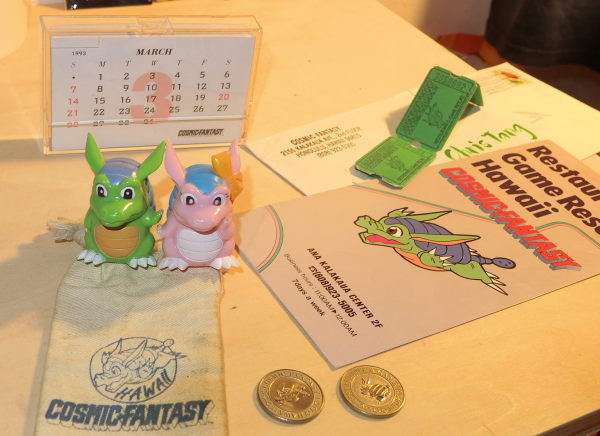
My previous entry sunk deep into the history of Dino Land, a middleweight pinball-video game from Telenet Japan and Wolf Team. While it had little time in the spotlight, Telenet used the Dino Land characters as mascots for their Cosmic Fantasy arcades. I recounted tales of people getting prize figures of the game’s protagonists, Bunz and Meeshell, and I wondered if we’d ever see evidence of them. 

Well, longtime reader Chris Tang (@strikeharbinger on Twitter) came through with amazing, incontrovertible photo evidence that those Dino Land figures existed. He even had some original tickets, a flyer, and a carrying bag from the Cosmic Fantasy Restaurant and Game Resort in Hawaii!


You’ll note that Bunz and Meeshell are molded so that their hands link together, making for an adorable pair of plastic toys and possible wedding cake toppers. Perhaps Dino Land wouldn’t be the number-one choice for a Telenet-themed reception, but I don’t think anyone will make bridge-and-groom figures of Earnest Evans and Annet Myer any time soon. 

I’m very glad to see these little collectibles. Dino Land may not be remembered among the best Telenet and Wolf Team offerings, but I’m fascinated that a company’s arcade briefly appropriated them for mascots. It’s a reminder of just how much odd video-game merchandise popped up in the 1980s and 1990s—and how little of it is documented well. The Japanese game market was compact enough that a publisher could crank out short runs of toys, t-shirts, or other promotional trinkets that would soon be forgotten by anyone who didn’t stop by a particular arcade or subscribe to the right fan club. As the push to preserve old video games and their attendant media expands into new horizons, we shouldn’t forget their toys, the proof that someone believed in a game enough to capture it in plastic.

Now, with this mystery laid to rest, I think I’ll see if anyone has the art cards from the Battle Mania Daiginjou cassette soundtrack.

Trouble Shooter: Behind the Scenes

Hey, I haven’t written about Trouble Shooter lately! I should, because this little two-game carnival of side-scrolling action and heavily armed anime heroines is one of my favorite series. I really don’t need a valid reason to cover it on a website bound by no professional strictures, but this time I have several good reasons for bringing up Trouble Shooter yet again.


(For those of you unacquainted, the original Trouble Shooter came out for the Sega Genesis in 1991 and was known as Battle Mania for its 1992 release in Japan. The 1993 Japan-only sequel is Battle Mania Daiginjou. The heroines are called Madison and Crystal in America and Mania Ohtori and Maria Haneda, respectively, in Japan. There. Now I don’t have to explain this further down the page.)

The first reason is an amazing interview with Trouble Shooter series creator Takayan the Barbarian. Recently translated by shmuplations, it covers plenty of interesting ground. Takayan discusses the history of Vic Tokai, a game company that has long fascinated me, and the inspirations behind the Trouble Shooter titles. He also confirms something I suspected and wrote about a while ago: he’s the butler in Kid Kool.

It’s essential reading for any fan of Trouble Shooter or Vic Tokai or the game-development climate of the 1990s. Among the revelations: Trouble Shooter started off as a prototype arcade game, heroines Madison and Crystal (or Mania and Maria) originally had a weirdo weapons-dealer sidekick named Fugu, and the games are of course littered with references to everything from fantasy novels to the train stops for Sega’s Japanese headquarters.


Takayan comes off as a delightful renaissance nerd creating a game he truly wanted to make and defying all marketing logic and company disapproval along the way. He even named Battle Mania Daiginjou after his favorite sake and commissioned his own highly limited run of model kits! You can buy a set on Yahoo Japan for only $300! And if that seems expensive, you don’t want to know how much the actual game goes for these days.

Takayan also mentions some minor censorship during the development of Battle Mania Daiginjou. The continue screen originally showed Crystal/Maria disrobing in a shower while the villainous Morgstein leered in the background, his sinful habits stymied by a falling bucket when the counter hit zero. Sega caught wind of this scene and demanded its removal, so the final game’s continue screen merely shows giant numbers formed from cute little Madison and Crystal portraits.

Toy Fair 2018: My Highlights


I haven’t been to the Toy Fair in a long, long time, but I always like looking at the new trinkets it brings. After all, a good chunk of the toy market targets adults collecting new versions of their beloved childhood possessions. I usually abstain from actual purchases, but there’s no harm in looking at things you want and then coming up with excuses not to buy them. I do it all the time.

NECA’S ALIEN VS. PREDATOR
NECA makes dozens of toys based on Aliens, Predators, and the cinematic unions thereof, but these are different. They’re based on Capcom’s Alien vs. Predator game, a semi-obscure 1994 arcade brawler never ported to any home console. As the wrestling fans say, I marked out and marked out hard for these.


NECA announced Alien vs. Predator arcade toys last year, but they stuck to the actual Aliens and Predators, including the playable Hunter and Warrior predators, the Smurf-colored Mad Predator boss, and the vexing Razor Claws. The new addition is a two-pack of the game’s human heroes: cyborged-out Dutch Schaefer from the first Predator movie and technically original Capcom heroine Linn Kurosawa. Fifteen years ago, a Linn Kurosawa toy would’ve topped any far-fetched wish list I made.

But what’s the big deal with Capcom’s Alien vs. Predator? For my money, it’s one of the best brawlers around. It has that gorgeous spritework you’ll see in all Capcom arcade games of the 1990s, and the designers really make the most of the license: the environments are wonderfully grimy and bleak, the new xenomorph variants fit perfectly into the mix, and even the standard Aliens slink along the ground and creep out of the shadows with wonderful Gigerian flair.


Alien vs. Predator also dodges that common flaw of belt-scrolling beat-‘em-ups: repetition. Each character has a wealth of attacks, and the throngs of Aliens show careful variety. And just when you might get sick of fighting the creatures, the game pulls out that familiar Alien plot twist of the military exploiting the xenomorphs, leading you to fight off brigades of corrupt soldiers and their power-loaders. And then the Aliens come back for the finale.

For that last dose of mystique, Alien vs. Predator never appeared on any home systems. A 32X port and a Saturn version were rumored and canceled, leaving Capcom’s brilliant creation to arcades and emulation. Linn Kurosawa has recurring cameos in some later games, appearing in backgrounds in Street Fighter Alpha 2 and Street Fighter III while inspiring the lookalike Simone in Cannon Spike. For a brief time, she was my favorite video game character ever, and I’d hear no talk about how she was just a Capcom clone of recurring Alien vs. Predator comic heroine Machiko Noguchi.

Why I Probably Won’t Buy Them:
Neca figures tend to be expensive. Going by the pricing on similar two-packs, Major Schaefer and Lieutenant Kurosawa will run about forty bucks. That, and Linn’s waist is too high and her crotch is too big. Perhaps I shouldn’t be picky about a toy I’ve wanted for twenty years, but there’s money at stake.

The Saga of Seaspray

I seldom buy new Transformers. It isn’t easy. Hasbro’s modern toys are little plastic torpedoes locked on to the nostalgia nodes of every kid who dug Transformers in the 1980s or 1990s. Countless new Autobots and Decepticons are modern takes on older characters, delivering the poseable, cartoon-accurate action figures we always wanted. That’s a tough poison to resist.

I try to abstain, but a few toys make it past my defenses. The most recent one is Seaspray, a Transformers: Titan Returns incarnation of the hovercraft-bot best known for talking like he was permanently underwater. Or drunk. Or both.


The updated Seaspray follows a design similar to his 1985 version, changing from a slightly tubby robot to a compact hovercraft. The current version has much more articulation, of course, and I like how his enormous feet could suit a clown, a water skiier, or a drowned mobster. I could see his many moving parts getting weak after a few dozen transformations, but then I’m no longer a ten-year-old kid who treats every toy like a stage from Wrecking Crew.


Seaspray also looks fine as a hovership, though I note one little shortcoming: his old ‘80s version had wheels on the bottom, and this new one does not. I know that most hovercraft don’t have wheels, but nor do most hovercraft turn into alien robots. All things considered, it’s a good little toy.

Yet there’s another reason I bought it, and it’s the same reason that Seaspray is one of my favorite Transformers.

Mission One Start

Last month brought the first trailer for Spielberg’s Ready Player One movie, based on Ernest Cline’s book about a virtual-reality treasure hunt in a dystopian future. This prompted me to finally read Ready Player One, and it convinced me that the future of profitable literature is all about nostalgia: pure, vacuous, unreflective nostalgia that namechecks as many childhood fascinations as print allows.

Well, I want a piece of that. I’m now at work on a science fiction novel called Mission One Start, and I know it’s bound for the best-seller lists. Here’s a sample.


I always liked Critical Mass Eisley. There were hundreds, maybe thousands of clubs across the OMNIWAY based on the Cantina from Star Wars Episode IV: A New Hope, but this one went beyond rote imitation. The layout echoed an alien version of the classic sitcom Cheers, and tonight a Skeksis from Jim Henson’s The Dark Crystal tended bar, wearing mirrored cyberpunk shades while mixing a Pan-Galactic Gargle Blaster from Douglas Adams’ The Hitchhiker’s Guide to the Galaxy. Here they knew the difference between a Trandoshan and a Gorn.

Even the patrons were a more eclectic mix. As I grabbed a Romulan Ale, I ducked around a winter-camo Robocop, a gaggle of teenage girls dressed as the Bangles in Voltron pilot outfits, and an impressively well-rendered Destro from G.I. Joe wearing Ghostbuster gear. It was great.

I slipped behind a table styled like the monster checkerboard from the Millennium Falcon and tapped my line open.

“You sure she’ll be here?” I asked.

“Totally,” Rhodel said in my ear. “The Minicons may be weird, but they always follow through. Besides, they need our passcodes, and we need their access.”

“I think I see her.”

She wove through the crowd like a ninja about to kidnap the president. Her avatar was a slim, sharp-featured woman with long red hair and just an adorable hint of anime around the eyes. She wore a Dune stillsuit that glowed with subtle crimson highlights, topped off with a visor and yellow trenchcoat right off Jubilee from the X-Men.

“Quit gawking and talk to her, man!” Rhodel piped up through my ear. I’d forgotten that he had a link to my visuals. “And don’t get caught up talking about that awful Dune movie.”

“You’re not supposed to be listening in,” I said. “That was part of their agreement. And Lynch’s Dune is great.”

“Oh, come on. That blithering, blundering mess destroys everything good about the—“

I cut the link before Rhodel could finish.

She was right in front of me, and even cuter up close.

“You’re Gawainterceptor, aren’t you?” she asked. “Nice name. Are you looking for the Holy Grail or Shadow the mercenary?”

I struggled for a reply. She’d caught my nods to both the Arthurian knight and the dog from Final Fantasy VI…or Final Fantasy III, as it had been known when it released on the Super NES in 1994.

“Uh, you can call me Wain,” I blurted. In an attempt to save face, I staggered my words to imitate an obscure Final Fantasy VI line: “And…who…might…you…be?”

“I am Elaine of the planet E-Square,” she said, and a wave of blue ran down her hair. She had an on-the-fly avatar editor as well, probably one a lot more expensive than my Belarusian knockoff.

“Well, then let me hop into my Flintlock,” I replied, picking up her reference to Xexex, the 1991 arcade shooter from Konami.

“So you’re looking for the Fifth Abyss?” She cocked her head to the side, a grin worthy of Ally Sheedy in St. Elmo’s Fire on her lips.

“I’m looking for a lot of things,” I said.

Including a girlfriend like you, I thought.

“Then follow me.” She grinned. “If you can keep up.”

With that, she turned and delicately threaded the crowd on her way to the door. I leapt from the table and followed.

She stepped out into the busy Nexus Prime street and flashed me a smile. Then she morphed.

I’d seen avatar-editors before, but never one so smooth. Her human shape dissolved into pixels and reformed as a sleek motorcycle that I instantly recognized as the titular bike from the Street Hawk TV series.

Her new vehicle incarnation sped off down the street, dodging everyone in its path. I frantically primed my own avatar editor and switched, perhaps less gracefully than she had, into another motorcycle. On a whim, I picked the Condor from the M.A.S.K. toy line.

We tore through the streets like two Tron light cycles, leaving behind neon contrails and indignantly scattered players who probably hadn’t seen Krull even a dozen times. She made a game of it, whipping around corners and slowing just enough in straightaways for me to almost catch her. I somehow managed to keep on her trail like a Gradius homing missile, ready to switch to the Condor’s helicopter mode if she took to the skies.

She rounded a bend and led me into MechAlley, a long avenue lined with statues of anime robots. Her avatar pixel-flickered again, turning into a small robotic creature, and she disappeared somewhere in between Giant Gorg and GoShogun.

I skidded to a halt and scanned the wide stretch of mecha effigies. It took me a minute to spy a tiny hole in the wall right between the feet of Gunbuster, the title robot from a six-part anime series by Hideaki Anno, the creator of Neon Genesis Evangelion.

Rolling toward the tiny entrance, I switched my avatar to the first small thing I could think of: a hamster. I slipped into the hole and found myself in a winding labyrinth that glowed green and black, like the primitive polygons of an early 3-D video game.

It led through so many turns I lost track of how far I’d come, but eventually I emerged into a small room where every surface was black glass. She was waiting at its center.

The tiny room was shielded, I realized. If this was an ambush, no one in the OMNIWAY could hear me, much less help me. At least I had a better look at her new avatar. She was a Ro-Bear Berbil, a mechanical koala creature from the classic Thundercats cartoon.

“We can talk here,” she said. “Most of the dark zones got deleted, but this one’s too small for Nextek to notice.”

“And here I thought you were taking me to see Lion-O and Cheetara.”

That made her smile.

“Nice rodent avatar,” she said. “But what’s with the getup?”

I glanced down. I’d given my avatar a robe festooned with glittering hearts.

“This?” I asked. “I’m Greg ‘the Hamster’ Valentine.”

She laughed at my invoking the old-school WWF wrestler. Then her avatar shifted to a pattern of pink and black stripes.

“All right,” she said. “I’ll be Brutus ‘The Berbil’ Beefcake.”

And then I knew for certain. I was in love.