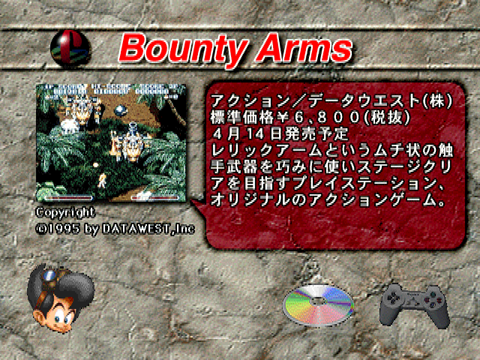
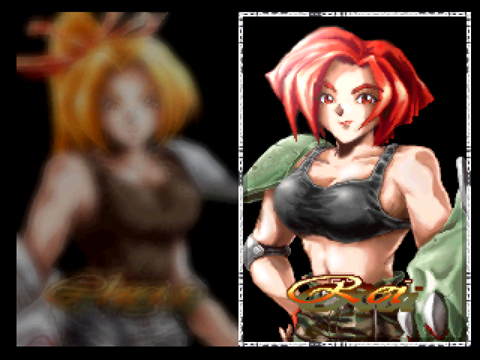
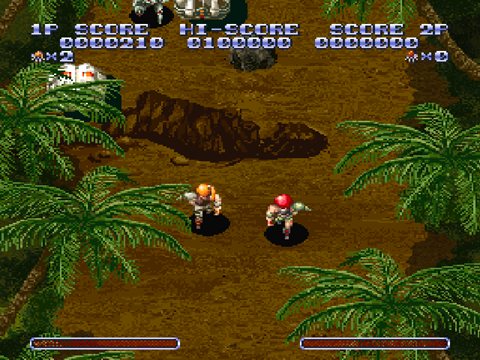
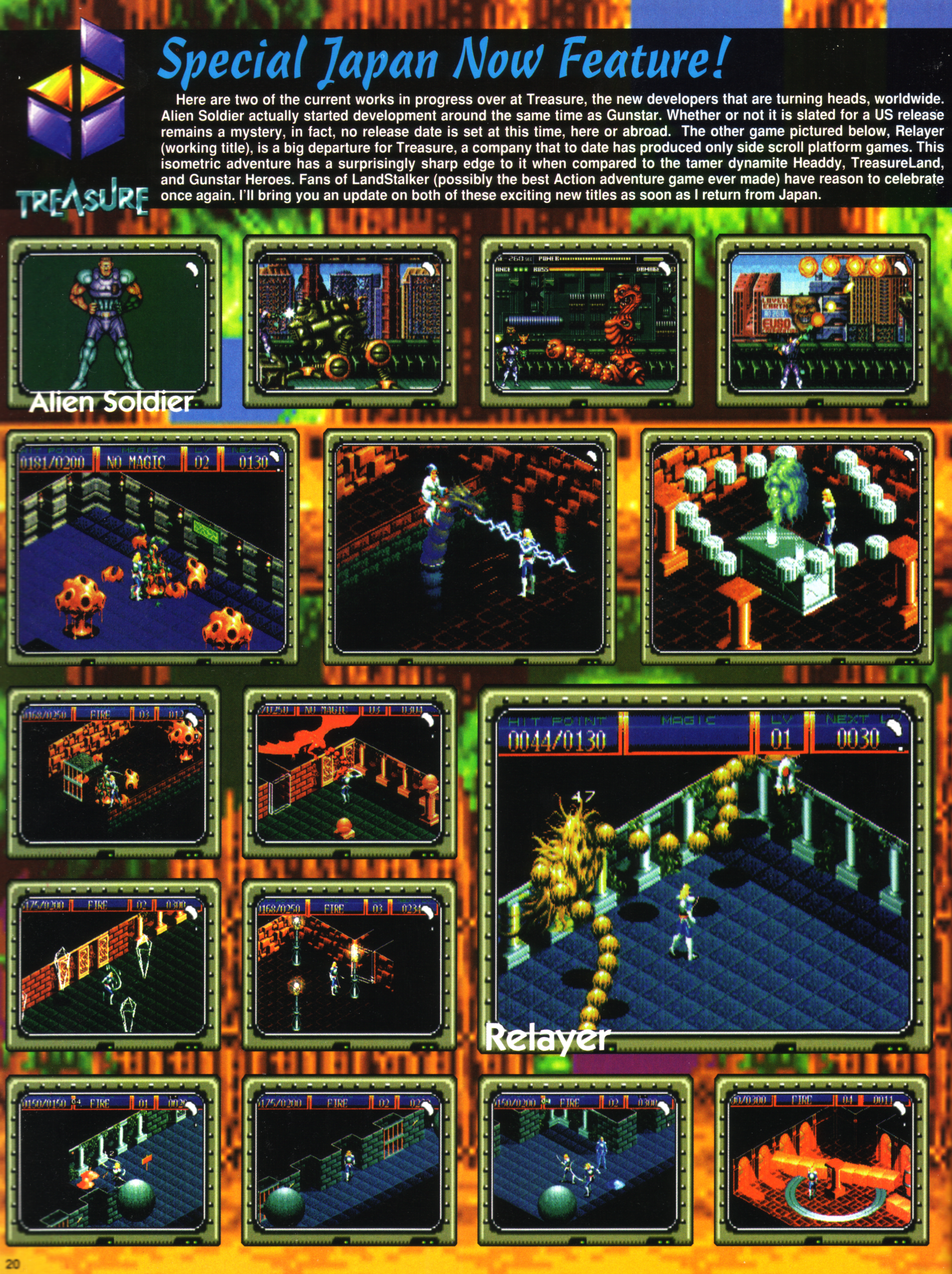
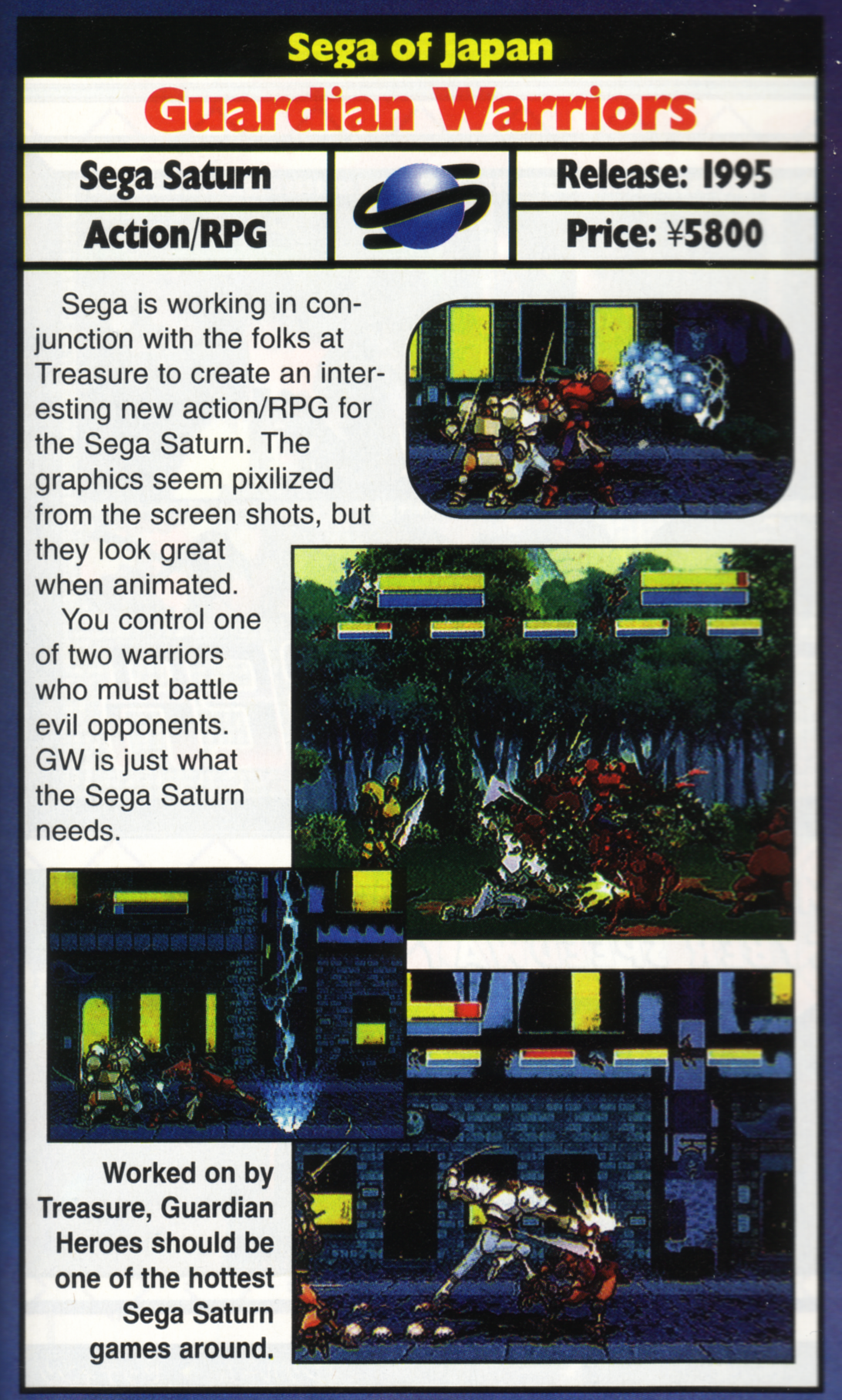
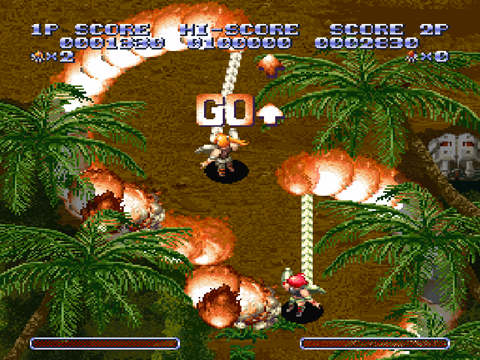
So what's new with Bounty Arms? Nothing major, as you might expect when it comes to a PlayStation action game canceled back in 1995. However, I made a Twitter post about how Data West’s Bounty Arms is chief among my video-game white whales, edging out Mega Man Legends 3 and Ultimate Journey and even Super Dog Booby.
Geez, I don't know where to start. How about video games? I'd like to find the most complete version of Bounty Arms, an early PlayStation game supposedly 60 percent done when it was canceled. There's a one-stage demo out there, but I suspect they finished at least two levels. https://t.co/zyjuM9H19X pic.twitter.com/345eeMCMll
— Todd Ciolek (@kidfenris) February 15, 2022
So it's a good time to discuss Bounty Arms. In the absence of real news, I'll just speculate about the connection between Bounty Arms and Yuke's.
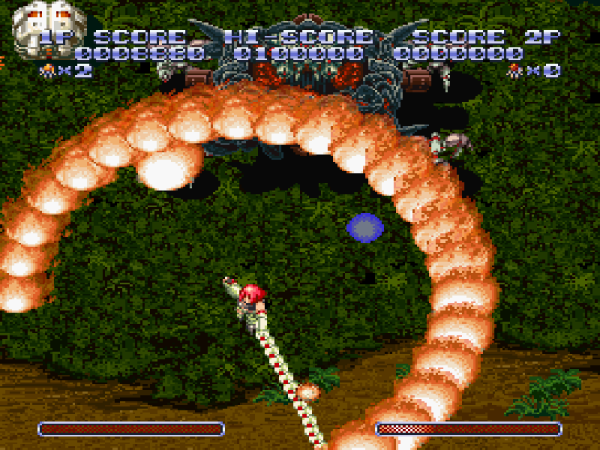
Yuke’s is best known these days for their extensive lineup of wrestling games, but they’ve tried all sorts of genres since Yukinori Taniguchi founded the company in 1993. Taniguchi figures tangentially into Bounty Arms’ history, as he worked on a number of Data West titles, including Rayxanber III and the LaserActive shooter Vajra.

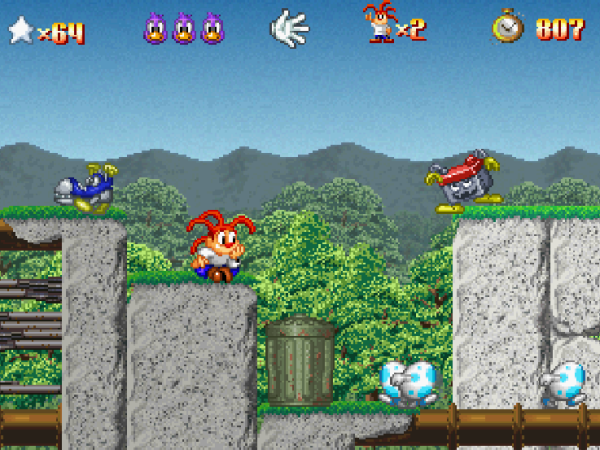
The first Yuke’s game unrelated to wrestling was an early Japan-exclusive PlayStation action-platformer called Hermie Hopperhead. While perhaps not a genre trailblazer in its depictions of a red-haired kid jumping on enemies and hatching allies from eggs, Hermie charmed GameFan founder Dave Halverson so thoroughly that he vowed to put it in every issue of his magazine until a publisher brought it to North America.
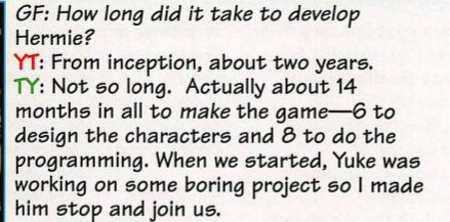
This did not come to pass, but before giving up, GameFan ran an extensive interview with Taniguchi and Sony’s Tetsuji Yamamoto. They discuss a lot about the company’s history, and there’s one interesting detail for the Bounty Arms files.

Yamamoto mentions that Taniguchi was working on “some boring project” before they developed Hermie Hopperhead. Might this refer to Bounty Arms?
I doubt that for two reasons. One: the timeline doesn’t quite add up, as Taniguchi had founded Yuke’s and apparently stopped working with Data West in 1993, years before Bounty Arms was announced or canceled. Two: I refuse to believe that anyone would find Bounty Arms boring, even in jest.
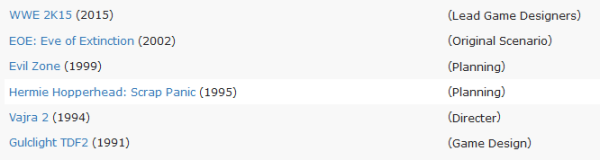
Yet there’s another connection. I’ve previously speculated about a former Data West staffer named Kenji Nakamura—and how he may be the same as Kazuhide Nakamura, who directed the first Vajra and designed or directed the three Rayxanbers. Even when sticking to separate credits, Kazuhide Nakamura directed Vajra 2, the last game Data West released before starting up Bounty Arms, and I suspect his departure was either a result of or the reason for Data West canceling it. After leaving Data West, Nakamura joined Yuke’s. And what was his first game contribution there?

Yep. Nakamura was a designer on Hermie Hopperhead. And that brings more speculation from me. Did he leave Data West to work on a new game at Yuke’s? Was he lured away by the opportunity to make a side-scroller about a street-savvy tentacle-haired boy and his battle against garbage enemies? Did Hermie Hopperhead kill Bounty Arms?
Probably not, but it’s still interesting to play Hermie Hopperhead and other Yuke’s games that involved Nakamura, looking for any common ground or residual influences of Bounty Arms. I’m particularly curious about EOE: Eve of Extinction, a PlayStation action game with Nakamura as scenario creator and lead designer. It’s fallen into such obscurity that I can’t even remember if I ever played it, but I’m still driven to investigate for the sake of the Bounty Arms Preservation Society. And because the English version has a nice lineup of then-ubiquitous voice talent. Cam Clarke! Kim Mai Guest! Jennifer Hale!
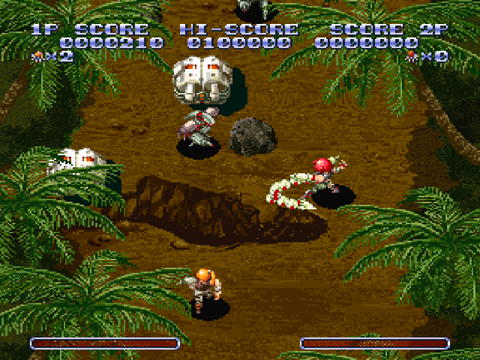
A few notes for those just learning about Bounty Arms: You can download the only known playable demo of the game here. And if you want to trick it into playing the entire first stage, check out these directions. And then you can devise nonsensical theories of your own!
Lately I've grown interested in football games of the NES era, specifically those developed in Japan. At that point football (that'd be American football) hadn't proven nearly as popular in Japan as baseball or soccer or possibly even badminton, so I'm intrigued by what Japanese developers of the 1980s envisioned when crafting a sports game primarily for Americans.

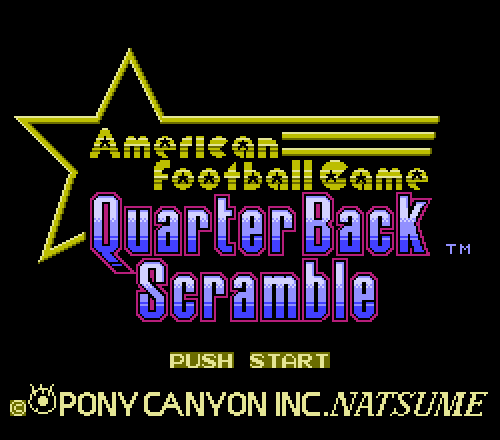
Quarter Back Scramble: American Football Game is a great example. Aside from the capitalization of “Quarterback” in its delightfully blunt title, it's mostly on point in its gridiron depictions, and it was scheduled to come out here as Mike Ditka's Big Play Football. It's also the work of Natsume, and its graphics and soundtrack even recall the slick appearances and punchy sounds of action titles like Shadow of the Ninja and S.C.A.T.
Yet Natsume made one very strange decision with Quarter Back Scramble, and you'll see it as soon as you press start.

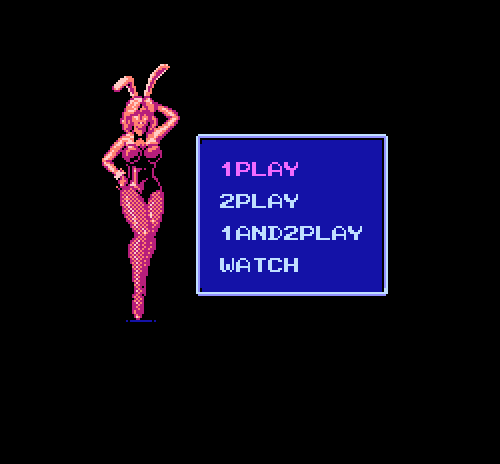
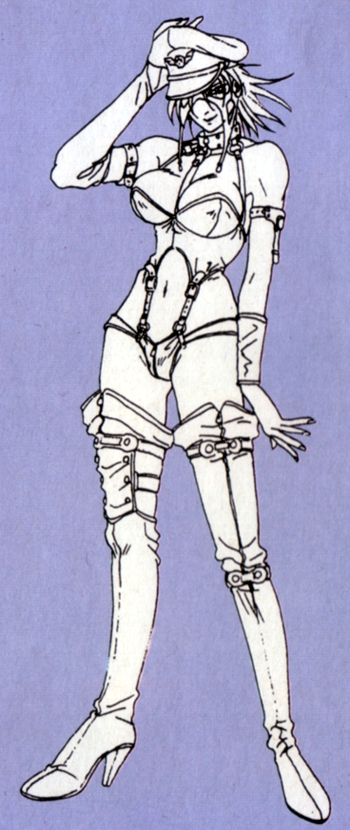
A woman in full Playboy bunny attire inexplicably poses next to the game's initial menu. She'd be right at home in a casino game of this era, but I have no idea what she's doing in a football title. There's a lot written about the sexist depictions of NFL cheerleaders, but I can find no record whatsoever of possible connections between Playboy costumes and football. Even the risque sights of the XFL cheer squads and the Lingerie Bowl were years away from Quarter Back Scramble's 1989 release.
Natsume evidently wanted some sex appeal to accompany those staid gameplay options, but why not just show a cheerleader? Perhaps some confused programmer thought the rabbit-eared cocktail waitress regalia actually was the sort of thing football cheerleaders wore, but I doubt that, considering that a conventionally garbed cheerleader shows up in the game’s intro. Or perhaps Natsume just had leftover graphics from a canceled anthology of blackjack and poker games, and damned if they were going to waste them.

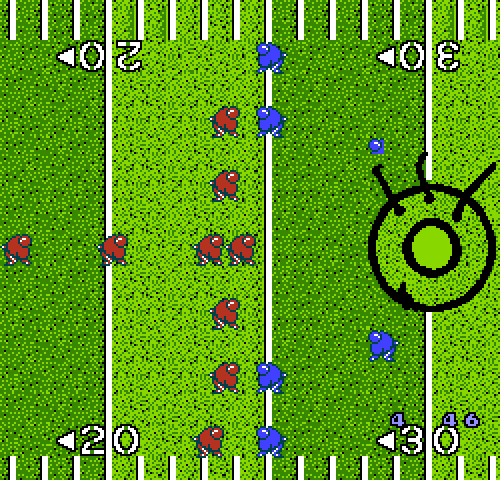
There are other amusing details in Quarter Back Scramble. I like the Pony Canyon logo in the middle of the field, as though the music publisher (and purveyor of many a crappy Famicom game) bought an entire football stadium. And like many sports games without official team licenses, Quarter Back Scramble had to make up its roster. You’ll pick from the Denver Miles, the Los Angeles Arks, the Chicago Forces, the San Francisco 50s, the New York Subways, and, my personal favorite, the Washington DC Hogs. With the real-world Washington team just about to announce a new name, I can only hope they’ll dig deep and reference a 1989 video game.
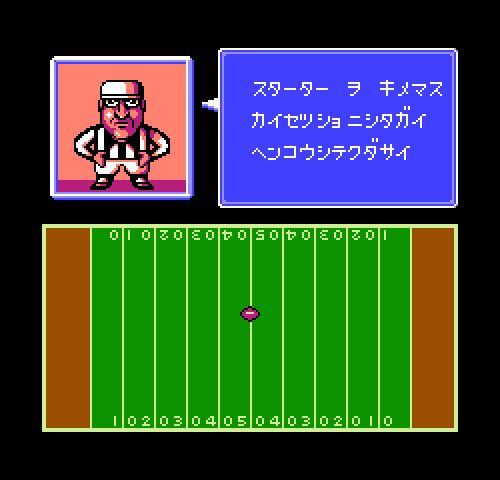
I also appreciate Natsume’s rendition of the referee. Instead of a detached face or a stiff single image, he’s a squat little goblin in the super-deformed tradition of many an anime gag. And his expression relays that he’s not about to tolerate any guff from the more evenly proportioned football players.
And then we have the game’s curtailed journey overseas. Accolade planned to release it on the NES as Mike Dikta’s Big Play Football but quietly canceled it. Footage of the American version shows only a few changes: the teams now have their official names, and the NFL logo replaces the Pony Canyon motif in the stadium—as well as the bunny-girl on the menu screen.
However, Hidden Palace and the Video Game History Foundation recently released a prototype of the American version before Ditka and the NFL license were attached. It’s almost identical to the Japanese release, complete with rabbit-eared women inviting fans to Pony Canyon Stadium to watch the Denver Miles play the Washington Hogs. Accuracy aside, that would’ve been much more memorable for American NES owners than just another realistic football game.
When it came to unreleased video games, Clockwork Aquario was a relentless, blatant, and downright sadistic tease. It went through arcade location tests back in 1993, but developer Westone deemed it unsuitable for the market. So it drifted into the same ether that absorbs most canceled games.
Yet Clockwork Aquario survived. Composer Shinichi Sakamoto and EGG released the soundtrack in 2006, and stories from those who played the game tantalized like UFO sightings. Then company co-founder Ryuichi Nishizawa uncovered the source code, sprites, and design documents, hinting that it might well be possible to restore the entire thing. Clockwork Aquario seemed just on the edge of coming back to life.
That’s exactly what happened, according to Strictly Limited Games. After a year or two of hints, the German publisher announced Switch and PlayStation 4 releases of a fully restored Clockwork Aquario. It’s due out next year, and they have screenshots, a website, and some gameplay footage to prove it. I usually don’t embed videos that aren’t mine, but I’m breaking that rule for Clockwork Aquario.
What’s that? It’s just twenty seconds of standard side-scroller gameplay? Yes, it is. But there’s more to the game than that. And there’s more to its appeal than a long shadow of makeshift nostalgia.


The little details have already won me over. I like the way the characters take damage by subtly changing appearance (as Elle does in the video) and the way they turn into strangely calm angels upon defeat. I even like the little character portraits in the background of the player-select screen. Just look at them.

Many canceled NES games exist only on paper, whether it’s a sheaf of old design documents, a press release, a magazine’s rumors section, or a bar napkin with DONKEY KONG FIGHTS GUNDAM scrawled on it. In some cases, having only a title makes a game all the more enticing, as we’re free to imagine what Vic Tokai’s Baby Gangster, LJN’s World War III, or Activision’s The Abyss might have been like had they shown up behind the glass at Kay-Bee.
Yes, some unreleased NES games left behind only their titles and vague descriptions. Until last month, I thought Mariner’s Run was among them.
Mariner’s Run is the work of Vic Tokai, a company that’s fascinated me for a while—and not just because of my unabiding fondness for Trouble Shooter. Vic Tokai crafted intriguing games throughout the NES era, whether it was the early (and unreleased in the U.S.) action-RPG Chester Field, the complex adventure of Clash at Demonhead, the charming The Krion Conquest, or the Golgo 13 games, which might not be great but remain marvels of sneaking gruesome violence and bleak spy-pulp stories onto a game system where alcohol and crucifixes were verboten.
We find little information about Mariner’s Run, known as Sea Dog in Japan. It appeared in magazines early in 1991, and the manual for Magical Kids Doropie (aka The Krion Conquest) describes it as a "battle RPG" with a March 1991 release date.
That was all I knew about the game, and it was all I needed to imagine the best possible NES treatment. I pictured a naval warfare epic in a post-apocalyptic or high-tech future, where you might roam the seas from an overhead perspective and fight intense battles from a first-person viewpoint. Kinda like SubRoc 3D crossed with a fun version of Silent Service.
I somehow neglected to notice that Mariner’s Run survived online in at least three screenshots, plus a Game Players blurb that describes it as “a game in the style of Ultima or Dragon Warrior” that “takes place in a land of seafaring towns.” And that’s enough to destroy my vision of the game.