Showing posts with label Comics. Show all posts

My Stinkor Story

He-Man and The Masters of the Universe is less a toy line or a cartoon than it is a case study in ruthless, well-timed marketing. The rush of commercialized animation in the 1980s is fascinating in its mercenary layers, but the short of it is that Mattel began it all by relentlessly promoting He-Man action figures with a cartoon thanks to loosened FCC restrictions. This may go down as one of the lesser machinations of the Reagan administration, but the competition there is fierce. 

Evil or not, toy companies swamped the airwaves with their TV shows. Among the creations that sprung from this ominous entwining of advertising and entertainment, He-Man wasn’t the most enduring. Transformers, Ninja Turtles, My Little Pony, and G.I. Joe arguably got better mileage. 

Yet He-Man was first, and He-Man was massive in its day. It wasn’t just toy sales or after-school cartoons, either. The Macy’s Thanksgiving Day parade had enormous He-Man floats. Dave Barry mocked He-Man toy names (“Lob-Stor”) in his books. Concerned Christian parents saw demonic imagery in the villainous Skeletor and fretted that their children might attach quasi-religious proportions to He-Man’s tagline of “The Most Powerful Man in the Universe.” 

I enjoyed this almost by accident. I was a little too young to catch the full weight of Mattel and Filmation’s toy-cartoon assault, but I had plenty of Masters of the Universe paraphernalia. Much of this was due to my grandmother, who of course spoiled me and my sister with new toys whenever we visited. I soon had He-Man and Skeletor and a good share of their dueling entourages, and a trip to the grandparents usually meant a new addition. 

One day in 1985, my grandmother brought out Stinkor.

Even those distantly familiar with He-Man toys may recall that every figure had some gimmick, such as spring-loaded punches or interchangeable arms or a water-spraying robot elephant trunk. Stinkor’s contribution to this feverish creativity was that he smelled bad. 

Yes, that was all. Stinkor was a skunk-colored action figure who emitted an actual odor.  Of course I found this amusing, and when my grandmother presented me with Stinkor I joked that I would leave him on her bed one night to spread his presumably fetid aroma. 

Grandma was not amused. Though not upset, she declared that if such was my intent, I would get no Stinkor. 


I’m certain she would have relented if I had apologized, but that’s the strange thing: I didn’t. 

Part of this doubtless came from me being a little brat, but the fact was that I no longer cared that much about Masters of the Universe. Transformers and GI Joe and Starriors (hey, they’re underrated) all interested me much more by that point, and I’d had my fill of He-Man. The cartoon seemed repetitive and preachy, and a lot of the action figures were suspiciously similar. I was hardly a discerning consumer as a kid, but even I could see that Stinkor was just the line’s earlier Mer-Man figure painted like Pepe Le Pew. His orange armor was reused from Mekaneck. And he didn’t even come with any accessories beyond a boring little shield. If you’ll pardon the phrase, Stinkor was running on fumes. 

So my grandmother put Stinkor away. I don’t recall if I got in trouble over this, but it made no difference to me at the time. Only many years later did I realize how dumb I’d been to turn down a toy. More importantly, I worried that I’d hurt my grandmother’s feelings by callously rejecting her gift. 

If I was outgrowing Masters of the Universe, I wasn’t alone. The series declined in popularity by the mid-1980s. It may have been a stagnation of ideas, as the line tried to introduce dinosaurs and a new lead called He-Ro to little effect. It may have been the general life cycle of a toy that isn’t a pop-culture keystone. Some even blamed She-Ra, He-Man’s sister, and her series for making Masters of the Universe seem like a property for girls. I don’t entirely believe that, but it’s sadly true that a lot of boys back then stigmatized any remotely feminine pastimes. That’s another tale for another time. 

Whatever the cause, He-Man was in a slump by the time the live-action movie arrived in 1987 with Frank Langella and a lot of Jack Kirby references. Masters of the Universe was the first big toy-and-cartoon onslaught of the 1980s, and so it was the first to die down. It became a symbol of Reagan-era excess, a hyper-macho hero shamelessly sold to kids in every way the government and media would allow. 

In that case, Stinkor was the decade’s toy industry at its most absurd. He didn’t have laser eyes or a grappling hook or some battery-powered talent. He just stank. 


Stinkor never had an easy time in the He-Man ranks. The staff for the cartoon reportedly laughed him out of the writers’ room, and he never appeared in the show (he would have presented a confused moral anyway, showing kids that you should in fact judge people by how they smell). The 2002 Masters of the Universe series featured him and tried to develop some backstory, but there’s only so much you can do with a character called Stinkor. 

The recent Masters of the Universe: Revelation, continuing the 1980s cartoon, tries to make up for Stinkor’s original absence by giving him a few moments before he’s thrashed by more popular characters. He does not appear in the trailer for that new Masters of the Universe movie, which looks almost bland and safe enough to ignore something as goofy as Stinkor.    

Even so, there are Stinkor toys aplenty. We’re in the grip of rampant 1980s nostalgia pandering to momentarily soothe our slow capitalist decline into ruin and chaos, so you’ll see not only multiple He-Man lines but multiple He-Man crossovers with Ninja Turtles, Thundercats, Transformers, and so forth. New Stinkors take every shape from little decorations to his elaborate redesign from Revelation. I resisted all of this. I didn’t need a Stinkor in 1985, so I didn’t need one today. 

Last month, however, my aunt and uncle were housecleaning and sent me some old toys that my cousins no longer wanted. This was among them.


Could it be the same Stinkor I stupidly refused so many years ago? It’s possible. My grandmother indulged my cousins as much as she did my sister and me, so it’d make sense if she offloaded Stinkor on them instead of taking him back to the store. I’d say that my prodigal Stinkor has returned, though to be accurate I must note that I, not Stinkor, was foolish and wasteful in my youth.

And he still smells! Mattel actually baked a patchouli mix into the plastic that composed Stinkor, giving him a distinct but hardly mephitic aroma. 

Perhaps if I’d jested about Stinkor to my grandmother after I received and opened the toy, she would have found the scent unobjectionable and seen nothing wrong with me leaving him around the house like some skunk-man air freshener. Yet this would have lumped Stinkor in with all of my other He-Man figures to be forgotten (and probably sold). And then I’d have nothing to write about this month. 

For further reading on Masters of the Universe and the interplay between toys and cartoons, Brian Brown’s The He-Man Effect takes a thorough look at the history and nature of the whole process. It’s a good primer for anyone navigating the traps of acritical nostalgia, though I think it leaves out a major reason He-Man and similar TV shows caught on: there weren’t a lot of better alternatives in children’s programming at the time. If Masters of the Universe sent kids down a treacherous path, I partly blame Turbo Teen and The Biskitts. And since Stinkor wasn’t in the original cartoon, I can’t blame him all that much.

There’s one more thing. Grandma, I’m sorry I made dumb jokes about Stinkor back then. I hope it’s okay that I’m making them now.

Teenage Mutant Ninja Turtles II: A Salute to Tora and Shogun

Many worlds collided in Teenage Mutant Ninja Turtles II: The Arcade Game for the NES. It saw the Turtles at the height of their popularity in 1990, and the game perfectly embodies their most marketable personae in a decent beat-up-‘em, like Double Dragon with Foot Soldiers instead of street punks and dominatrices. It also found Nintendo at a similar apex, as the NES library enjoyed its most prodigious year, stretching from Super Mario Bros. 3 to Crystalis to StarTropics before the Sega Genesis ruined that delightful monopoly.

Just about any NES game was important to the children of 1990, but a Ninja Turtles game, and a good one at that, verged on a religious experience. And the game even threw in a coupon for a free Pizza Hut personal pan pizza. It was a marvel of efficiency when it came to shoving cartoons, video games, and junk food into the gullets of American youth.

Yet after the game ended and the free pizza was devoured, Teenage Mutant Ninja Turtles II: The Arcade Game didn’t enjoy a very influential legacy. Perhaps that’s because it’s notably by-the-book, following both its arcade roots and overall Turtle canon right down to the quips that the turtles spout when they fall into manholes.

Three embellishments stand out, however. One is a curious skateboarding woman who I’ve written about before, though she’s merely unexplained background decor. The other two are bosses invented just for the NES game: intergalactic bounty hunters named Tora and Shogun.


No mere throwaways, Tora and Shogun each received an entire personalized stage. Tora shows up early on, as a Krang-supplied weather device plunges New York into a wintry apocalypse. The Turtles slash through a stage of snowball-tossing Foot Soldiers and missile-firing snowmen, and Tora waits at the end.


Tora’s just a polar bear in a leather jacket, but he’s true to the Ninja Turtle aesthetic of weird animal mutants. What he lacks in laser guns or mohawks, he makes up in pure brutality by hucking giant ice boulders at the Turtles and smacking them across the screen if they’re dumb enough to face him head-on.


Shogun gets his turn a few levels later. Perhaps his name should be “THE Shogun,” but manuals say otherwise. His hideout is all paper screens and tatami mats, complete with leaping ninja-bots, laser scorpions, and tiger artwork that comes to life. Well, robotic life. Keeping with the Turtles cartoon’s flailing efforts to skirt real violence, all of the non-boss enemies are machines.


As the level-topper, Shogun wastes no time in deploying his gimmick: his head detaches and floats around the screen while his body attacks with a naginata. It leaves players little room to dodge, and the head is either invincible or very difficult to hit. Once you’ve wailed on the Shogun’s body enough, he explodes, leaving behind a lower mechanical skeleton and effectively mooning the player. Really.


That’s it for Tora and Shogun. They appeared in no other official Ninja Turtles fiction; not the comics, not the live-action movies, and not even the long-running cartoon. Such absences are explained, of course, by the fact that they never became action figures in the first place.

And yet that’s strange in itself. The Ninja Turtles toy line ran out of good ideas by 1992 and grew more and more ridiculous, putting the Turtles in everything from military gear to Star Trek outfits, but it somehow wasn’t desperate enough to put together Tora and Shogun figures. I assume it was a matter of licensing, because when you’re peddling Z-list mutants like a Dalmatian firefighter and a moose Canadian Mountie, a polar bear with a weather weapon will fly off the pegs.

They would’ve fit perfectly, too. Give Tora a freeze-ray (let’s call it an “Icicle Gun”) and some boulders to toss, and he’s as much a hot seller as Muckman or Scumbug. Shogun might not have many accessories beyond his samurai weapons, but he’d get attention with a removable spring-loaded head—one that would be lost by 90 percent of all kids who owned the toy. Thus we would see decapitated Shoguns in flea-market bins across the nation and costly eBay squabbles over complete figures. What a fine legacy that would be.

One more thing: remember when I said that Tora and Shogun never made any more official appearances? Well, you’ll see them in TMNT: Rescue-Palooza, a fan-made reimagining of the older games that includes over 60 playable characters, from April’s newsroom cronies to Aska from Tournament Fighters to the suspiciously underutilized Ace Duck. Tora and Shogun might’ve missed a prime merchandizing boat and remained obscure in the memories of countless young Turtles fans, but they’re still good for a boss fight or two.

Game Magazine Matters: EGM2's Debut


If you ever want someone to realize just how excessive video game magazines were in the mid-1990s, you don’t need to say a thing. Just grab a bloated holiday issue of Electronic Gaming Monthly and wave around all 3,781 pages of it. Then pull out an issue of EGM2 and show the crowd that it wasn’t enough for the magazine to publish just once a month.

EGM2, technically named with an exponent that I don’t care to recreate, doubled Electronic Gaming Monthly’s presence with its premiere issue in July 1994. It retained the layout and features of its parent mag, right down to the letters pages, the wacky What-Ifs column, and the unambitious middle-school reading level. The only thing EGM2 lacked at the time was a reviews section, so readers still needed regular EGM if they wanted to know what editor-in-chief Ed Semrad’s ghost writers and the mysterious Sushi-X thought of Contra Hard Corps or Art of Fighting 2.


Yet EGM2 had slightly different priorities. Semrad’s opening letter explains that EGM2 emphasizes import coverage and arcade-game guides (auguring the publication’s later switch to nothing but strategies). Indeed, the first issue has a robust import section by Nob Ogasawara, who details two freshly announced and rapidly doomed game systems that would never leave Japan: NEC’s PC-FX and Bandai’s Playdia. Of particular note are the aspirations for each console. Bandai envisioned over 200,000 Playdias flying off shelves, and NEC hoped to move half a million PC-FX systems. I hope no executives staked their careers on those numbers.

I picked up EGM2’s first issue during the summer of 1994, for reasons I’ll admit further down the page. Before that, however, I’ll pick out a few of the magazine’s most interesting sights.

1. A STREET FIGHTER BACKLASH BEGINS
Street Fighter and Mortal Kombat dominate the issue, of course, with huge previews of Mortal Kombat II and Super Street Fighter II, the latter of which actually uses art from Street Fighter II: The Animated Movie. It’s not all a cheerful parade of hadokens and bicycle kicks, however. You see, the fans are tiring of Street Fighter!


The letters section dedicates a page to readers complaining about Super Street Fighter II, the third iteration of Street Fighter II in as many years. Capcom asked a lot of kids and teenagers in the 1990s: a bunch of us paid over $70 for Street Fighter II in 1992, then $75 for Street Fighter II Turbo in 1993, trading in the older game and soaking up the difference just because Turbo let us play as M. Bison and throw Chun-Li’s fireball. We weren’t going through that again for Super Street Fighter II, not when it offered only four new characters and the only one we cared about was Cammy.

To be fair, some readers are a little off in their math. A Street Fighter II arcade machine cost thousands more than a mere Super NES game in 1994, and good luck beating back the arcade operators who wanted one.

I’ll also admit that Capcom essentially won. Super Street Fighter II wasn’t nearly as successful as its originator, but subsequent games in the series, from the Alphas to Street Fighter V, went through multiple upgrades. And we always buy ‘em.

Mission One Start

Last month brought the first trailer for Spielberg’s Ready Player One movie, based on Ernest Cline’s book about a virtual-reality treasure hunt in a dystopian future. This prompted me to finally read Ready Player One, and it convinced me that the future of profitable literature is all about nostalgia: pure, vacuous, unreflective nostalgia that namechecks as many childhood fascinations as print allows.

Well, I want a piece of that. I’m now at work on a science fiction novel called Mission One Start, and I know it’s bound for the best-seller lists. Here’s a sample.


I always liked Critical Mass Eisley. There were hundreds, maybe thousands of clubs across the OMNIWAY based on the Cantina from Star Wars Episode IV: A New Hope, but this one went beyond rote imitation. The layout echoed an alien version of the classic sitcom Cheers, and tonight a Skeksis from Jim Henson’s The Dark Crystal tended bar, wearing mirrored cyberpunk shades while mixing a Pan-Galactic Gargle Blaster from Douglas Adams’ The Hitchhiker’s Guide to the Galaxy. Here they knew the difference between a Trandoshan and a Gorn.

Even the patrons were a more eclectic mix. As I grabbed a Romulan Ale, I ducked around a winter-camo Robocop, a gaggle of teenage girls dressed as the Bangles in Voltron pilot outfits, and an impressively well-rendered Destro from G.I. Joe wearing Ghostbuster gear. It was great.

I slipped behind a table styled like the monster checkerboard from the Millennium Falcon and tapped my line open.

“You sure she’ll be here?” I asked.

“Totally,” Rhodel said in my ear. “The Minicons may be weird, but they always follow through. Besides, they need our passcodes, and we need their access.”

“I think I see her.”

She wove through the crowd like a ninja about to kidnap the president. Her avatar was a slim, sharp-featured woman with long red hair and just an adorable hint of anime around the eyes. She wore a Dune stillsuit that glowed with subtle crimson highlights, topped off with a visor and yellow trenchcoat right off Jubilee from the X-Men.

“Quit gawking and talk to her, man!” Rhodel piped up through my ear. I’d forgotten that he had a link to my visuals. “And don’t get caught up talking about that awful Dune movie.”

“You’re not supposed to be listening in,” I said. “That was part of their agreement. And Lynch’s Dune is great.”

“Oh, come on. That blithering, blundering mess destroys everything good about the—“

I cut the link before Rhodel could finish.

She was right in front of me, and even cuter up close.

“You’re Gawainterceptor, aren’t you?” she asked. “Nice name. Are you looking for the Holy Grail or Shadow the mercenary?”

I struggled for a reply. She’d caught my nods to both the Arthurian knight and the dog from Final Fantasy VI…or Final Fantasy III, as it had been known when it released on the Super NES in 1994.

“Uh, you can call me Wain,” I blurted. In an attempt to save face, I staggered my words to imitate an obscure Final Fantasy VI line: “And…who…might…you…be?”

“I am Elaine of the planet E-Square,” she said, and a wave of blue ran down her hair. She had an on-the-fly avatar editor as well, probably one a lot more expensive than my Belarusian knockoff.

“Well, then let me hop into my Flintlock,” I replied, picking up her reference to Xexex, the 1991 arcade shooter from Konami.

“So you’re looking for the Fifth Abyss?” She cocked her head to the side, a grin worthy of Ally Sheedy in St. Elmo’s Fire on her lips.

“I’m looking for a lot of things,” I said.

Including a girlfriend like you, I thought.

“Then follow me.” She grinned. “If you can keep up.”

With that, she turned and delicately threaded the crowd on her way to the door. I leapt from the table and followed.

She stepped out into the busy Nexus Prime street and flashed me a smile. Then she morphed.

I’d seen avatar-editors before, but never one so smooth. Her human shape dissolved into pixels and reformed as a sleek motorcycle that I instantly recognized as the titular bike from the Street Hawk TV series.

Her new vehicle incarnation sped off down the street, dodging everyone in its path. I frantically primed my own avatar editor and switched, perhaps less gracefully than she had, into another motorcycle. On a whim, I picked the Condor from the M.A.S.K. toy line.

We tore through the streets like two Tron light cycles, leaving behind neon contrails and indignantly scattered players who probably hadn’t seen Krull even a dozen times. She made a game of it, whipping around corners and slowing just enough in straightaways for me to almost catch her. I somehow managed to keep on her trail like a Gradius homing missile, ready to switch to the Condor’s helicopter mode if she took to the skies.

She rounded a bend and led me into MechAlley, a long avenue lined with statues of anime robots. Her avatar pixel-flickered again, turning into a small robotic creature, and she disappeared somewhere in between Giant Gorg and GoShogun.

I skidded to a halt and scanned the wide stretch of mecha effigies. It took me a minute to spy a tiny hole in the wall right between the feet of Gunbuster, the title robot from a six-part anime series by Hideaki Anno, the creator of Neon Genesis Evangelion.

Rolling toward the tiny entrance, I switched my avatar to the first small thing I could think of: a hamster. I slipped into the hole and found myself in a winding labyrinth that glowed green and black, like the primitive polygons of an early 3-D video game.

It led through so many turns I lost track of how far I’d come, but eventually I emerged into a small room where every surface was black glass. She was waiting at its center.

The tiny room was shielded, I realized. If this was an ambush, no one in the OMNIWAY could hear me, much less help me. At least I had a better look at her new avatar. She was a Ro-Bear Berbil, a mechanical koala creature from the classic Thundercats cartoon.

“We can talk here,” she said. “Most of the dark zones got deleted, but this one’s too small for Nextek to notice.”

“And here I thought you were taking me to see Lion-O and Cheetara.”

That made her smile.

“Nice rodent avatar,” she said. “But what’s with the getup?”

I glanced down. I’d given my avatar a robe festooned with glittering hearts.

“This?” I asked. “I’m Greg ‘the Hamster’ Valentine.”

She laughed at my invoking the old-school WWF wrestler. Then her avatar shifted to a pattern of pink and black stripes.

“All right,” she said. “I’ll be Brutus ‘The Berbil’ Beefcake.”

And then I knew for certain. I was in love.

Monster Wrecks

What’s the anime-manga industry up to these days? Monster girls, from the look of it. Mike Toole recently wrote an Anime News Network article about this trend, which seizes the base elements of sex comedies or domestic dramas and adds centaurs, lamia, harpies, mermaids, ogres, spider-people, slimes, and other creatures, most of them female.

I find this fascinating in concept. I always like it when people appropriate legends and creatures in new and ridiculous ways, so I see nothing wrong with a sitcom about a guy forced to share a house with a snake-person or a pile of sentient protean goo. I’m sure the storytellers of ancient Greece and general antiquity came up with things like this. They just didn’t write them down.


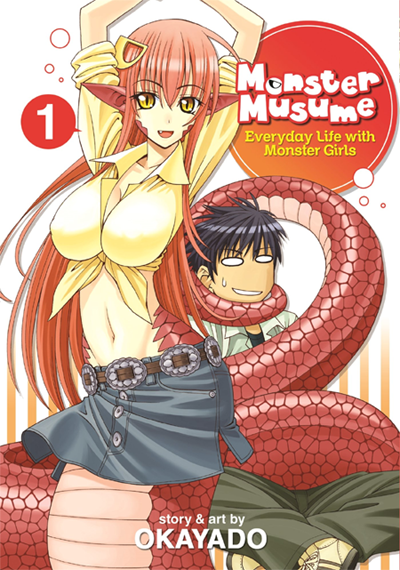
The problem with most of these monster-girl series is that they’re typical stories beneath the new paint. The leader of the whole movement is Monster Musume, a manga and anime about an average guy with various roommates from the monster realm: first a lamia who can’t keep her coils off him, then a juvenile harpy, then an uptight centaur, and so on. It adheres to the same bland template as countless other risque comedies, as nearly all of the mythical beast-women want the protagonist in one way or another. That's why I gave up on the series. Well, that and I started feeling sorry for the lamia, who met the protagonist first and clearly liked him best.

Monster Musume doesn’t hesitate to overload on titillation, and rarely does it take its premise to imaginative heights. For example, we’re told that lamia are all female and thus require human males to breed (gosh, how convenient), even though many brands of fiction have male snake-men. What about Michael Swanwick’s The Dragons of Babel, where a male lamia is called a lamius? What about the G.I. Joe movie, which features a serpent-emperor voiced by Burgess Meredith? What about those Piers Anthony novels that a lot of people warned me against reading? I’m sure at least one of them has a male lamia.

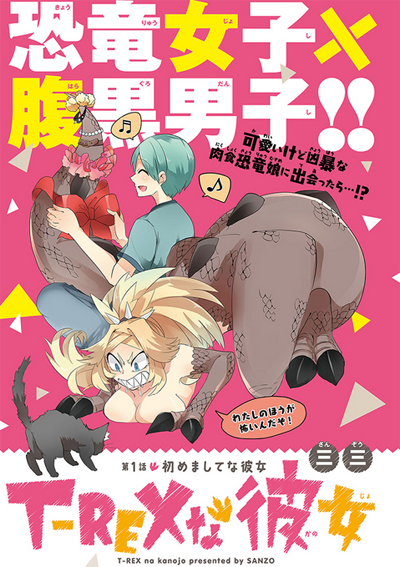
There’s another section of the monster-girl trend that I enjoy much more, if only for selfish, nerdy reasons. It’s a manga called T-Rex na Kanojo, or My Girlfriend is a T-Rex.


It’s ostensibly a parody of the whole monster-girl thing, and it envisions a world where dinosaurs didn’t go extinct so much as they evolved over untold epochs to live and work alongside humans. Of course, this evolution means that dinosaur girls look human as far as their heads and torsos are concerned—everywhere else they have scales, claws, horns, or armor plating.


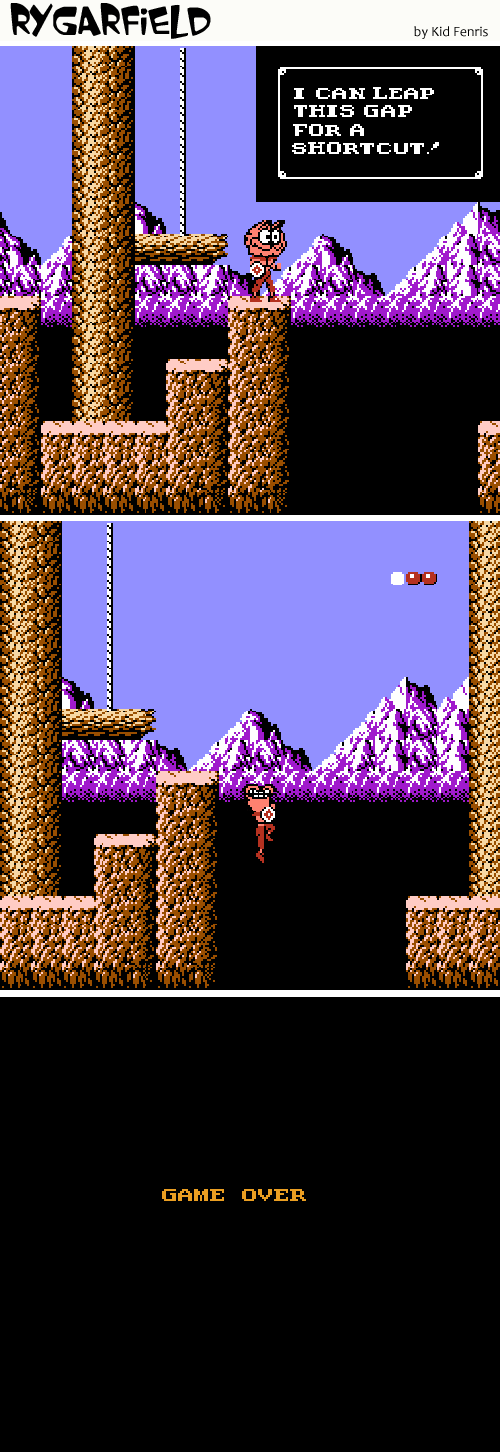
Rygarfield: The Third Impact

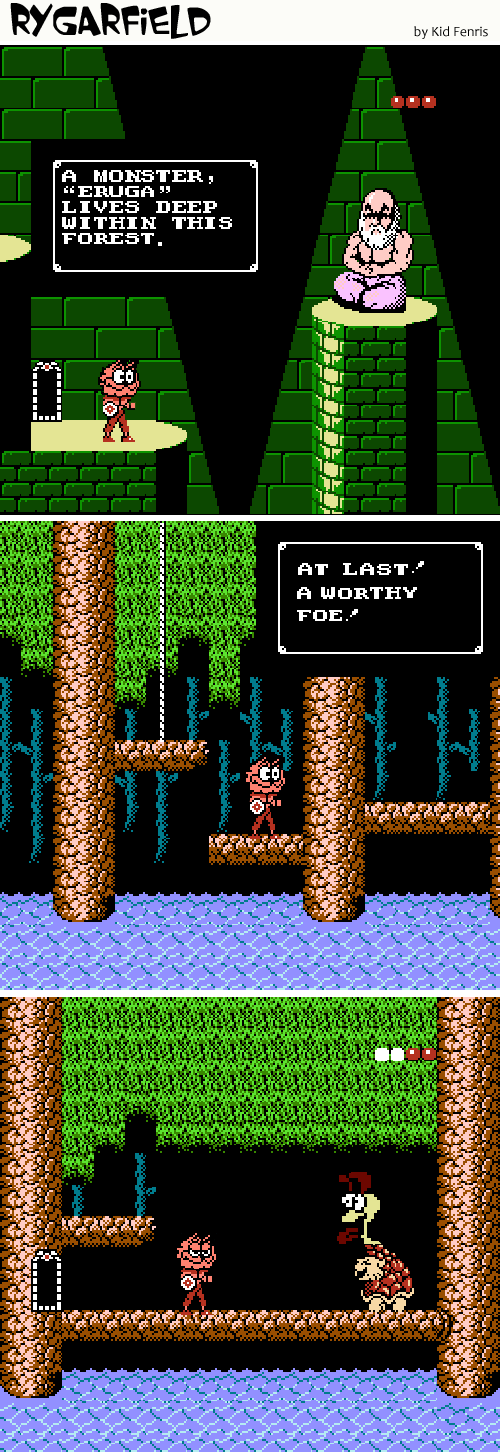
I realize that I let Rygarfield fall behind schedule, as I've made only two strips in fifteen months. I’m not worried, though. All of the best webcomics and many of the terrible ones go on long, largely unexcused hiatuses, so it’s only natural that Rygarfield reflect its medium. And I think the third strip is the best yet!


Abysmal webcomics aside, making Rygarfield led me to appreciate the NES version of Rygar more and more. It already occupied a special place in my nostalgia, since it was the first NES game I saw nearly in its entirety. A neighbor kid had mastered most of it, and he spent one afternoon showing me the whole game up to the final boss. I was so fascinated by the sprawling scenery, the cool monsters, and the little secrets that I didn’t realize I never actually got to play the game. Rygar may as well have been a crude pixel movie for me.

More to the point, Rygar is highly impressive for a 1987 NES offering. Most of that period’s worthwhile games came straight from Nintendo themselves; the majority of third-party titles were simple arcade derivatives or crude side-scrollers. Yet Tecmo recast the boring arcade Rygar as a spacious NES quest that mixes overhead stages with horizontal stuff, offering the player RPG-ish leveling and an arsenal of neat accessories (well, the grappling hook is neat; the rest are rarely used). The creatures encountered are remarkably varied, and there’s a lot to explore as each new item opens up previously impassible areas, like some fantasy-themed Metroid. It even has one of the earliest floating castles in an NES game!

I’m surprised that Rygar didn’t become a series-launching cult classic along the lines of Castlevania or Mega Man. Tecmo tried a PlayStation 2 remake, but it doesn’t count.

No matter. I’m sure that Rygar will see a parasitic resurgence once Rygarfield lands itself a movie deal, a low-budget CG cartoon, and fields of merchandise. Maybe someone will make bootleg T-shirts that show Rygarfield peeing on, say, a Sega Master System.

A Lack of Lunar, Elucidated

The first two Lunar games remain cases of RPG clichés done unimpeachably right. They button up every little part of the genre that grew old during the early 1990s, but they do it all with exceptional artwork, grand music, likeable characters, and cinematic aplomb (oh, and goofball Working Designs localizations that I still find irresistible). That’s especially true of the second game, Lunar II: Eternal Blue. In fact, in the whole skein of RPGs where plucky young heroes meet mysterious, blue-haired women, Lunar II is the best damn RPG where a plucky young hero meets a mysterious, blue-haired woman. And you can quote me on the box.

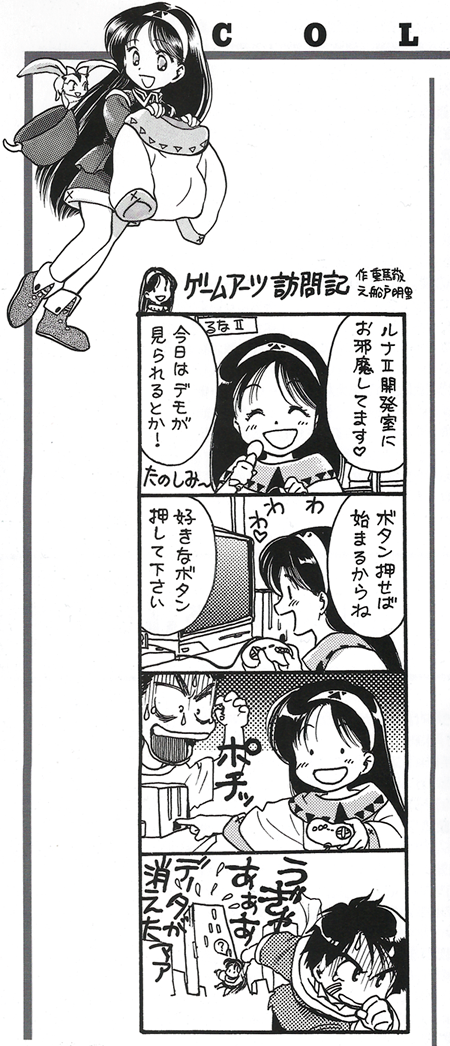
The original Lunar: The Silver Star gets most of the attention when it comes to remakes, but you’ll find that Softbank’s Lunar artbook, source of early production art and other things, grants a touch more space to Lunar II. For example, the second game gets this comic strip by artist Akari Funato. In it we see Eternal Blue protagonists Hiro and Lucia visiting their makers at the Game Arts offices.


It’s easy to follow if you have even a minor understanding of Japanese and game-development gags, but here’s a rough translation anyway.

A Demo Demo Dilemma

I discussed the Demo Demo PlayStation series here before, partly because it has the only publicly released bit of Bounty Arms and partly because it’s a neat relic of the PlayStation’s uncertain first year. The Demo Demo line appeared in store kiosks shortly after the PlayStation’s debut in late 1994, when Nintendo and Sega and even the NEC-Hudson alliance dominated much of the game industry’s giant Risk board. Demo Demo lasted only a few years and was soon forgotten, but it helped show off Sony’s new system in time of need.

Demo Demo discs weren't sold commercially, but they had to catch the eye in stores. That’s why a lot of them have comics on their covers. They’re simple strips with a few recurring characters, and among them are two girls who serve as a doofus and a straightman (or “boke” and “tsukkomi” if you want the Japanese terms) as they promote Sony products. I previously looked at one of their cover comics, and I now present their first appearance, which comes on the only Demo Demo PlayStation disc I still own. Through no coincidence, it’s the one with the Bounty Arms demo.


I guessed wildly and incorrectly when I summarized a Demo Demo comic before, so I’ll translate it here. Neither character has a name as far as I can tell, and it’s tempting to label them Demo and Dummo. But I'll be consistent.

PANEL ONE 
Brown-Haired Stupid Girl: I wonder if these games are any good…
Blonde-Haired Smart Girl: Why don’t you just go to the store and try them out on Demo Demo?

PANEL TWO
Smart Girl: Check out videos of new and upcoming games! Play demos yourself! And there’s a new edition every month!

PANEL THREE 
Stupid Girl: Wow, this game’s really interesting! Oh, but so is THIS one! Uh oh, which one do I want?
Smart Girl: Sigh. There she goes…

There’s less of a joke here than we see in the girls’ later outing, but it revolves around the fact that someone can’t decide what PlayStation game to get. And why? Because every PlayStation game is amazingly good. It doesn’t matter if it’s Nekketsu Oyako or Cosmic Race or TAMA or Toshinden or Kileak: The Blood, my dear, because you’re guaranteed to love it!

Our indecisive heroine’s friend could just tell her to get Ridge Racer, which was the console’s most impressive first-round release and still plays well today. However, Sony has a Demo Demo quota to meet this month. Something’s gotta move PlayStations, and I’m afraid it won’t be Bounty Arms.

Rygarfield Returns

I'm afraid that Rygarfield has not yet emerged as this century’s hottest new comic strip. At first I didn’t know what the problem might be. It has everything kids like: video games, webcomics based on video games, and ironic Garfield humor. Then I realized what was wrong. Rygarfield had only one panel instead of the multi-panel format used by every good comic that isn't The Far Side!


Now Rygarfield is the complete work that it should have been at the start. It also delivers biting commentary about cats and the marginal secrets of old NES games. It's like Howard and Nester meets Heathcliff!

Introducing Rygarfield

You know what’s wrong with webcomics? They just don't have broad appeal. Name any webcomic, and you can find a great mass of people who hate it or, worse yet, ignore it.

Fortunately, I have devised a new project to scale magnificent heights in online comedy and profit. It is a webcomic that no one could shun, a webcomic that fuses the Internet’s boundless affection for old video games with the proven success of one of the past century’s most marketable characters. I call it Rygarfield.


Rygarfield is available for syndication, merchandising, and whatever funding you might care to send me. Feel free to make ROM hacks and memes about Rygarfield, so long as you credit me and pay me royalties. And if anyone points out that Rygarfield is a blatant arrogation of copyrighted material, tell them it’s OK under the doctrine of fair use. Just don’t tell them to look up what the doctrine of fair use actually means.

Be sure to check back for regular Rygarfield comics about sarcasm, dog abuse, and that weird, unreachable door in the water just above Dorago's lair!

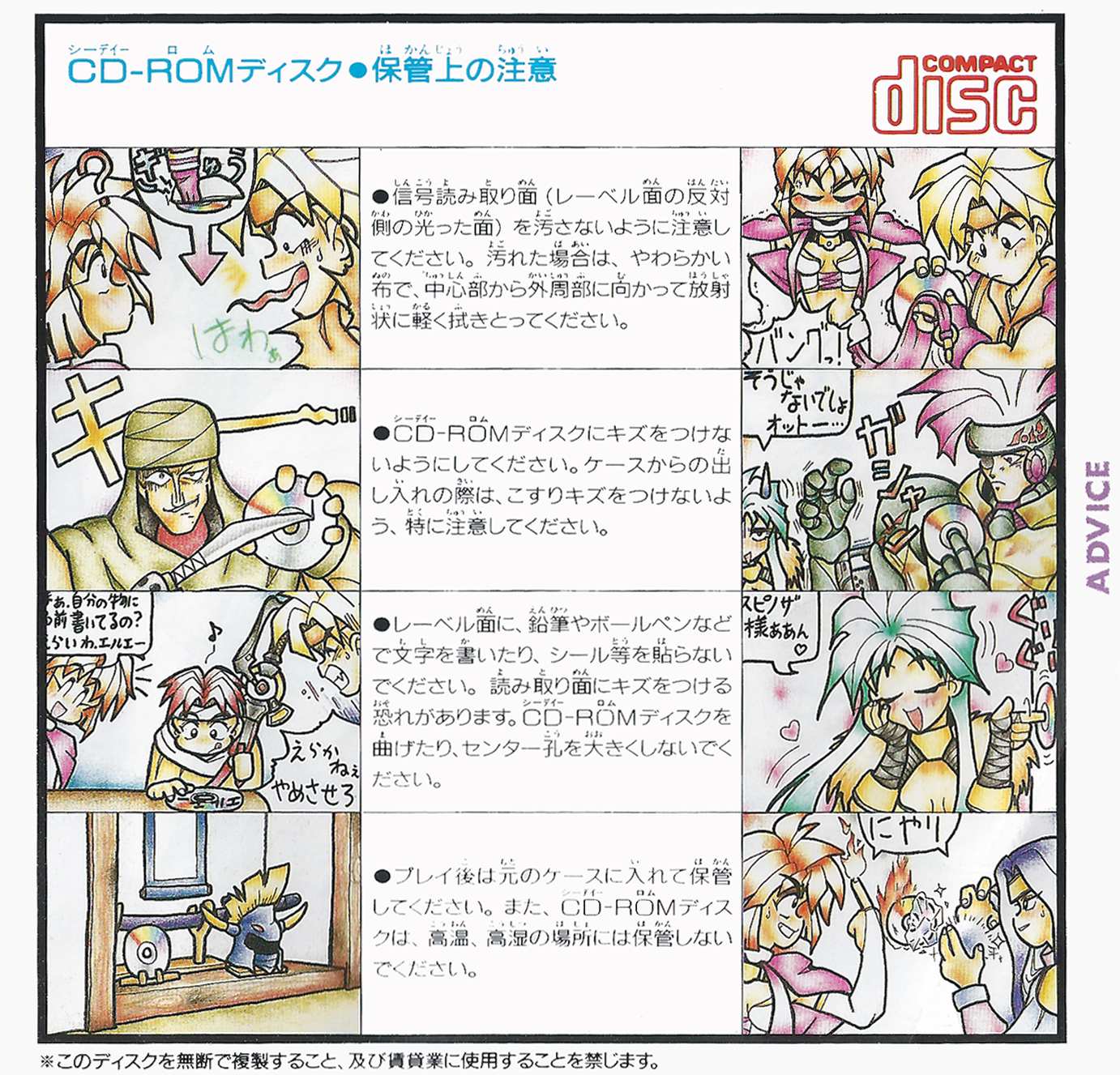
Flash Hiders: Safety First


Flash Hiders and Battle Tycoon rarely draw notice in the history of fighting games. The two titles were the now-defunct Right Stuff’s attempts at snatching a piece of the genre’s sugary and super-saturated pie in the 1990s. Neither succeeded, but I suspect they were ahead of the curve. Every modern fighting game has a console-oriented story mode with RPG-ish customization, and Right Stuff explored that territory with the original Flash Hiders in 1993. More can be read in this GameSetWatch piece I wrote years ago, even though I now see some typos and at least one factual error: Patchet is a were-polar-bear, not a werewolf.

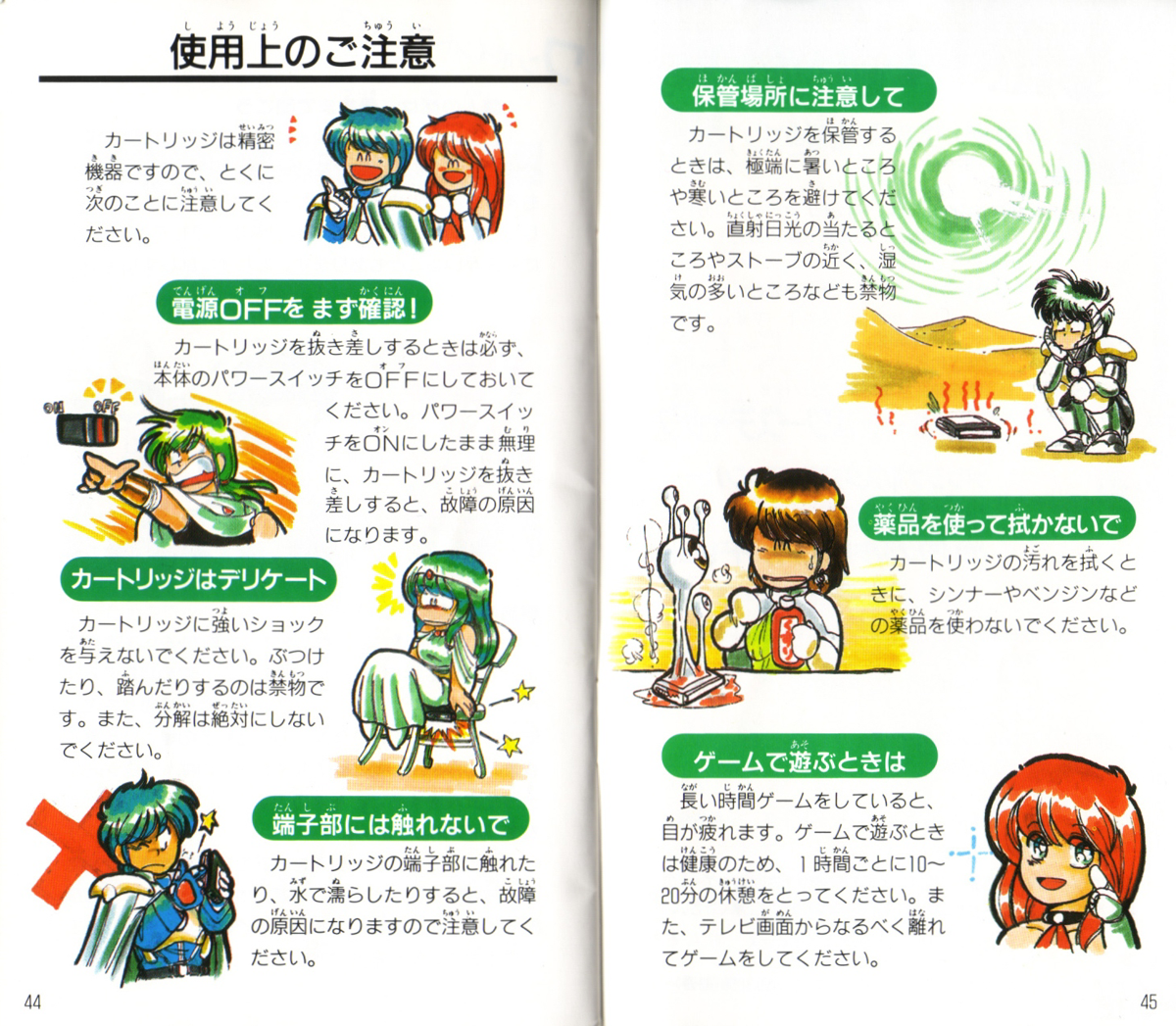
I like Flash Hiders, and I also like its manual. Game instructions usually include guidelines for handling a cartridge or CD, and every so often the publisher might add little comics of the game’s characters failing to heed such advice. This is a lost art today, but it was common in the Japanese market of the early 1990s, when CDs were a new technology and there was always the chance that some consumers would try to play a game by breaking the disc apart and picking their noses with the shards.

My favorite game-safety guides are the ones from Phantasy Star III and IV, but the last page of the Flash Hiders manual is also very helpful. It offers plenty of illustrated advice for first-time CD-ROM owners.

Toren Smith and the Right Words

Toren Smith passed away on March 4. Many remember him as a pioneer in the manga-translating world, and there’s a lot to his story: how he scraped by while living in Japan, how he made friends with the Gainax crew, how his name was affixed to a Gunbuster character, and how he brought all sorts of manga to North America, starting with Masamune Shirow’s Appleseed. You can read more about Smith’s illustrious career in Jonathan Clements’ writeup and Mike Toole’s recent column, so I'll just concentrate on one small thing.

I was introduced to Smith’s work in the very first manga I ever bought: volume two of Appleseed. In those days I took for granted all of the colorful and coherent dialogue rendered into my native tongue by Smith and his fellow translator Dana Lewis. It was only after I’d digested some manga from other sources that I appreciated how much effort Smith and Lewis put into the process. It was all the more amazing that they'd handled something as technologically dense as Masamune Shirow manga.

Smith and Lewis did excellent work all around, and yet there’s one particular panel that comes to mind whenever I think of their output. It shows up in Shirow’s original Dominion Tank Police manga. Our spitfire heroine Leona has once again destroyed property and endangered lives in her pursuit of justice, and once again she expects a chewing-out from the chief of police. That doesn’t happen.


It’s one little exclamation, but it captures the way Smith and Lewis could find the perfect word for a situation. Oik. Not “huh?” Not “eh?” Not some drawn-out “Say what now?” Those would be adequate, but they fall short of the simple sputtering “oik.” It's pure bewilderment crystalized in three letters, and it fits Leona’s look in a way that no other interjection could.

Finding the best possible phrase is very hard. It’s a ubiquitous challenge for anyone who writes, edits, translates, or, in my case, babbles childishly about old Sega Genesis games. Most of us compromise. To paraphrase Mark Twain, we settle for the lightning bug instead of the lightning. Toren Smith didn't, and a great many manga titles were all the better for it.

Lost Anime: Route 20

A wise observer once described Gainax as two diametrically opposed anime studios in one. Good Gainax takes chances and creates interesting stuff. Evil Gainax does its best to ruin everything. Good Gainax made FLCL and those cool Daicon shorts, but Evil Gainax made Mahoromatic and He is My Master. Good Gainax made most of Royal Space Force: The Wings of Honneamise, but Evil Gainax made that scene. Good Gainax upended the anime industry with Evangelion, and then Evil Gainax exploited it with remakes and uncomfortable merchandise.

Where does the never-made Route 20: Galactic Airport fit into this tangle of heroism and villainy? We’ll never have a complete answer, since Gainax canceled the project over twenty years ago and hasn’t mentioned it since. Yet all available evidence points toward Good Gainax.


Route 20 apparently began life shortly after The Wings of Honneamise hit theaters. It was the 1980s, Japan’s bubble economy was surging to the skies, and Gainax had scored an unprecedentedly huge budget for Honneamise. A second ambitious film seemed natural, and early magazine previews suggested that Yoshiyuki Sadamoto and Mahiro Maeda’s Route 20 would be that film.

Pictures of Toys and Toys of Pictures

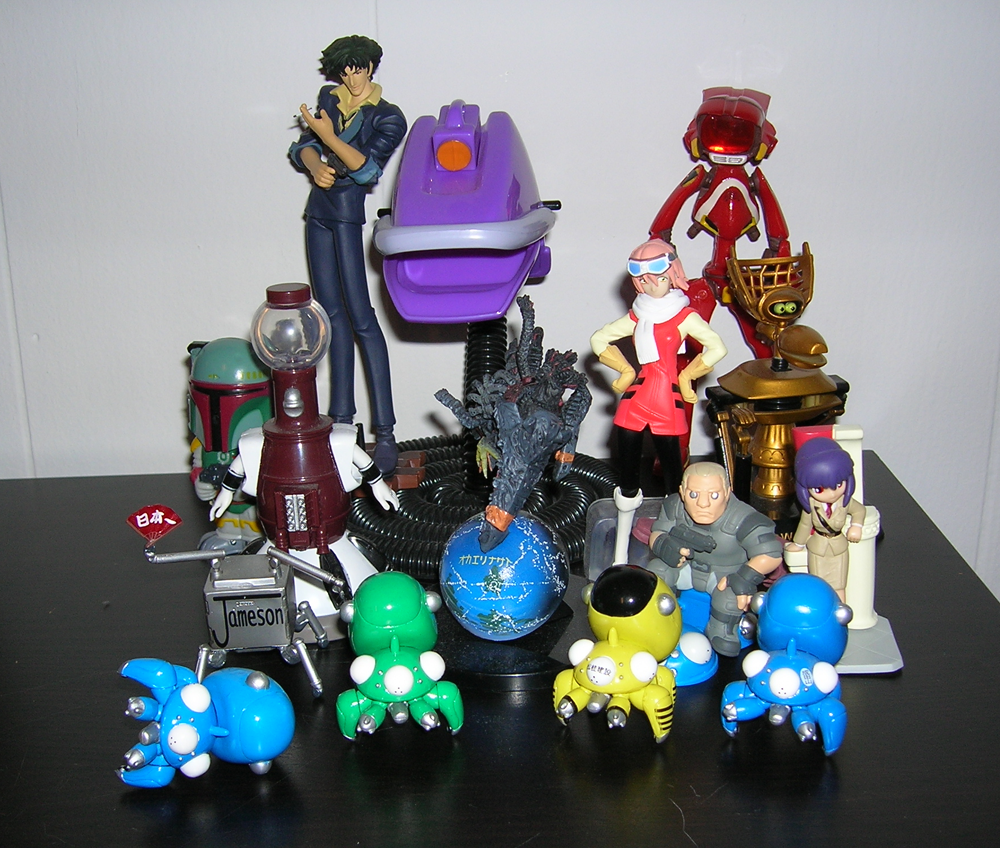
It’s time I talked about toys. I’ve acquired a number of them over the years: some bought, some received as gifts, and some offered as promotional trinkets by game companies. Nearly all of them are stored in my closet, well out of sight.

But I decided to gather them all for a picture. And a reminder. Whenever I want to get any sort of action figure or miniature statue based on a video game I happen to like, I can look at this image and remember that I already have a pile of plastic merchandise that I've stashed away in embarrassment.


As you can see, my collec…wait, what’s that?


Hey! That’s a Tachiko…Fuchi…one of those robots from Ghost in the Shell! And Ghost in the Shell isn’t a video game! Well, there are actually three Ghost in the Shell games, but the whole franchise wasn’t a game from the start and therefore doesn’t count.


Yes, purge the intruder. THROW IT TO THE WOLVES.


Or just throw it over there, with all of the toys based on things that aren’t video games. The sanctity of our cherished gamer culture must never be violated by inferior alien elements such as anime or Star Wars or even Mystery Science Theater 3000. That’s another thing I’ll have to remember.

The Dark Side of Captain Commando

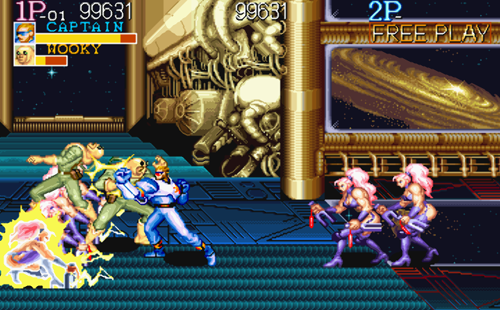
Captain Commando was a veritable chameleon among game mascots. As mentioned in a recent feature at 1up.com, the Capcom icon started off as a box-art pitchman and went through two different designs in the 1980s. It wasn’t until 1991 that Capcom finalized his look with an arcade beat-‘em-up.

Captain Commando is a typical enough outing in the Final Fight tradition. The eponymous Captain and his three Commando assistants pound street thugs and monsters, and it's dressed in a futuristic style inspired by manga superhero tales and old serial adventures like Captain Future and Lensman. It’s also pretty mild as the violence goes. Sword-wielding enemies can cut the Captain in half, and the mummy commando, a.k.a. “Mack the Knife,” causes foes to disintegrate into skeletons when he defeats them. That's about it. These scenes were removed in the Super NES version of Captain Commando, and there wasn’t much to take out.


There’s nothing in Captain Commando to suggest that Capcom’s underlying vision for the game was a bloody procession of sadism and gruesome deaths. For that, you’ll have to read a promotional comic that Capcom made.

It's a little graphic, so I'll hide it behind this cut.

Phantasy Star III: Care and Feeding

Game manuals are a dying breed. As the industry shifts toward online distribution and cheap packaging, manuals grow thinner and less informative. In fact, some modern titles don’t even include them. And why should they? Most of today’s games have extensive, intrusive tutorials that make manuals unnecessary. Yet there’s one important thing that only manuals have: drawings of the game’s characters telling you not to set your new purchase on fire and throw it in the toilet.

The majority of games lack such warnings, of course. That sort of thing was seen mostly in Japanese releases during the late ‘80s and early ‘90s, when game companies felt the need to inform players of the best ways to care for the imposing technologies of CDs and game cartridges. My favorite little warning section comes from the manual for Phantasy Star III.


I don’t know Japanese well enough to fully translate this, but I’m not worried. I tried to do the same thing with a Demo Demo PlayStation cover, and someone dropped in to correct my largely wrong interpretation. So I’ll just translate this Phantasy Star III cartridge-care guide as best I can. It’ll all work out in the end.

Vagrant Story: The Graphic Comic Novel Book

Comics based on video games usually stumble for two reasons. Most games have threadbare, cliche stories to start with, and their comic versions rarely get top talent and indeed sometimes show artistic standards that even Rob Liefeld's nadir would find wanting. Yasumi Matsuno’s games fix the first problem: from Tactics Ogre through Final Fantasy XII, they’re have complex, fascinating storylines that could handily become books or movies without extensive reworking. 

They could, but they haven't so far. The comics based on Matsuno’s games are few in number and slight in complexity. Over in Japan, there’s a brief Tactics Ogre manga and a slightly longer Final Fantasy XII project, both made without taking much advantage of the source material. In America, we have only a Vagrant Story comic that’s barely a comic at all.

Vagrant Story is already part comic, anyway. The game is a PlayStation dungeon-crawler, heavy on customization and the darkly political tone that guides most of Matsuno's stories. The characters are realistically proportioned (in artist Akihiko Yoshida’s strange semi-bondage outfits), and their dialogue’s all told through unvoiced word balloons. So it feels like a comic book, albeit one where medieval-fantasy cult leaders and scheming pontiffs chatter on about sellswords and faerie tales. At the very least, a Vagrant Story comic would attract those who hastily extolled the game as true art upon its release.


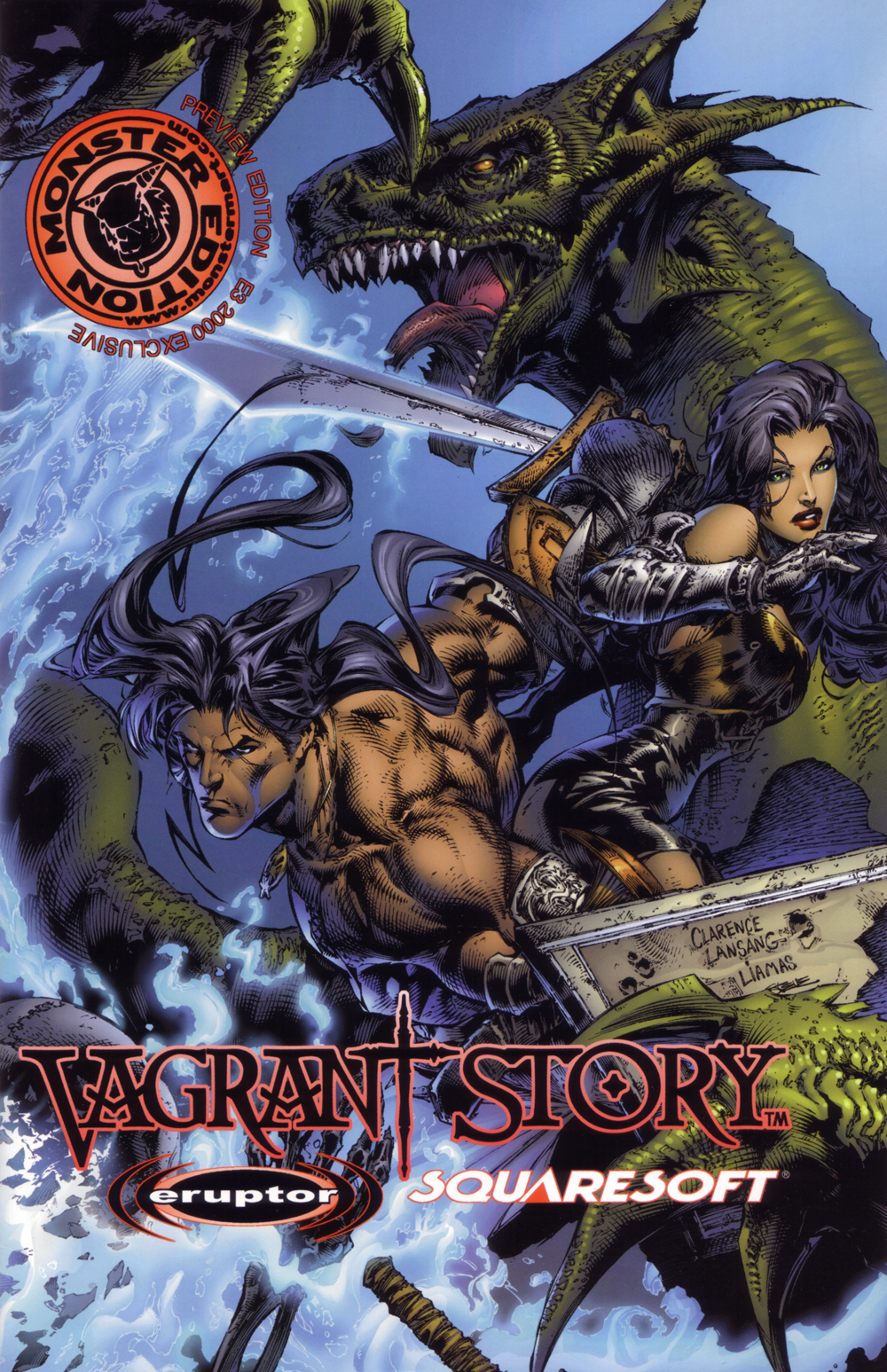
Eruptor Entertainment’s Vagrant Story comic is really just a preview issue, given away at E3 in 2000, but its cover promises all sorts of camp wonder. Are main characters Ashley Riot and Callo Merlose now 1990s-style comic heroes? Will they be preposterously built vigilantes with violent, mysterious pasts? Will they pose uncomfortably while hiding their feet or hands or whatever body part the artist can’t draw? Will they scream miles of expository dialogue in mid-air as they leap at enemies? Will they say things like “Kill THIS, ya bastards!” before pulling out handguns large enough to launch short-range aircraft?

Demo Demo PlayStation Predicts the Future

Sony’s Demo Demo PlayStation series is less than a footnote in the system’s history. They’re very similar to the Play Play demo discs that were mailed to new PlayStation owners across Japan starting in 1995, as Demo Demo volumes are also loaded with promotional videos and playable previews. Unlike Play Play, Demo Demo discs were originally made for PlayStation store kiosks in Japan, and they were perhaps the first PlayStation demo discs ever released. They stretch back to the system’s launch in late 1994, making them relics of a time when Sony was doubtless worried that the PlayStation would flop and send their entire video-game division scrambling for new jobs at Nintendo’s Virtual Boy department.

I'll remember Demo Demo PlayStation mostly for including a playable version of Bounty Arms, yet these discs are interesting beyond that sample of my most-wanted unreleased game. True, Demo Demo volumes are bare-bones compared to the Play Play series. Play Play discs come with plenty of extras, commercials, original games, booklets, and glossy designs. Demo Demo discs just get covers with generic comics. That's understandable if these cases were meant to sit idly on a shelf while the disc ran in a kiosk somewhere. Sony gave Demo Demo covers to any manga artist willing to sacrifice a few panels to obscurity.

My favorite Demo Demo PlayStation cover comes from Volume 11, because it’s the only one I even remotely understand.


If this were a good website like Magweasel, I’d have a detailed translation of this comic. It’s not, so here’s a crude guess (edit: I am, in fact, mostly wrong; see the comment below). Starting on the upper-right and going clockwise, we find two girls wolfing down cake, with the brown-haired one fretting about gaining weight. Her blonde friend points out that she’s not worried about her own figure, explaining in the second panel that “games” keep her thin. I assume she’s talking about sports.

Our heroine, being none too bright, interprets this to mean PlayStation games, and the next panel sees her embracing a “Game Diet” with the help of her trusty Sony-manufactured game console. This diet presumably consists of her sitting around all day while playing Ridge Racer, Philosoma, and maybe even Hermie Hopperhead. In the last panel, she laments that she hasn’t lost any weight on the Game Diet, while the blonde girl laments the unfathomable stupidity on display.

Edit: Since I guessed wrong, here's a actual translation.


PANEL ONE
Brown-Haired Stupid Girl: We’ve had so many sweets this fall, we’re going to get fat…
Blonde-Haired Smart Girl: Oh, I’ll be OK.

PANEL TWO
Smart Girl: I lose weight with video games. I play them so intensely, I don’t have time to eat, you know?
Stupid Girl (vagrant floating thought): Really.

PANEL THREE
Stupid Girl: All right! I’ll try it too! I’m on the Game Diet!
(Headband: Something about losing 5 kilograms. It’s hard to read.)

PANEL FOUR
Stupid Girl: I was so bad at playing games, I got depressed and started eating. And I gained weight!
Smart Girl: You are such an idiot.

This sort of allegedly classic humor has entertained manga readers for decades, yet there’s something charming about this little throwaway gag. Perhaps it’s the way the comic unwittingly predicts Wii Fit fourteen years down the road. Or perhaps it’s the backhanded, Sony-endorsed admission that playing video games will make you a gloomy fatass.