Showing posts with label Arcades. Show all posts

Voyage Into Darkstalkers

I usually can tell right away when I’ll like a game. It may take a little while to fully seep into place, but even then there's something that grabs my reptilian synapses right away: a striking title screen, a memorable piece of music, a first-stage appearance by a skeletal villain who calls himself the chief of governors. It's also rare for me to initially dislike a game and then come around to utterly adoring it. 

Well, I didn’t like Darkstalkers at first glance. It was the winter of 1994, and I was still very much enamored with a hyperviolent arcade fighting game called BloodStorm. That’s a strange tale in itself, but the short of it is that I really liked BloodStorm and couldn’t understand why it had disappeared from every arcade in Ohio. I held out hope during a Christmas visit to my grandparents in New Orleans, where the arcades were better supplied and surely would maintain a BloodStorm cabinet for me and the fifteen other fans it had across the nation.

They didn't, of course. The New Orleans arcades had a plethora of new and interesting sights, but BloodStorm was long gone. One of the games that had taken its place was Darkstalkers, Capcom’s head-to-head fighter starring various classic monsters culled from myths and movies (it started off as a Universal monsters pitch, in fact). Its fluid animation and ornate designs were amusing and impressively detailed beyond any game of the era.

I hated it. What was this weird new thing with a grotesque assortment of creatures? Who were these warped and cartoonish versions of boring old movie monsters? Where was the conventional and comprehensible gore of BloodStorm or Mortal Kombat II? And is that cat-woman naked? Can they actually show that?

Darkstalkers earned only one try from me. I picked the spindly fish-man Rikuo, made it a few matches in, and then walked away. I couldn’t wrap my head around the bizarre sights and the bright backgrounds and the animation that was somehow a hybrid of Disney-style smoothness and anime expressions. And though I was accustomed to just about every fighting game dressing its female characters in impractical attire, I wasn’t going to be seen playing something with a character like Felicia, who indeed wore nothing but suspiciously sparse fur. 

So I shunned Darkstalkers and sulked over to the new Killer Instinct machine. Its robots and ninja warriors and off-brand velociraptors presented far more comfortable characters, and the game’s sole human woman only briefly turned into a cat and faced away from the player when she pulled open her top for a finishing move. It was nice to see things back to normal. 
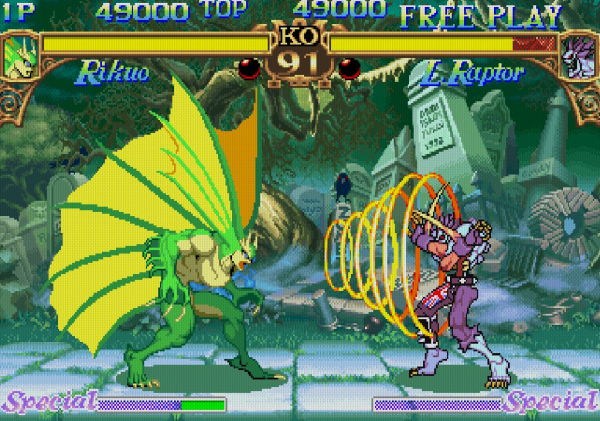
 

Yet things changed over the next year or so. I started reading GameFan Magazine, where Nick Rox and Takuhi and other writers would lionize the wonders of Capcom’s hand-drawn animation while pish-poshing the “plastic rendered deathfest” of Killer Instinct. Several 1996 issues had lavish spreads about the upcoming PlayStation version of Darkstalkers and the Saturn version of its semi-sequel, Night Warriors. I spent far too much time examining all the screenshots and artwork, picking out the details in the characters and their oddball attacks. 

 I was ready to give Darkstalkers another chance, and after getting a PlayStation later that year I lucked into a heavily discounted copy of Darkstalkers at a store-closing Babbage’s sale. I now had time to enjoy the game at home and soak in it all. 

And I loved it. Playing Darkstalkers outside of the arcade let me take everything: the colors, the animation, the background details from the swinging bar sign in London to the neon riot of the Las Vegas stage. Characters that I’d once written off as generic or silly now seemed remarkable. Jon Talbain wasn’t just a werewolf; he was a werewolf with nunchucks, a hilarious taunting pose, and a special move that sent him hurling like a ping-pong meteor all over the screen. Morrigan wasn’t a mere standard-issue sexy vampire woman; she was a playful succubus with Elvira-like swagger. Sasquatch wasn’t just another bigfoot; he was an adorable goof from his giant teeth to his huffy frost breath. 

As for Felicia, I was still uptight enough to dismiss her as a shameless piece of pandering. Then I saw the win pose where she turns into a regular cat and emits a pitch-perfect meow. At this point I grew convinced that she was the greatest character in the history of all artistic expression and that any who denied this should be exiled to a habitable yet remote island until they were willing to recant such heresy.


Darkstalkers even made me want to be better at fighting games. Capcom’s entries in the genre had always seemed a little complex to me next to Mortal Kombat or Killer Instinct, but with Darkstalkers I had an incentive to learn every move, as they always resulted in some entertaining new sight. It was worth struggling with a stiff PlayStation controller to see Bishamon slice his foe into halves like some Looney Tunes gag. 

All this grew from the less-than-perfect PlayStation port of Darkstalkers. It’s an impressive feat for what it is, but it has strange bouts of sluggishness and seems brutally hard. It took months for me to beat even the lowest difficulty setting. Yet it was a great introduction, and I was intrigued by the idea of a much better version. I can’t say that Night Warriors was my only reason for getting a Sega Saturn the next year, but it was the first game I picked up for the console. 

I never drifted away from Darkstalkers. I was there to import the Saturn version of Darkstalkers 3 and its RAM cart, there to buy Darkstalkers Chronicle: The Chaos Tower for the PSP a week before the actual system came out, and there to complain when the Darkstalkers collection for the PlayStation 2 never got translated and when no one bought Darkstalkers Resurrection years later. 

The lesson? Don’t give up on something after a rough first impression. Especially not if you’re a teenager who likes BloodStorm—or even an adult who still likes it.


Arcade of My Youth: Cap'n Bogey's Golf & Games

A woman knocked on our door one summer evening in 1992. She was circulating a petition against the planned construction of a huge arcade and mini-golf course not far from our neighborhood. As a Concerned Citizen, she felt that it would lower property values and promote delinquency in the delicate suburban environs of Beavercreek, Ohio. 

I feel bad for that woman. Not only did my father, a man so cautious he balked at giving his credit card to Blockbuster, decline to put his name on the petition, but her visit guaranteed that arcade one more customer: I was now aware of Cap’N Bogey’s Golf & Games, and I couldn't wait to go there.


Cap’n Bogey’s was close enough to our neighborhood to worry overprotective homeowners, and that meant it was within easy walking distance. Every weekend I’d hike there, usually early enough to avoid major crowds, and spend far too much time lost in a maze of arcade cabinets. My sister would tag along, but I’d make her walk a good distance behind me. Because you needed to look as cool as possible when you arrived at Cap’n Bogey’s.  

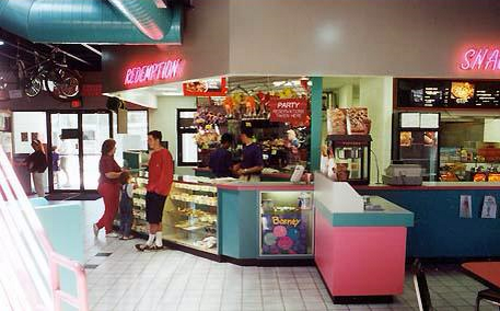
There were many arcades in the Dayton suburbs, but compared to the typical nook in a mall or the back room at a pizza joint, Cap’n Bogey’s wasn’t just an arcade. It was a kingdom. The main building surrounded itself with a golf course, bumper-boats, and batting cages. Inside, the first floor was devoted to a snack bar and redemption games, with everything decorated in white, blue, and occasionally pink. I usually walked past such juvenile distractions and made straight for the upper level and the genuine arcade games.

This was the 1990s, and that put me right in the middle of the fighting-game craze. Street Fighter II had started it in 1991, Mortal Kombat had cemented it in 1992, and within a few years every arcade had a wealth of head-to-head fighters and the whole industry was raking in profits not seen since the heyday of the early 1980s.

The Cap’n Bogey’s arcade was stocked with every genre, including four sit-down Dayton USA cabinets, two T-Mek machines wired for versus play, the elaborate foot-pedal setup of Time Crisis, and the glorious driving-shooting hybrid of Lucky & Wild. Yet it was the fighting games that drew me. The gaming magazines of the day couldn’t stop hyping up the latest Street Fighter or Darkstalkers or Samurai Shodown or Virtua Fighter, and the first place to see them was the arcade. This was well before consoles were on par with arcade hardware, and unless your parents bought you a $600 Neo Geo home system, the arcade versions were always just a little bit better.

Some of these games would vanish within a month, but the big names stayed and took me through the heights of an arcade renaissance and its whimper of an ending.

KILLER INSTINCT
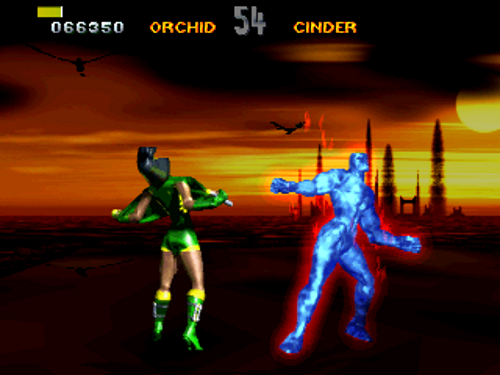
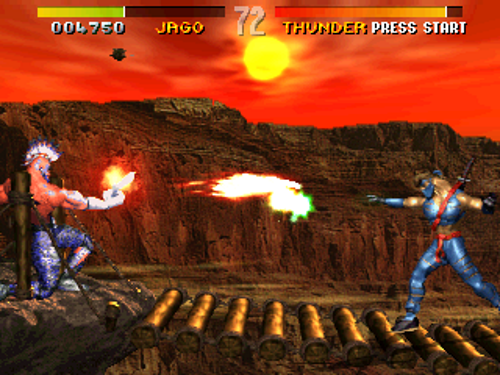
Is Killer Instinct the best fighting game of the 1990s? Hardly, but I think it’s the best example of a 1990s fighting game. Rare and Nintendo fashioned it with CG-rendered visuals that looked impressive in early 1995 but awkwardly plastic by that September. The game boasted every possible stereotype in its lineup: a Predator-like robot, a mystically powered ninja, a boxer, a velociraptor, a low-detail ice alien, an equally low-detail fire mutant, and, of course, a female character whose signature finishing move involved pulling open her top to give her opponent a heart attack. I'd say that the 1990s were a different time, but in this case I'm not sure that applies.

I learned to play fighting games on Killer Instinct. I’d enjoyed Street Fighter II and Mortal Kombat, but I was never particularly good at them, rarely pulling off a special move more complicated than jamming a button really fast. Killer Instinct was approachable enough that I could pull off the special moves and even trigger the extended combo attacks that made the game’s announcer yell BLASTER or AWESOME. And when I went back to playing Street Fighter Alpha or The King of Fighters ’95, I actually understood what was happening.

There’s a better reason I remember Killer Instinct well. One Saturday, local radio station Z-93 set up a contest with a Super NES and the newly released port of Killer Instinct. The previously selected participants didn’t show, so the station held a quick lottery and drew names of five random arcade patrons. I threw my name in and, thanks to the relatively light crowd, I got picked.

The contest wasn’t an actual tournament. Instead of facing each other, the five of us just played solo, using the ninja Jago, to see who could rack up the highest score in a single match. This was clearly planned by someone who still thought that video games were in the score-driven heyday of Pac-Man and Space Invaders, even though an actual fighter like Killer Instinct was all about beating an opponent and showing off an ULTRA combo.

And I won. I managed to perform a bunch of combos and Jago’s finishing move, which put me well ahead of the other participants. I got a nearly new Super NES and made a brief appearance on the radio. To this date it remains the nicest thing I’ve won in a contest, eclipsing the cake I got at a county fair when I was five and even the used DVD of Steel Angel Kurumi Encore that I received in a trivia challenge at Anime Central.

In retrospect, spending all my time in the upper-level arcade of Cap’n Bogey’s wasn’t as practical as visiting the lower-level, where at the very least I could have played skee-ball, earned tickets, and exchanged them for prizes. Yet that day I walked out with a game system and the assurance that, for once, no one could tell me that I’d wasted my time at an arcade. 

Arcade of My Youth: Wright-Patterson

Wright-Patterson Air Force Base is famous for two things. It has the world's largest air force museum, and it has Hangar 18, the now-ordinary storage facility that supposedly housed aliens from the Roswell crash in 1947. In fact, Wright-Patt is rarely mentioned beyond those points. Oh well. There are worse ways for a military base to make a name for itself.

I remember Wright-Patt for other reasons, though. My father worked there after we returned from Germany in 1991, so I recall going along to the base exchange, the commissary, and, of course, the tiny arcade.

Wright Patt’s arcade was barely even a room. It was more of an alcove with a dozen cabinets inside, situated near the vending machines. I’d go as often as I could, regularly sacrificing Saturday morning cartoons so I could tag along with my father. While he shopped, I’d spend an hour or two in this little gallery of arcade games.

Solitude was part of the appeal. In the early hours of most Saturday mornings I was the only one at the arcade. There was no one around to hog Super Baseball 2020 or beat me at Fighters History Dynamite, no one to make too much noise over a game of Raiden, and, most importantly, no one to recognize me from school and therefore remind me how miserable I was during the rest of the week. Wright-Patt’s arcade wasn’t the biggest or best that I’d ever visited, but for an hour or two each week it was the only one that was all mine.

A lot of arcade games came through Wright-Patt’s little nook, but I’ll narrow it down to three that I remember vividly and haven’t yet discussed too much here.

CADASH 
I always went for RPGs as a kid, whether it was the latest Final Fantasy or some lesser curiosity like Dragon View. It was a matter of economics. I bought only two or three full-priced games a year, and an RPG was all but guaranteed to last me three months. Even if it was a bland three months of Traysia or Breath of Fire, that was a surer bet than even the finest action game or fighter on the market. Perhaps it was often a case of picking the Golden Corral buffet over a five-star restaurant, but I wanted my money’s worth.

I also liked the pace of RPGs. I could explore. I could take my time. I could wander a village where half the residents said the same thing, or spend hours fighting monsters in the hills. RPGs offered a lot of freedom, and I rarely saw the same thing in arcade games.


That’s why I liked Cadash so much. It’s a side-scroller with cheap demises and a time limit, but it’s trimmed with RPG devices, from the pacing townsfolk and their awkwardly translated hints to the weapon shops and minor plot threads. The Wright-Patt arcade had only one Cadash machine, so I never saw the game in its LAN-linked four-player glory, but I always liked seeing how far I could get on a few quarters. At most, I could make it past the second boss and learn that a village girl marked for sacrifice was really a mermaid—a technically topless mermaid, the likes of which my at-home RPGs could never dare depict.

So Cadash was my go-to for many Wright-Patt arcade mornings. I liked all of the four playable characters, but I most often picked the Priest—or rather, the Priestess—just to mess with every villager who greeted the player as “BRAVE MAN.” It felt like I was outsmarting the game, or at least turning the king into being a subtly sexist jerk. Yeah, he’s been waiting for a brave man to arrive, but he figures he has to take what he can get.


It’s strange that I never got into the home versions of Cadash. The Genesis port removed the two best characters (that’d be the priest and the ninja), and the much better TurboGrafx-16 version slipped my notice until it was madly expensive. I had other RPGs to play at home, after all, and while Cadash clearly had substance, I couldn’t be sure it would occupy me all the way to Christmas or my birthday. For the arcade, though, it was perfect. It was nice enough to kill me slowly.


Seven Perfect Halloween Arcade Games


Arcade games are unappreciated Halloween decorations. True, they’re harder to arrange than plastic severed zombie feet or cheap, potentially toxic spider webbing, but I maintain that they’re worth the trouble. Whether you run MAME on a laptop or actually have a basement full of original cabinets, nothing sets apart a Halloween gathering or mood table like some appropriate old arcade games.

Why old arcade games? A few reasons. They’re easy to grasp, they’re often visually striking, and they display generous game footage when no one’s playing. That’s the beauty of it: even if they go untouched, these games look great just running in the background, as fitting as Addams Family episodes or every Sleepaway Camp movie.

I picked seven lesser-known examples of Halloween-friendly arcade games. Ghosts ‘N Goblins, Ghouls ‘N Ghosts, and Splatterhouse are the first-round choices of just about everyone, so I don’t need to extoll them here. I also left out anything that requires a light gun or other proprietary hardware to truly appreciate. House of the Dead isn’t the same without big plastic Wicked City revolvers, Crypt Killer loses something without a massive shotgun to pump, and a full Golly! Ghost array is probably beyond the price range of the average Halloween shindig. I went after games easy to appreciate in any form.


DARK ADVENTURE
Released: 1987
Aka: Devil World

It’s tempting to stick Gauntlet in your arcade lineup and be done with it. After all, Gauntlet is a reliably entertaining race through top-viewed dungeons. Yet there’s a more seasonal alternative available: Dark Adventure, Konami’s unabashed 1989 knock-off of the Gauntlet ideal. Three players control two archeologists and an unlucky reporter in a realm of mazes full of skeletons and minotaurs and…well, evil rats. Yet mundane rodents are forgivable when the first stage has giant mud swordgolems chasing you.


While you’re at it, throw in the Japanese version of the game, Devil World. No mere language swap, it differs a great deal: only two players can join, but the characters get projectile weapons instead of melee attacks, power-ups are more complex, and the expanded arsenal includes a rocket launcher that beautifully demolishes everything. You won’t find that in off-the-shelf Gauntlet.


DARKSTALKERS
Released: 1994-1997
Aka: Vampire, Vampire Hunter, Vampire Savior
Also On: PlayStation, Saturn, Dreamcast, PS3, Xbox 360

I’ll have you know that this list was not an convoluted excuse to push the Darkstalkers games. Yet I will admit that I cheated here. Underrated as it is, Darkstalkers is still popular enough to see recent reissues, and Capcom can’t make a Marvel crossover fighting game without including succubus antiheroine Morrigan at the very least. Even so, Darkstalkers escapes a lot of people when it comes to Halloween-appropriate games, and that is a bitter shame.


In fact, I will count the Darkstalkers line as the best thing to play on Halloween. It’s a great series of fighting games stocked with wonderfully animated monsters, from a karate werewolf to a mercenary Red Riding Hood to a vampire lord who transforms every character on the roster into a biteable young maiden. And that barely scratches the surface.

I recommend either Night Warriors or Darkstalkers 3, both of which are impressive and approachable even for casual players who haven’t touched a fighting game since trying Mortal Kombat at a deli in 1993. Some of the more risque Darkstalkers characters might not sit well at an all-ages party, but just remember that Felicia, the technically naked catgirl, is intended as a “cute” character. She’s not supposed to be sexy. It says so right in some official artbook that I can’t locate at the moment.


DEMON’S WORLD
Released: 1989
Aka: Horror Story

Toaplan’s conventional spaceship shooters overshadow some of their decent side-scrolling arcade outings, and Demon’s World is among them. Its heroes dress like dollar-store Ghostbusters and carry a plentiful supply of rockets, lasers, and other seemingly overpowered weapons. The stages are full of ghosts, Frankenstein abominations, Jason clones, and more, but my favorite might be this dapper, barrel-riding mummy from the first stage.


The casual appeal of Demon’s World is diminished by cheap hits; it’s a half-hour arcade outing from the 1980s, when no game could afford to let players walk all over it. Even so, it’s good fun for players who’ll either credit-feed or memorize their way to the admittedly disappointing final boss. It looks neat, but its pupal trappings promise a horrific final form that never emerges. You’re a big tease, Toaplan.


NIGHT SLASHERS
Released: 1993

Nothing brings revelers together quite like a classic arcade brawler in the tradition of Final Fight. Two of the genre’s best offerings, Capcom’s Alien vs. Predator and Irem’s Undercover Cops, are good for any list of gruesome arcade titles, but even more essential is Data East’s Night Slashers. It’s a battle through every possible Halloween staple: zombies supply most of the grunt forces, but the game’s three playable leads (including a hilariously gung-ho American cyborg) also face vampires, mummies, Voorheesian thugs, mutant cyborgs, skeletons, and an evil puppeteer and his creation. It’s as though Double Dragon ate an old video store’s entire horror section.


Night Slashers
sells itself mostly on its grisly sights, but some details perk up the familiar gameplay: the heroes can pound enemies into the ground, block when health runs low, and use impressive screen-clearing specials that deplete enough life to be costly and strategic. With two or three players along, it’s a great ride from its opening van crash to the villain’s cheap last stand. The only caveat: grab the Japanese version, which preserves all of the bloody effects and the “Go…TO HELL!!!” arrow that spurs you through each stage.


SATAN’S HOLLOW
Released: 1982

Arcade selections from the late 1980s and early 1990s may prompt complaints from older guests, who’ll tell you that that games were better back when they were single-screen shooting affairs like Galaga and Space Invaders. For them, you can roll out Satan’s Hollow.


Beneath the vintage-1982 gothic wasteland, Satan’s Hollow is straightforward: dodge bullets and zap dragon-gargoyles until a tiny Mephistopheles floats into the picture and spews fire. It’s game relatively obscure even in its day, as all ports to home consoles got canceled. Was it the unwholesome theme or just the fact that Galaga-esque shooters were common as quarter-munching dirt? No matter. Satan’s Hollow should entertain those who find games made after 1985 too violent and sexy and interesting.


SHADOWLAND
Released: 1987
Aka: Yokai Dochuki
Also On: PC Engine

Shadowland gets a Halloween angle by accident. It lacks traditional Western werewolves or vampires, but it has every sort of hellish creature that Japanese legends devised. It follows Tarosuke, a kid resembling a more sensibly coiffed Gegege no Kitaro hero, on a stygian trek through the eerie gray cliffsides and lava pits of the underworld. He has unimpressive spiritual bullets at his disposal, but Shadowland hides a lot for an arcade side scroller. Stages branch out and lead to healing springs, gambling mini-games, and a mermaid dance revue that might turn Tarosuke elderly–a condition curable only by buying angel poop from a shopkeeper. There’s a good conversation starter for the party.


Shadowland might not look enticing at a glance, as the designers labored under the idea that players had to see a map and a huge lifebar at all times, leaving only half the screen for actual gameplay. Stick it out, however, and you’ll find all sorts of unconventional weirdness, plus various endings that penalize you for picking up money and killing enemies. And there’s another conversation starter.


WARDNER
Released: 1987
Aka: Pyross
Also On: Genesis, FDS

Bear with me. I know that Wardner has no distinct Halloween atmosphere, and that I remember it only because of its long tenure in one of my defining childhood arcades. Yet I submit that Wardner has a valuable role in any roundup of scary arcade games, simply because it’s harmless and middling. It’s ideal for small children or those of dispositions too gentle to stomach exploding zombies or completely non-sexualized catgirls.


Wardner finds a tubby hero trudging through forests and factories to the castle where his ladyfriend sits imprisoned, and it’s a basic side-scroller with Mario-esque rules that any kid can follow. It’s not an easy game by any measure, as one hit dooms the hero at first, but it’s paced slower and with less threatening foes than Ghosts ‘N Goblins. The gloomy woods, dank buildings, and monstrous hazards are all cartoonish in tone no matter their pitfalls. Wardner simply can’t offend anyone except for the hosts of those anti-Halloween cable shows about finding the devil’s face on a fun-size Snickers.

I have no doubt that, even with my restrictions in place, I missed a few arcade games ideal for the season. Add your own! Do you prefer to show off the bizarre Ninja Kids, the even more bizarre Pu-Li-Ru-La, or the guaranteed room-clearing spectacle of BloodStorm in your Halloween decor? As long as it creeps you out, it belongs.

Arcade of My Youth: Landstuhl

A lot of us had childhood arcades, and most of us saw them change. If you’re my age, you might’ve watched a gallery of varied offerings, Final Fight and Ghosts ‘N Goblins and Raiden and all, shift into a throng of Street Fighter II, Mortal Kombat, and every fighting game aping their success. If you’re older than I am, you might’ve seen an arcade trade pop-culture staples like Pac-Man and Space Invaders for things with vaguer goals and smaller crowds. If you’re younger than I am, you might’ve had time only to observe a neighborhood fixture waste down to a few prize-grabber machines and an Area 51 cabinet with only one plastic pistol working. Then it finally closed and signaled that the modern world has little space for childhood arcades.

I say all of this in envy, because I never had much of a childhood arcade. I spent five years of that childhood in Germany, as my father was in the Air Force. Instead of living on an American military base, we lived in a German village, and if that warren of half-timbered homes and dangerously sharp turns had an arcade, I never found it.

The closest I had was the small arcade at Landstuhl Regional Medical Center. It was a mere nook in the base cafeteria, but it was my best vision of quarter-devouring culture in the late 1980s and early 1990s. The selection was the video-game equivalent of the Armed Forces Network, where you’d see current TV shows like ALF and In Living Color aired in tandem with black-and-white movies. Older Kung-Fu and Tiger-Heli cabinets would sit alongside Cabal and Golden Axe, and I couldn’t be sure if a game would stick around for the next time my family dropped by the BX.

In this arcade the size of a small moving van, I remember three games most vividly.

WARDNER 
Arcades intimidated me, and I doubt I was alone. A game on the computer or NES could be practiced in your own home, but arcade titles were merciless and impatient. You put in a quarter and tried to grasp the gameplay through a joystick and buttons, and heaven help the slow learners.

My mother always admonished me against playing arcade games. I once thought she merely disdained them as unproductive wastes, but I now think she had a more insightful motive. She didn’t want me spending money on arcade games because I was terrible at them.

That’s why Wardner got my attention. Arcade games tended to kill you off in barrages of enemy bullets or throngs of street punks, but Wardner was less threatening at first. It was a side-scrolling game where a pudgy hobbit bounced across forest floors and threw fireballs. It was a lot like Super Mario Bros., and I already knew how to play that! This Wardner thing should be easy!


Well, it wasn’t. Wardner is an action-platform game from Toaplan, a company better known for crafting impressive shooters like Batsugun and Outzone. Those shooters are tough, and so is Wardner. It sees its rotund hero waddling through a fantasy realm in search of his girlfriend, who’s encased in crystal and offered to the local tyrant, Mr. Wardner. Our protagonist can boost his fire magic and don a protective cloak, but at the game’s start he tosses only one limp flame at a time, and a single hit does him in. I’d later learn that his name is Dover, but after losing a few quarters to the game, I was more inclined to call him Fatsy Bumbledick.

As frustrating as Wardner was, it fascinated me with the loose, unexplained logic arcade games often put forth. The second level is a dilapidated factory where Fatsy faces whirling blades, conveyor belts, spiked drones, and other challenges required by any game where someone can jump. Yet I was intrigued to see all of this pop up after a stage full of forests and castles and dragons. Was Mr. Wardner trying to industrialize this peaceful land, like something out of that unnecessary chapter at the end of The Lord of the Rings? Or did Wardner actually occur in the future, when gnomes and fairies live among the ruins of humankind and an entire factory still treads on in ignorance, slowly devolving into one massive death trap?


I also liked what awaits at the end of the factory. You’ll see a woman pacing in a locked room, but once the level-boss dragon is defeated and the door is opened, she turns into a generic ghoul. If that occurred only on the second level, I just knew that the game held stranger twists later on. Perhaps the real villain would be Fatsy’s crystalized sweetheart or some mutated, long-lived survivor of whatever catastrophe had ended human civilization!

Wardner wasn’t worth my speculation. As I found out years later, it grows wearisomely hard by the last stage, and there are no shockers apart from Mr. Wardner transforming from an aged sorcerer to a hirsute demon. That's really a standard disappearing-handkerchief trick among the dark sorcerers of video games. Wardner is just an average action title with a few neat ideas and solid Toaplan execution. It’s Ghosts ‘N Goblins after a big meal, but for a little while it opened up a post-apocalyptic fantasyland for me. In several ways.