In Defense of Mighty No. 9

Mighty No. 9 was among the most detested video games of 2016, deservingly or not. It began as an earnest attempt at a Mega Man revival from producer Keiji Inafune, who had guided the series for much of his time at Capcom.

Delays ensued, of course, and holes appeared with them. It was soon apparent that the final Mighty No. 9 wouldn’t look nearly as sharp as the Kickstarter mock-ups, and Inafune constantly got ahead of himself. He pitched a Mighty No. 9 animated series as well as two separate Kickstarters for Red Ash, a resuscitation of the Mega Man Legends sub-series. All of this came before Mighty No. 9 even arrived.


When Mighty No. 9 finally appeared, many pointed and laughed at a mediocre side-scroller. Technical hiccups abounded, trailers were terrible, the cutscenes looked amateurish, and the level design mostly rated somewhere between the humdrum Mega Man 6 and Mega Man X5. It's not the worst thing ever inflicted on Mega Man by a long shot, and it can be fun in that standard-issue Mega Man way. Yet it's a crippling disappointment for anyone who threw decent money at the Kickstarter and hoped for Mega Man's second coming.

There is, however, one part of Mighty No. 9 that I really like: the way it treats the bosses.

The Mystery Game Exposed, Sorta

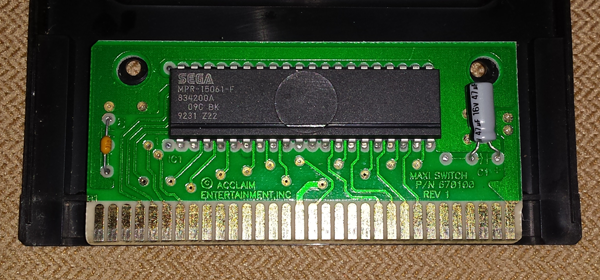
Well, it’s time to reveal what’s inside that curious, label-free Sega Genesis game I picked up at the flea market. About a dozen people put in their guesses across this site and various forums, suggesting everything from classics like M.U.S.H.A. and Castlevania Bloodlines to the nightmare of Revolution X.

The bad news: the game would not play. No amount of cleaning seemed to help it, and so it robbed me of the chance to uncover the mystery by plugging it into my Genesis, showing it on my TV, and getting mocked for the aspect ratio and improper resolution.

Fortunately, there are other ways of identifying a game. I’ll just open up the cartridge and check the MPR code.


There we go. And the mystery game is…

Flea Market Watch: The Mystery Game

If there’s one thing I miss about my hometown of Dayton, it’s the flea markets. At least three decent ones lie within pleasant driving distance of the city, and I always enjoyed checking them out on the weekends. But then I moved to a stretch of New York where finding a flea market requires a daunting trip to New Jersey, Long Island, or the upstate wilderness. Poor me.

Last weekend sent me up to the Dutchess Marketplace in Fishkill, and it was worth the hour-long drive. It’s hardly the biggest flea market I’ve seen, but it has a decent outdoor rummage-sale area and a spread of fancier indoor booths. Of course, flea-market parlance defines “fancier” as “merchandise actually in bins instead of just strewn across the cold concrete” but both can lead to good deals.

I’m not as adept of a bargain hunter as, say, Dinosaur Dracula and The Sexy Armpit are on their flea market forays, but I think I did well for myself. I bought only video games this time, and the current state of game collecting is so overinflated that it’s a bargain to walk away with anything notable for under ten dollars. And I spent nine.


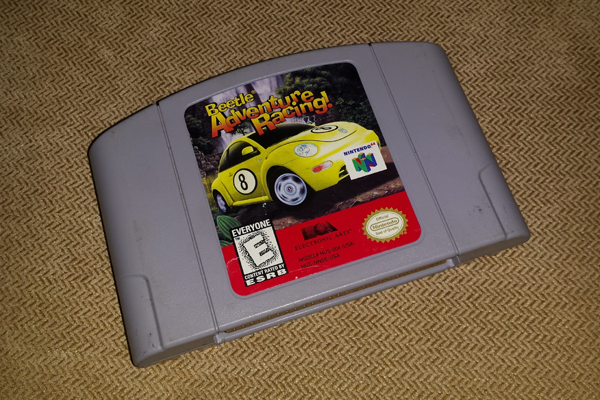
BEETLE ADVENTURE RACING 
Cost: $5

I can’t say this was a huge steal, as five bucks hovers not far below the eBay standard. It is, however, one of the best racing games on the Nintendo 64. It’s also a solid substitute for Mario Kart 64, which I hope to one day nab below the ridiculous going rate. There are millions of Mario Kart 64s around, after all.

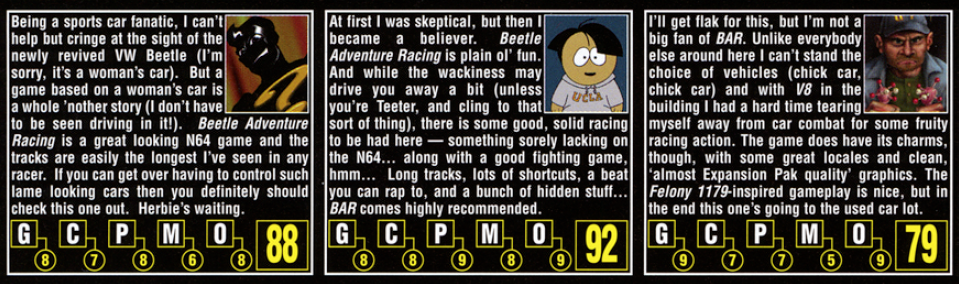
So Beetle Adventure Racing is a good buy with its colorful tracks and four-player mode. It’d been on my mind ever since someone uncovered the lost April 1999 issue of GameFan magazine. This isn’t the first generation of GameFan (1992-1997), mind you. It’s from the second generation of GameFan (1998-2000), which changed its tone and only carried over a few of the staff. What did GameFan think of Beetle Adventure Racing? Most of the reviewers liked it, but…


Man, I sure hated the second generation of GameFan. Moving on...

Trouble Shooter Travails and Game Collecting

Buying old video games is ridiculous in this day and age. It wasn’t so long ago that cheap, unwanted cartridges littered garage sales, thrift shops, and any retro-game store brave enough to exist. Yet video games fell into the deep and inescapable swamp of being collectible, and anything less common than a Sega Genesis sports title spiked in price. Ten years back, NES games like Metal Storm and Kick Master might have sat in flea markets bin with a “$5 EACH OR THREE FOR $12” sign protruding from rows of obsolete plastic. Today they’re considered bargains if they stay under a hundred bucks for just the bare cartridge. And if you want the box and instructions, I have some bad news for you.

I considered myself lucky, however. I collected old games in the late 1990s and early 2000s, when Goodwill sold NES cartridges for two bucks apiece and people would throw 32X systems in the garbage when Electronics Boutique refused to take them in trade. I sold most of my library when prices reached absurd levels, and I told myself that I’d done well and stayed sensible. I’d never paid more than $100 for a game, provided I didn't adjust old RPGs for inflation. More importantly, I got everything I wanted before the collecting scene turned psychotic.

Well, almost everything.

Trouble Shooter, aka Battle Mania, is one of my favorite series, if two games constitute a series. I’ve written about their appeal several times before, how their mix of solid side-view shooting and stylish comedy captures everything I like about silly ’80s anime. I bought the original Trouble Shooter when it was cheap, but I never could bring myself to pick up its Japan-only sequel, Battle Mania Daiginjou.


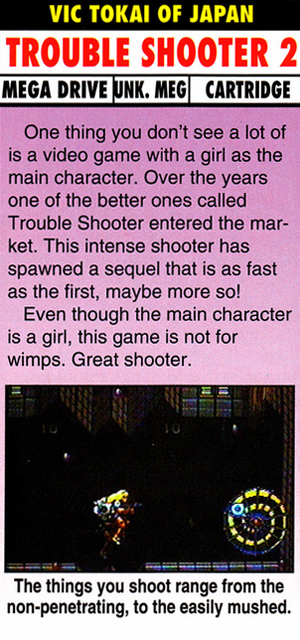
I wanted Daiginjou ever since a 1993 issue of EGM introduced it as Trouble Shooter 2 in a sexist writeup, but it was too expensive. By the time I started collecting games, Daiginjou went for over $150 on eBay, and I refused to spend that much on a single Genesis title (not even if I could call it a Mega Drive title, since it was from Japan). Of course, that was fifteen years ago, and like every other game more popular than Cyberball, it more than tripled in price. Buying Battle Mania Daiginjou is even dumber today than it was back in 2003.

So I bought it.

Ghost in the Live-Action Shell

I was prepared. The live-action Ghost in the Shell movie had middling reviews, irksome casting, and many other signs of mediocrity. I went to see it anyway.

Why? I’m highly susceptible to Ghost in the Shells. Mamoru Oshii’s movies and Masamune Shirow’s manga loomed large over my time as a teenage anime nerd, and only a small speck of my fondness for them stems from nostalgia. That speck would be the afternoon back in 1996 when I checked all over town for the original Ghost in the Shell film and eventually found a shelf full of it at Media Play, which had apparently looted every other video store. I miss Media Play.

On its own merits, the original Ghost in the Shell became a film I return to over and over like a kid rewatching Disney movies. It’s on my list of old reliables, right there with The Adventures of Baron Munchausen Watership Down, Mad Max: Fury Road, Dune, and, uh, Jason X. I’ll explain that last one someday.

So I was unafraid of wasting money and two hours on a potentially bad movie. It wouldn’t change the Ghost in the Shells that I liked, and it probably wouldn’t be the nadir of the whole series.


And I can say this much: the 2017 live-action film isn’t the most aggressively bad part of Ghost in the Shell history. Yet it could be the blandest. That might be worse.

The Curious Case of the PlayStation

You can judge a game system by how much unnecessary merchandise it inspires. The good ol’ NES had a market nearly to itself in the late 1980s, so companies swamped it with accessories: dust covers, rolling TV carts, turbo switches, eighteen different brands of cleaning kit, and even locks so concerned parents could control their Nintendo-addicted children. In contrast, you won’t find a great deal of third-party knickknacks for the Sega Saturn, the Atari Jaguar, or even the TurboGrafx-16.

The original Sony PlayStation was an obvious success by 1996, and ancillary goods appeared rapidly. Extension cables, boomerang-shaped controllers, and unreliable high-capacity memory cards weren’t necessary, but I found one specialized item helpful: a PlayStation game carrying case.

CD cases are commonplace even today, as the format slips into the digital ether, yet most of them are mere wallets that hold otherwise naked discs. In the 1990s, it was easier to find transporters that let you haul CDs still inside their jewel cases. Sure, they were bulky and held about 30 discs at their largest, but even the 15-CD models offered extra protection for your complete discographies of The Shaggs, New Radicals, Ursa Major, One Dove, The Pulsars, Young Marble Giants, Operation Ivy, The Grays, Leviathan, 4 Non Blondes, Kak, The La’s, David and David, Mother Love Bone, and The Sex Pistols.


That’s the idea behind the PlayStation game carrier from Smart Pouch, which assumed that consumers would be more concerned about damage to $50 game discs than any scuffs incurred by that Spacehog album no one ever played past the first track.

Outwardly, the case sports a nondescript design, affixing the PlayStation logo to a pattern commonly seen on metal floors and pickup truck mats. It’s largely the same product as a tote for regular music CDs, but there’s one key difference inside.

Blaster Master: All About Eve

Comeback attempts are a big part of Blaster Master. Sunsoft’s original game is a near-classic of the NES library for two things: mixing side-view gameplay with overhead on-foot stages, and having a storyline wherein teenager Jason follows his pet frog down a hole and ends up driving a high-tech combat tank in a world of hostile mutants. That's how most remember it, too. No matter how many sequels or remakes Sunsoft attempts, Blaster Master always comes back to the frog.


The series returns yet again with Blaster Master Zero this week. It remakes the original game with new visual flourishes and gameplay, overseen by the throwback specialists at Inti Creates (Mega Man 9 and 10, Azure Striker Gunvolt). The trailer makes sure to exhibit catchy revamped music, sharp graphics, and my favorite part of Blaster Master: a mysterious woman named Eve.

To tell the truth, it’s not Eve herself that I like so much. It’s the way Sunsoft adopted her from the Worlds of Power book based on Blaster Master.

Altered Banner

Yes, the site has a new header image. I stuck with a simple one for years on end, but I grew jealous of other sites with big, fancy logos that proclaim their nerdery outright. The new spread comes from the artist known as Bratwurst, so please check out his Tumblr and badger him into updating it.

This won’t be the only change to the website. You may see some advertisements here in the near future. I know they can grate, but this site needs to pay for its own keep. While it’s currently running for free on Blogger, I still buy hosting for the domain and server, and I’d like to move things back to a more independent platform. I don’t miss the days of coding everything in HTML and having no comments section, but I do miss having a website that stood on its own.

Anyway, new banner. It’s full of things I’ve written about over the years. Even the two human figures pay tribute to my favorite action-RPGs in their hairstyles, and my hat goes off to anyone who can pick out the references. I left a lot of the characters represented there up to Bratwurst, though Rygarfield’s inclusion is all my fault.

Of course, the banner evokes Altered Beast, Sega’s silly 1989 Greek-werewolf action game, more than anything. This may make me a hypocrite and poseur, because I’m not a huge fan of Altered Beast.


I like the aesthetic of the ruins and all, but I’ve never had a strong connection to Altered Beast. I grew up a Nintendo kid who didn’t go nuts for any Sega series beyond Panzer Dragoon and Phantasy Star, and I didn’t get a Genesis until the mid-1990s. That was well after Sonic had replaced Altered Beast as the system’s pack-in game and everyone had forgotten about it.

By the time I played it, Altered Beast was just an old curiosity, worth playing just to snicker at the grotesque monsters and the homoerotic bellows of “Power Up” as the centurion hero bulks up into an Athenian lycanthrope. If you asked me to name my favorite Sega games, Altered Beast would be way down there below Arrow Flash but probably above the version of Fighter Vipers that doesn’t have Pepsiman.

But if I’m going to borrow Altered Beast’s aesthetic, I should find its best side.

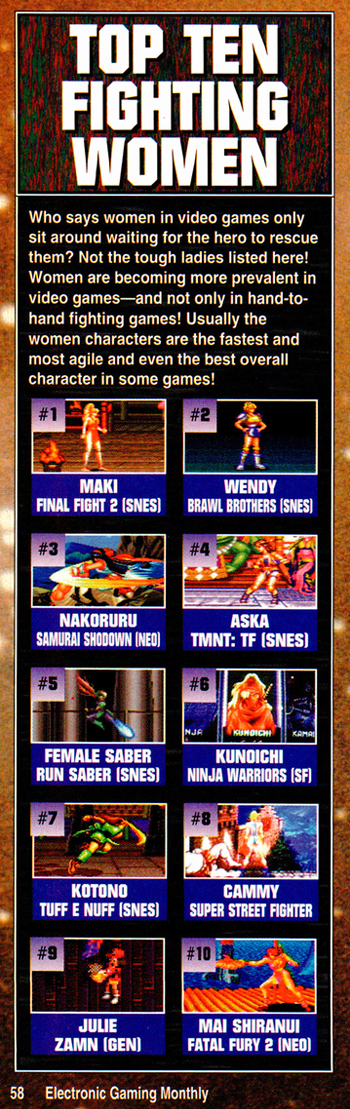
EGM's Fighting Women of 1993: Where Are They Now?

It’s too easy to pick on old issues of Electronic Gaming Monthly. By the early 1990s it might have been North America’s biggest multi-format game magazine in both its influence and page count, but it was slapdash, leaping from game to game without a consistent voice or memorable writing style. Competitors like Nintendo Power and GamePro might have skewed younger and narrower, but they were consistent in tone and editing. They knew what they wanted to be. Poor EGM often had the awkward patina of a high-school newspaper.

Yet even the sloppiest early-90s EGM is fascinating to me. It documents a long-gone era in its scattershot coverage, its reader-sent “What-if” jokes, and its envelope art galleries full of Mortal Kombat characters killing Barney or Beavis and Butthead. With time and maturity on our side, we can enjoy ancient EGM as an amusing window into a time when just about every game wanted to be Street Fighter or Sonic the Hedgehog and no one dug very deep into anything.

For example, observe “The Top Ten Fighting Women” from the December 1993 issue of Electronic Gaming Monthly.


When halfheartedly tackling the game industry’s endemic sexism, EGM opted for the old comic-book approach: it’s fine for a woman to be sexualized and shallowly written just as long as she kicks ass. Who says women only sit around waiting for the hero to rescue them? They also stand around waiting for the all-important male gaze to wash over them! Well, at least it’s better than the magazine’s Hottest Game Babes feature, which I apparently wrote about here almost fifteen years ago. I must’ve been an embryo.

Most of the characters here did not become industry icons, but that’s OK. Let’s see if I can find nice things to say about them all.

Unholy Night: Fight Like It's 1995

My parents warned me when I asked for a Super NES back in 1991. It was a scam, they told me. Nintendo would quit making games for the Super NES in a few years, they said, and then I'd just have to buy another expensive console. Well, mom and dad, you were right about the general practices of the consumer electronics industry, but you were wrong about one point: somebody’s still making games for the Super NES.


Of course, the Super NES and other long-dormant game systems live on today through independent creators, not large companies and familiar series. Even so, Unholy Night: The Darkness Hunter has a pedigree. The developer, Foxbat, includes veterans from SNK's Neo Geo fighters and Eolith’s little-seen 2004 arcade release Chaos Breaker. However, their new fighting game is devoted to the Super NES, and they even began a Kickstarter to fund a run of actual cartridges.


Unholy Night is a throwback in its choice of console, but in many ways it’s a collection of every fighting game staple modern and distant. And those aren’t necessarily inventive or accomplished ways. The swordsman Blaze, ostensibly the hero, has weirdly oversized hands, and the knight called Reinhardt appears to wear his armored gown at nipple-height. The other fighters are less oddly drawn but no less cliché. We have a knife-packing maid named April, an older fencer named Chronos, and Nightmare, a woman who wields dark magic and wears even less than the half-naked werewolf.

Trouble Shooter's Third Strike

It’s a good time to be a fan of Trouble Shooter. Or Battle Mania. Or whatever you might call the two comedic Sega Genesis shooters that put heavily armed heroines named Madison and Crystal in a blend of Forgotten Worlds and Dirty Pair. I am a fan, because I know of no other game that drops you into a giant claw machine so you can fight a farting pig robot.


Hardcore Gaming 101 recently put up an entry on the series, and it covers the first game, which we knew here as Trouble Shooter, and the second game, which we never saw here and thus knew only by its Japanese title, Battle Mania Daiginjou. The article also mentions Madison and Crystal’s cameo in Segagaga. Of course, they would go by their Japanese names, Mania Ohtorii and Maria Haneda, respectively. I would be annoyed at having to explain that every time I talk about Trouble Shooter, but I like talking about Trouble Shooter too much.

The big attraction in the article is a set of design documents for the never-made third game in the series, Battle Mania N.Y. Gankutsujou. The scans come from the fourth volume of Nazo no Game Makyou, which printed them small and in black-and-white. I bought this very issue about a month ago, but I dragged my feet on scanning it, restrained by that new-purchase aura that congeals when you spend twenty bucks on a little book about old video games. Fortunately, Hardcore Gaming 101 stepped up and scanned them as nicely as possible, considering that the original images were only slightly larger than Wheat Thins.

Those design documents show what could’ve been an amazing game. You can check out the entire set at Hardcore Gaming 101, but I picked out my favorite things from this game that never was.


Gravity Rush 2 Contest Results

Well, the Gravity Rush 2 Contest turned out much better than I expected. I had seven whole entries from four different people! And they were pretty good!


The winning entry came from Craig G, who cut mercilessly deep with the above revelation. Even so, Gravity Rush lets Kat throw enemy soldiers and average citizens off the edges of floating islands, allowing them to plummet into an ominous void. Perhaps she really is evil after all.

But that wasn't the only good entry I received! Check out the others!

Rental Stickers: An eBay Tour

I recently grew fascinated with those rental stickers often seen on old VHS tapes, DVDs, and video games. For many they're an annoyance, a sign that you're getting something that was digested and regurgitated by a hundred VCRs or Nintendo decks. But I like them.

This stems from my ongoing effort to buy fewer old games. Instead, I just look at them on eBay, where odd labels and faded warning tags only give cartridges and discs more personality. You’ll see hundreds of auctions for NES games at any given time, but only one might be from a long-gone Hastings Entertainment in Aurora, Colorado. A game assumes a greater place in history when it carries an old rental-store emblem. It’s not just a battered cartridge; it’s a memento from an age when Blockbuster Videos were as numerous as Burger Kings and renting a game was a blessed alternative to spending months of allowance on Brawl Brothers or Valis III.
 
I picked out a handful of intriguing (to me, anyway) ex-rental games from eBay, avoiding the more commonplace remnants of Blockbuster and Hollywood Video. There’s a little story in each one of these.


VIDEO EZY'S LAST BATTLE
Seller: 8bitlives (ended)

I love it when something wears its past in price tags. This Last Battle cartridge served its time at Video Ezy, an Australian chain that apparently survived the rental crash by embracing kiosks. Games were five bucks a week (which is about $3.50 in my native currency), and I’m sure a bunch of early Sega Genesis/Mega Drive owners got their fill of repetitively punching and kicking post-apocalyptic thugs. No, Last Battle isn’t a very good game. It was a Fist of the North Star title in Japan, but Sega excised the exploding heads, rampant blood, and manga-anime license for tender Western sensibilities, and what remained wasn’t very interesting.

No longer a hot renter, Last Battle ended up in the sales bin for about twenty bucks. And because that’s too much for a mediocre Mad Max knockoff, Video Ezy slashed the price below ten dollars. Someone nabbed it at that point, though I hope they held out for a buy-two-get-one-free offer and got, say, Forgotten Worlds and Truxton in the bargain.

Little Things: Legacy of the Wizard

In my last Little Things, I forgot to mention other small details that I like about Legacy of the Wizard. For example, I like the portrait that the family of playable heroes has on their wall.


There's a lot to enjoy on this screen, which presents the Worzen clan in their domestic forms and shows them transforming into fantasy archetypes once selected by the player. The best is Pochi, the dog who is really a grumpy dino-dragon creature.

However, my favorite piece of their home is that portrait on the wall. It supposedly depicts the bearded and bald ancestor who once sealed away the ancient dragon that the family must now defeat, but that picture also looks like a parrot.


Little Things: The Falcom Bounce

Video games diverge when it comes to falling. A harsh, semi-realistic adventure like Dark Souls shows no mercy to anyone who drops too far a distance. A cute side-scroller like Super Mario Bros. 3 or Dino City lets you plummet from great heights unharmed, provided there’s a place to land and you’re not just tumbling into a bottomless pit. There’s not much to it: if you fall, you either take damage or walk away cartoonishly unscathed.

Some games from Falcom put a little more thought into this. Characters don’t just fall. They bounce.

A good example appears in Legacy of the Wizard for the NES. It’s technically part of Falcom’s Dragon Slayer series, and it sends an adventurous family (and their pet) through a ludicrously complex maze. The gameplay resembles a side-scroller, so the members of the clan can jump, climb ladders, and, of course, fall from great heights.


Observe this example with Pochi, the family’s loyal monster pet. I’m using him because he's a dog in the family portrait and a dino-dragon in the game and therefore the best character.

Gravity Rush Now Even More of a Cartoon

Gravity Rush 2 is little under a month away, and I prefer to pretend it’s already here. I’m running a Gravity Rush contest for a few more days, and I’m busy playing the demo that went up on the PlayStation Network last week. And just today, Sony released the two-part Gravity Rush: The Animation – Overture. Sure, you can watch it for free on Sony’s YouTube Channel, but why do that when instead you can read my opinion of it?

Or maybe I'll just use a picture.


A bridge between the first game and the sequel, Overture answers at least one important question about Gravity Rush: what do the characters like to eat?

Yes, it goes all of two minutes before trotting out a harmless but tiresome cliché: the heroine flying into a violent fury when a precious, newly acquired snack is destroyed. Floating around a market, Kat buys a kabob, loses it, and trashes bug-eyed Nevi shadow creatures, whereupon Raven, her less cheerful rival, shows up and lends a hand. This occupies half of Overture’s running time.

The second half jumps back a short while and finds Kat and Raven eating snacks (of course) and discussing a recent spate of disappearances in their home city of Hekseville. They’re suddenly sent to a mysterious floating island where a HAL-like computer holds children hostage in little power cels. Two half-masked, mummy-like antagonists appear, and then everyone ends up warped to the strange new city we’ll see in Gravity Rush 2.

Overture is an enjoyable gap-filler, all things considered. I can't imagine it swaying those with no interest whatsoever in Gravity Rush, but it brings up the game's best points. The animation is vibrant and mostly fluid, capturing the details of the floating city and Kat’s bubbly personality—which fortunately develops beyond “I like to eat” in the second half. It also keeps the fictional language from the games, as the characters all use the same melodious semi-French, semi-Japanese tone (in which Kat and Raven’s names sound the same as they do in English). I’m a sucker for made-up languages. I’d watch Barb Wire if everyone talked like they were speaking Italian and Swahili backwards.

 Short as it is, Overture stokes my Gravity Rush 2 interest, which was, of course, crazily high already. I’m gonna go play the demo another dozen times.

The Best of Anime...Music

America’s anime fans were pretty busy in the late 1990s. We weren't satisfied just watching Robotech reruns on Toonami; we fervently devoured favorite series, wrote letters to keep Sailor Moon on the air, and went to conventions in numbers previously unseen. We also spent lots of money on anime and its ancillary merchandise. So great was our hunger that some of us thought it a momentous privilege to pay thirty bucks for the imported soundtrack to a movie or series we enjoyed.

In that light, The Best of Anime seemed like a great deal. Rhino Records released it in 1998 at the same price as a new album from Weezer or Neutral Milk Hotel, and it promised us anime's greatest music of all time. Within limits, of course.


The Best of Anime aimed itself as much at new fans as it did at old-timers, and it shows in the cover choices. The CD comes with an illustration of either Cutey Honey or Speed Racer, and the art itself is a thin cel-like sheet posed before the booklet’s cover image of a Silent Mobius cityscape. I was a teenage boy at the time, and despite Speed Racer’s ironic cred, I went with the Cutey Honey cover. And then I tucked the cel inside the booklet before anyone could see it on my shelf.

Despite the title, this isn't an authoritative collection of the finest music spawned in Japan’s animation circuit. If it were, it’d have the Orguss 02 opening.

No, this is less a Top-40 countdown and more an educational sampling from three decades of popular anime series, and it might be more accurate to call it The Best of Anime That We Could Afford to License. It’s helped by some nice liner notes from Fred Patten, who introduces each series and explains just how it fits into the broader vein of anime. He also provides a brief rundown of just how certain shows and the attendant fandom took off in America—starting with an anecdote about the heroine of Brave Raideen kicking an enemy soldier in the crotch.

And the songs themselves? The Best of Anime is a hodgepodge of corny opening tunes and disposable puffery surrounding a few genuinely good numbers. In other words, it’s a perfect encapsulation of anime music.

Notes on Gravity Rush 2

Gravity Rush 2 was delayed, and I needed to compensate somehow. Sony wasn’t diplomatic about their reasons, either. Both Final Fantasy XV and The Last Guardian are shipping in late November or early December, and those games would bury Gravity Rush 2 and bury it deep. The solution? It’s now coming January 17. That way Resident Evil 7 and Tales of Berseria can bury it.

Without any chance to buy Gravity Rush 2 this year, I decided to buy something related to Gravity Rush 2. I went to eBay and looked for the cheapest possible fix.


I found this, an apple-shaped Gravity Rush 2 notepad. Apparently given away at conventions, it’s pretty much the only promotional trinket I’ve seen for the game. It’s about the size of a standard Post-It pad, and it was only 99 cents. That wasn’t bad, even if buying it would mean that I spent money on blank pieces of paper somehow connected to Gravity Rush 2.

Good thing there’s a surprise within.

The Tale of a TurboGrafx

What was the first thing you bought on eBay?

It’s an inane question, but I expect it’ll come up more and more often as the decades lurch onward and turn us nostalgic about every microscopic detail we recall from our younger years, whether it’s the first Star Wars figure you got or the LeMenu microwave dinner plate that your family reused almost every night for fifteen years. It doesn’t matter what it is as long as you remember it.

In that light, it’s not hard to find some appeal for the early years of eBay. The website’s still around and will be as long as the Internet exists, but it was a different creature in the late 1990s, when just about everything online was more suspicious. Auctions didn’t need images, sellers and buyers were on even ground when it came to feedback, and PayPal was largely unknown. You might find yourself wondering if that Gundam model or old Arby’s kids-meal toy was really worth the trouble of getting a money order and mailing it off.


I first heard of eBay in 1998, but it was through a coworker who would interrupt conversations in the most awkward manner imaginable. He once accosted me in the store's video-game aisle just so he could point at Dead or Alive for the PlayStation and announce “this is the bounciest fighter.” When he mentioned eBay, I decided to stay away from it.

I didn’t stay away for long, and the next year I jumped into eBay. The first things I bought were not memorable: two Final Fantasy VII posters and an unopened Chun-Li figure from the G.I. Joe/Street Fighter cross-up of the early 1990s. The posters, which I now realize were bootlegs, stayed on my wall for only a month or so, and Chun-Li sat in a closet for a good decade until I sold her, still unopened, for about the same amount I’d paid.

My third purchase was the first important thing I bought on eBay: a TurboGrafx-16.


Fun with Mariner's Run and Loppy

Many canceled NES games exist only on paper, whether it’s a sheaf of old design documents, a press release, a magazine’s rumors section, or a bar napkin with DONKEY KONG FIGHTS GUNDAM scrawled on it. In some cases, having only a title makes a game all the more enticing, as we’re free to imagine what Vic Tokai’s Baby Gangster, LJN’s World War III, or Activision’s The Abyss might have been like had they shown up behind the glass at Kay-Bee. 

Yes, some unreleased NES games left behind only their titles and vague descriptions. Until last month, I thought Mariner’s Run was among them.

Mariner’s Run is the work of Vic Tokai, a company that’s fascinated me for a while—and not just because of my unabiding fondness for Trouble Shooter. Vic Tokai crafted intriguing games throughout the NES era, whether it was the early (and unreleased in the U.S.) action-RPG Chester Field, the complex adventure of Clash at Demonhead, the charming The Krion Conquest, or the Golgo 13 games, which might not be great but remain marvels of sneaking gruesome violence and bleak spy-pulp stories onto a game system where alcohol and crucifixes were verboten.

We find little information about Mariner’s Run, known as Sea Dog in Japan. It appeared in magazines early in 1991, and the manual for Magical Kids Doropie (aka The Krion Conquest) describes it as a "battle RPG" with a March 1991 release date. 

That was all I knew about the game, and it was all I needed to imagine the best possible NES treatment. I pictured a naval warfare epic in a post-apocalyptic or high-tech future, where you might roam the seas from an overhead perspective and fight intense battles from a first-person viewpoint. Kinda like SubRoc 3D crossed with a fun version of Silent Service.

I somehow neglected to notice that Mariner’s Run survived online in at least three screenshots, plus a Game Players blurb that describes it as “a game in the style of Ultima or Dragon Warrior” that “takes place in a land of seafaring towns.” And that’s enough to destroy my vision of the game.


Yet Mariner’s Run is more interesting now that I’ve seen it. The first screenshot shows the overhead RPG portion, and it's downright primitive for an NES game from 1991. Still, it’s enough to speculate as to which sprite is the main character (my bet is the blue-gray one) and what time period it wants to evoke.