Halloween Moods

I wanted to do this for a good while.


Over the past month, Dinosaur Dracula readers have posted Halloween Mood Tables of all sorts. I liked the idea, but I didn’t have that much in the way of Halloween decorations or scary movies. So I improvised with Darkstalkers stuff and Ghosts 'N Goblins, and I stretched the definition of just what a scary movie means (I even used Titanic: The Animated Movie, which is scary in several ways). Here’s a less moody version if you want a better look at the accessories!

Happy Halloween, folks! Play Darkstalkers games if you got ‘em! And, uh, if you’re old enough.

Little Things: Ninja Combat

I remember it with perfect and disquieting clarity: a line from an early 1990s issue of GamePro. A writeup about a new arcade game stated “the all-girl round is imaginative, and it starts with a surprise that we can’t reveal here, but watch out! These women are MEAN!”

This evocation of feminine mystery must have lodged deep within my borderline-teenage brain, because it stayed with me long after I forgot even the title of the game it was talking about. I recalled only that it was some side-scrolling brawler, and the arcades of the 1990s practically used those to prop open doors and whack cockroaches. Well over a decade later, I remembered that curious phrase and finally figured out that it described Ninja Combat for the Neo Geo.


The second stage of Ninja Combat leads the player to a group of women menaced by the game’s generic ninja. They even call for help with a plaintive sound effect. And you, as the hero, clearly should rescue these women just as you would a kidnapped president.


Then comes the surprise. Once you advance, the terrified hostages reveal themselves to be disguised ninja women and attack you. I’m not sure why the Gamepro blurb connoted this as “mean,” but I'll say this much: it would have surprised my younger self. Hostages were a cliche in arcade games even back in 1991, but we were used to freeing them for bonus points, whether it was the children in Moonwalker or the stone-encased citizens of Black Tiger (all of whom were old men for some reason). It’s a tradition that lives on today in any arcade light-gun shooter where unfortunate civilians cringe and dash through zombie outbreaks or anti-terrorist firefights. These citizens are inevitably mowed down by unwary younger players, who learn that shooting the innocent costs soldiers or police officers only a chunk of life meter. Or a few weeks of paid leave until the investigation clears them.

Ninja Combat isn’t very good. It’s the sort of primitive arcade title that gave the Neo Geo a reputation for mediocre games costing $200 and lasting about forty-five minutes. Yet it’s not without some invention. Enemy mid-bosses become playable characters once defeated, the cutscenes have some hysterical acting, and the enemy ninja include such novelties as harpy ninja, fan ninja, and burly executioner ninja whose Klansman-like hoods weren’t changed to appease North American audiences.


Is there more to Ninja Combat's little joke about captive damsels in arcade brawlers? Is it subtly telling us that the concept of helpless, imperiled women pleading for rescue is an outdated and chauvinistic ideal, and that those who accept it do so to their ninja-swamped misfortune?

Probably not.

Rygarfield Returns

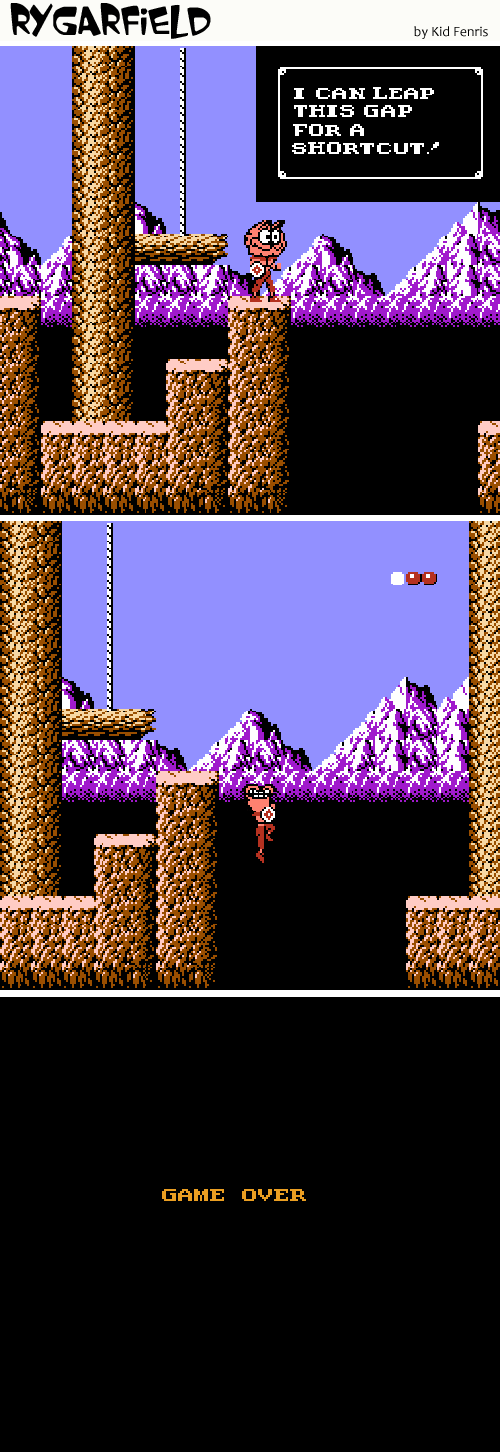
I'm afraid that Rygarfield has not yet emerged as this century’s hottest new comic strip. At first I didn’t know what the problem might be. It has everything kids like: video games, webcomics based on video games, and ironic Garfield humor. Then I realized what was wrong. Rygarfield had only one panel instead of the multi-panel format used by every good comic that isn't The Far Side!


Now Rygarfield is the complete work that it should have been at the start. It also delivers biting commentary about cats and the marginal secrets of old NES games. It's like Howard and Nester meets Heathcliff!

Good Box Art: Advance Wars

Remember when I used to write about awful box art? Well, I actually updated the old gallery with an entry on Wing of Alnam. Lots of people discuss bizarre game cover illustrations these days, but as far as I can tell, nobody's taken a crack at this one just yet. Besides, I enjoy pretending that the last ten years haven’t happened.

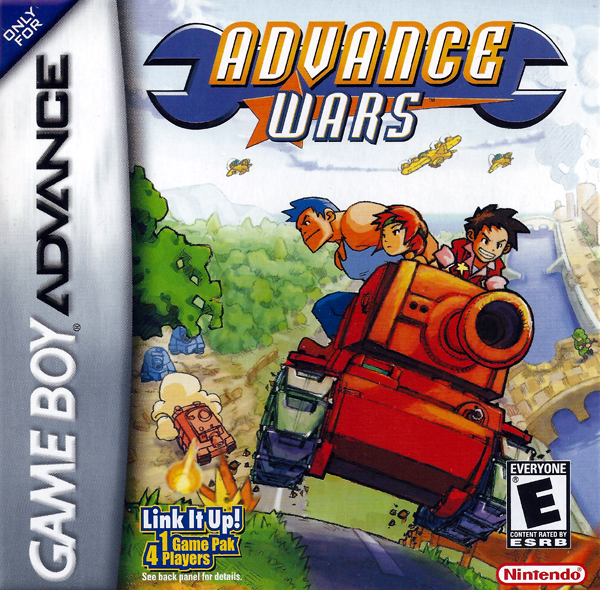
I also want to highlight good box art—the stuff that sells a game better than any panting laudatory quotes or pre-order gadgetry ever could. I’ll start, in no way alphabetically, with Intelligent Systems and Nintendo’s original Advance Wars.


Advance Wars is a game of jovial strategy, a game where little rounded helicopters and puttering tanks and squat, rifle-toting troops clash in big colorful battlefields. And the cover illustration captures it perfectly. Three young heroes commandeer a tank and rush into battle with such energy that the treads lift off the churned concrete. Andy, an Orange Star officer, mans the controls with a maniacal cartoon grin. It’s all a good taste of what’s inside Advance Wars.

Yet Advance Wars, like many outwardly cute video games, is rather depressing when you think about it too hard. The most disposable pieces of any Advance army, as Andore Jr. eloquently points out, are the humble soldiers in your basic infantry units, and at least a few of them are guaranteed death every time they rise to attack or defend. Advance Wars may be precious and gleeful, but it’s still about wars.

This brings me to my favorite part of the cover. Andy may brim with gusto as he guns that tank toward victory, but his companions don’t. Max wears a look of grim caution, while Sami stares numbly before her. Because they know.

Darkstalkers Redirection

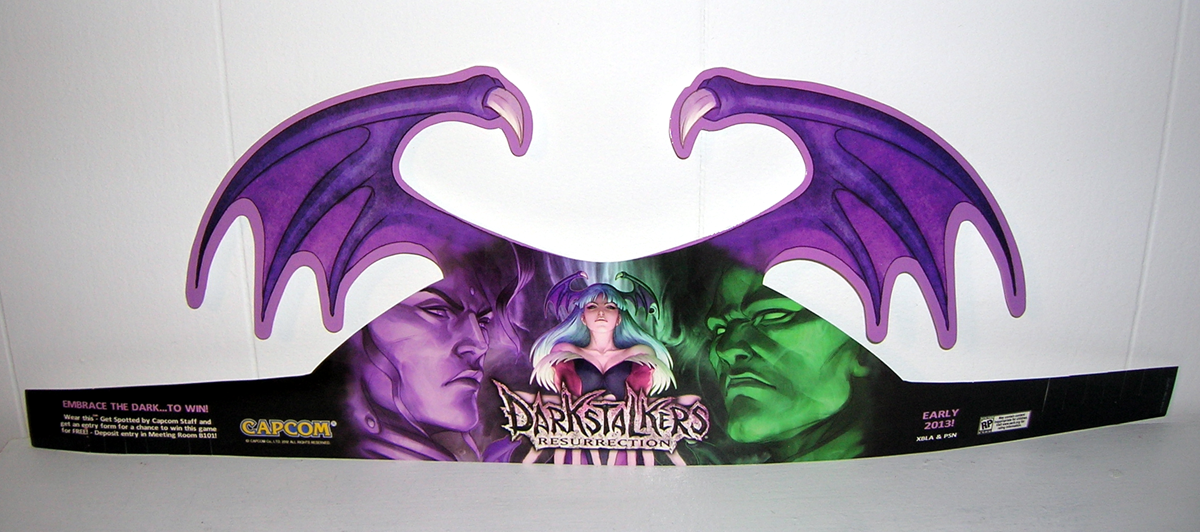
Sometimes I have to ask myself why I have a set of Darkstalkers novelty head-wings. The answer is complicated.


It’s exactly what it looks like: a promotional Darkstalkers Resurrection band that you can wrap around your head like a Burger King crown. The bat-wings imitate the headgear of Morrigan, as she’s the focus of the Resurrection art and the main character of the series. Darkstalkers is notable in that respect. Street Fighter and Guilty Gear and Tekken and most other major fighting games deem men their iconic leads, but Darkstalkers has Morrigan. I suspect that's because she usually looks ready to spill out of her demon-lady costume if someone so much as pats her on the back, but hey, small victories.

Capcom gave away these bat-crowns at conventions back in 2012. They had just announced Darkstalkers Resurrection, a collection of the two best games in Capcom’s monster-fighter series, and so they put together a large booth for the game. It was a fine time to like Darkstalkers, as I certainly do. Resurrection was a great repackaging of the series, and Capcom strongly implied that they’d make an all-new Darkstalkers if the reissue did well enough.


A little blot of dread grew in me. As excited as I was at the promise of a new Darkstalkers, I suspected that Resurrection wouldn’t do so well and that Capcom wouldn’t make much Darkstalkers merchandise beyond this little strip of paper that looks vaguely like a crab's maw if you view it from behind. So I resolved to save mine. I made sure I that I got it home in one piece, and I didn’t try wearing it at the convention, even though that would’ve given me a shot at winning a free download of Resurrection (I was content to buy the game twice, once on Xbox Live and again on the PlayStation Network). I would not tarnish so wonderful an artifact with my slovenly nerd-brow.

I was right. Horribly, horribly right. Resurrection didn't sell nearly well enough to begin a new golden age of Darkstalkers, and Street Fighter producer Yoshinori Ono, who for years claimed “Darkstalkers are not dead,” is now a shade more taciturn about the subject. Yet Capcom still keeps Darkstalkers alive with artbooks, this poster set, and suggestively posed Morrigan statues that I wouldn’t put on my shelf. So the series will survive as long as fans lurk in the wastelands of Resurrection’s online lobbies or needlessly remind people that Morrigan is a succubus and not a vampire. They’re keeping the faith, and so am I.

Drakengard 3: Four

Drakengard 3 arrived last month. It’s a very strange game, abusive and self-mocking and technically graceless. It’s a monster that won me over in ways I never expected. It’s a lot of things, but it’s most clearly a portrait of Zero, a goddess-like Intoner who goes around a twisted medieval Europe and murders her deified sisters with a mixture of vicious abandon and blasé cruelty. I’ve talked at length about just what Drakengard 3 did to me, and it’s time for an addendum about one of the game’s more interesting characters. She’s not who you might think.

Four is the least threatening among Zero’s numerically named sisters, all of whom decided to rule the world and rather rudely didn't invite Zero. We meet them when Zero attacks their city stronghold. One is the rational leader, Two is cheerful, Three is spookily distracted, and Five is hedonistic to no end. Four seems the most reluctant to fight; during an initial free-for-all with Zero, Four pleads for her sister to reconsider such violent rebellion. Later in the game, Four is the second victim in Zero’s conveniently numbered murder spree. En route to a mountain fortress, Zero tells her companions that Four is an uptight virgin and that “deep down, she’s evil.”


If Four’s evil, we don’t see it in the prime stretch of Drakengard 3. Upon confronting Zero, Four again begs her to stop and proclaims how highly she thinks of the murderous Intoner. So great is Four’s faith in her sister that she’s even willing to fall for a blatant and deadly ruse. Later, as the game’s timeline unravels into chaos and paradoxes, Four reappears as a lunatic, driven mad by the ominous floral entity that birthed all of the Intoners. She’s a piteous sacrifice, hiding in poorly concocted innocence and a mess of happy, Zero-centered memories that aren’t even real.

For a look into Four’s true depths, one must venture beyond the central game. The short stories available on the Drakengard 3 website introduce Four as a teetering stack of neuroses. Traveling with her sisters (minus Zero), Four worries about her sibling Intoners, mends their clothes, tries to keep a borrowed house clean…and then explodes into a room-wrecking fury and seethes with hate for her family. And herself most of all.

Dark Matters

[The following article discusses rape and other forms of sexual assault as they are depicted in video games. Please avoid reading further if this subject upsets you.]

Video games seldom take a responsible tone when addressing rape. It’s rare to see a title acknowledge sexual assault as anything more than an exploitative dash, a cheap, nasty surprise for a vulnerable and usually female character. It’s a brilliant package deal for the careless writer beleaguered with demands for maturity. What better way to paint a villain as instantly loathsome, stoke the player’s righteous fury, and elevate your game above the childish superficialities of past eras! After all, trashy films, sleazy anime, and execrable comics with titles like Stormfang Saga do it, so why shouldn't video games?

The latest such attempt is in Metal Gear Solid V: Ground Zeroes. It drops the elder of the saga’s two Snake operatives into a secret American military compound, from which he must rescue operatives Paz and Chico. Along the way, the player can uncover recordings of the game’s villain, Skullface, torturing the prisoners. Both Paz and Chico are raped. Chico is forced to rape Paz. The audio log concludes with Skullface and his surgeon planting two explosive devices in Paz—the second one apparently hidden in her vagina. Should you doubt this, the scene provides the squelching, visceral sounds of a bomb going somewhere it probably shouldn’t.


This may be the most horrifying of Metal Gear creator Hideo Kojima’s uses of rape, but it sure isn’t the first. The original Metal Gear Solid strongly implies that Meryl is sexually assaulted during Revolver Ocelot’s torture sequence, the second game finds once-laughable nerd Otacon confessing that his stepmother raped him, the third has some disturbing notes about undercover agent Eva, and Metal Gear Solid 4 luridly mixes sexuality and trauma into The Beauty and the Beast Corps. The entire Metal Gear Solid web weaves together grim realities and goofy fourth-wall assaults, and Kojima’s infusion of radio-drama rape and vagina disploda is both, entwining the absurd and the horrific.

Kojima is no lone provocateur. Numerous other games trot out rape scenes with all the care of a backhandedly misogynistic romance novel, a torture-porn flick, or the Raveonettes’ “Boys Who Rape (Should All Be Destroyed).” You can find it callously applied in Heavy Rain’s TV-movie interludes, F.E.A.R. 2’s finale, and just about any game where a female character’s backstory boils down to “she was raped” and little else.
Is that all video games can do? Do any of them treat the subject with a modicum of respect?


Introducing Rygarfield

You know what’s wrong with webcomics? They just don't have broad appeal. Name any webcomic, and you can find a great mass of people who hate it or, worse yet, ignore it.

Fortunately, I have devised a new project to scale magnificent heights in online comedy and profit. It is a webcomic that no one could shun, a webcomic that fuses the Internet’s boundless affection for old video games with the proven success of one of the past century’s most marketable characters. I call it Rygarfield.


Rygarfield is available for syndication, merchandising, and whatever funding you might care to send me. Feel free to make ROM hacks and memes about Rygarfield, so long as you credit me and pay me royalties. And if anyone points out that Rygarfield is a blatant arrogation of copyrighted material, tell them it’s OK under the doctrine of fair use. Just don’t tell them to look up what the doctrine of fair use actually means.

Be sure to check back for regular Rygarfield comics about sarcasm, dog abuse, and that weird, unreachable door in the water just above Dorago's lair!

Off-Kilter Instinct

I’d like to talk about Killer Instinct and B. Orchid. Really.

I admire Killer Instinct in a strange historical capacity. It’s not the reluctant fondness I have for the considerably trashier BloodStorm. It’s more of a distant appreciation for the way the original Killer Instinct summarizes all of the trends that video games toyed with in the mid-1990s. It’s a fighting game, of course, and it has plastic-looking computer-rendered graphics, profuse guitar licks, comical violence, preposterous sexism, an announcer squawking excitedly about BLASTER COMBOS, and a lineup of stereotypes exploiting everything from the Predator to Jurassic Park. And all of this came from Nintendo, who by then was sick and tired of Sega pretending to be the more daring game-industry titan.

If you want to experience a good game from 1995, play Chrono Trigger, Full Throttle, Panzer Dragoon, or Metal Warriors. If you want to experience what most games were really like in 1995, play Killer Instinct.

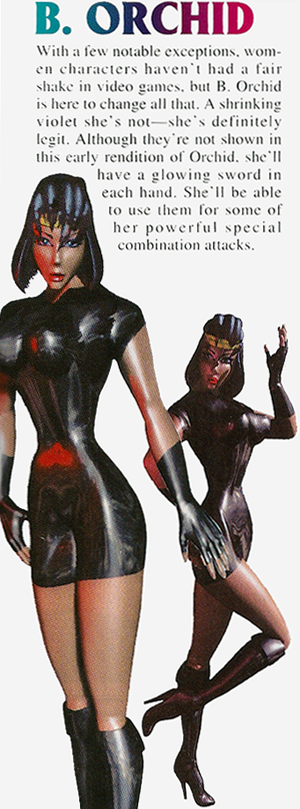
B. Orchid is part of that, of course. Her design is an amalgamation of every unfortunate stereotype inflicted on women by that decade’s video games. She gallivants around in a skin-tight suit with “HOT” on the side, moans provocatively during her post-fight footage, and, for a “No Mercy” move, whips open her top and shocks her male opponents into cardiac arrest. Yet there was a time when people were hopeful about B. Orchid.


The above profile comes from a 1994 issue of Nintendo Power. I can sympathize with the writer who had to find good things to say about Orchid, looking as she does like some hideous 1960s Eastern European knockoff of a Barbie doll. In a bout of vague optimism, Nintendo Power suggests that Orchid will change the way female characters are portrayed in video games. In hindsight, the kindest view of Orchid is that she didn’t influence such depictions one way or the other, that she was a symptom and not a catalyst.

Little Things: Kid Kool

Some mysteries are compelling not because they’re important, but because they’re so weirdly insignificant. For one example, consider the king’s butler in the awkward and rampantly detested Kid Kool and the Quest for the Seven Wonder Herbs. He's a miniscule oddity in a lousy old NES game, and that makes the enigma itch all the more.

Kid Kool’s interminable story sequences introduce only four characters: the ailing king, his butler, the titular Kid Kool, and, in the best endings, a princess. The butler doesn’t serve much of a purpose beyond rattling off the details of Kool’s herb-gathering mission and announcing the hero’s demise. The latter happens a lot in Kid Kool, because Kid Kool despises everyone who plays it.

But it isn't the butler's dialogue that's puzzling. It’s his appearance. His haircut, glasses, and snaggletoothed nerd visage clash with the King’s Garfield-like appearance and the mundane anime-kid design of Kool and the princess. And why do his shorts clearly say “T YAN”?


It all suggests that the butler is a caricature of someone, possibly this T. Yan individual. But who could that be?

The most obvious explanation would be that the butler is a leftover joke from Kid Kool’s original Japanese version, Kakefu-Kun no Jump Tengoku: Speed Tengoku. It was a vehicle for Kenji “Kakefu-kun” Sagara, a popular child actor in Japan during the late 1980s. Vic Tokai’s Americanization of the game replaced his Hanshin Tigers baseball cap with a spiky coiffure and changed his name to the less expensive Kid Kool, but the other characters were left alone. One clue crops up in the Japanese credits: the butler’s name is listed as “Dirty Echigoya.” It also lists the king’s name as Nioccory V of Poconioccory and his daughter as Josephine Nioccory, and I have no idea what that might mean.

Yet I think I know who T.Yan is.

The Wonderful Weirdos of Bangai-O

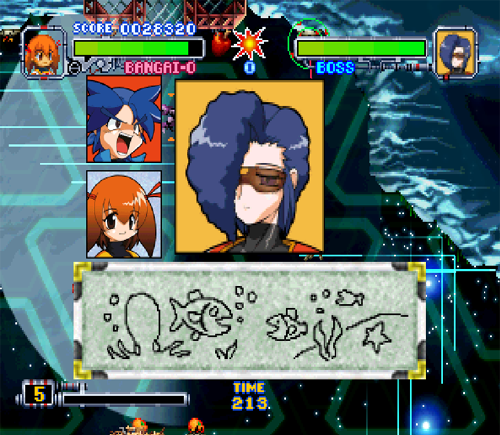
Treasure’s Bangai-O games are wondrous menageries of destruction. They drop tiny robots into zoomed-out stages and let them wreak havoc with lasers, baseball bats, grenades, and blinding storms of enough missiles to choke an Ichiro Itano dogfight. This brand of adorable chaos is easy enough to find. Bangai-O HD: Missile Fury is still on Xbox Live, and Bangai-O Spirits is pretty cheap among DS games. They’re both decent games, and yet they lack one endearing point of the original Bangai-O: nonsense-spouting bosses.

The dialogue is one of the best parts of Bangai-O, odd as that may be for a shooter with no real storyline. Robot-pilot siblings Riki and Mami get advice from a bored housewife and a medium who channels long-dead celebrities, and every stage caps off with some bizarre boss who pilots a rival mecha or sits in a computer core. In localizing the Dreamcast version of Bangai-O, Conspiracy Entertainment intentionally left the text unpolished. It reads like something fresh off a buggy, wheezing translation machine, and it suits Bangai-O perfectly.


Conspiracy even carried the tone over to the boss profiles in the manual. The rest of the booklet is fairly straight-faced about everything, but every boss gets a description rife with absurdity. My favorite is 86, the SF Kosmo Gang leader who communicates entirely through sketches.


The entire set of character profiles can be found here. Bangai-O fans will note that very little of this backstory ever sees mention in the game itself. For example, you’ll never learn about the heroic Yomeiri Masuke’s hit TV series unless you read the manual.

Several Dreamcast games made their way to modern systems in recent years, but they’re limited to Sega offerings like Sonic Adventure and Space Channel 5. I hope that Treasure, now pursuing Steam development, sees fit to reissue Bangai-O in its blithering Dreamcast glory. Perhaps they’ll include the manual, so that all who play it can appreciate things in full.


Yes, Riki. It really is.

Gravity Rush: Touched by the Hand of God

Gravity Rush is my favorite game from last year. It was the reason I bought a Vita, and it's the reason I still own a Vita. It gives a woman named Kat control over her personal gravity, and she slowly becomes a floating city's misunderstood resident superhero. The journey isn't entirely smooth for her or the player, but there's rarely a tepid moment. It’s incredibly fun just to mess with gravitational defiance, to send Kat hurtling across skyscrapers and racing along the underside of a metropolis that’s part Mobius comic, part Russian art deco. It’s a shame that the Vita’s limited success keeps Gravity Rush out of reach for many.

A certain part of Gravity Rush is troubling in one way or another. The game uses the Vita’s touch screen primarily for menus and one rather unnecessary sliding move, yet there’s a secret addition. If you touch Dusty, Kat’s pet cat and floating companion, he’ll disintegrate in a puff of smoke and re-materialize himself a second later. If you touch Kat, she’ll gasp in surprise and look around her.


Many of the Gravity Rush players who’ve noticed this assume that it’s some perverted joke, and they point out that Kat vaguely motions at her rear end as though to shield it. Sadly, this would fit with another unpleasant part of Gravity Rush. While the game takes the high road a good deal of the time, at least one scene subjects Kat to the sexualized nonsense that comic books often visit upon their heroines; a visitor catches her just after a shower, so she loses her towel and blushes. Haw haw. And since Kat’s an exceptionally likable and sympathetic heroine, this event grates even more than it would in a mediocre game. Gravity Rush, you are better than this.

But let’s give director Keiichiro Toyama and the Gravity Rush team the benefit of the doubt for a short while. Kat’s response is the same no matter where the player taps her, and her motions are identical to those she makes if she drifts too far from the city and warps back to safety. It suggests that she’s perplexed rather than harassed, or at least that the director left it purposefully vague.


Kat’s reaction is still disturbing, but for a much better reason. She’s felt the presence of some unseen entity, a being that exerts control over everything she does. Kat may be esteemed as the “Gravity Goddess” in her own world, but she now realizes that she isn’t the top of the pantheon. Unlike the player lending prayers to the final battle in Earthbound or fielding questions from the robot-girl of Wonder Project J2, there’s nothing comforting about Kat’s brush with her manipulator. She clearly doesn’t know what she experienced, only that it came from a place beyond everything she knows. As with all cases of omnipotent intercession, she can’t be sure it even happened.

Kat recovers quickly from her tinge of divine influence, and it leaves any reflection up to the player. Perhaps you, the meddlesome architect of Kat’s triumph and suffering alike, should feel bad about confusing her. You’ve dropped her off floating cities, crashed her into streets, and pressed her into service for both a scheming military and ungrateful citizens. Now you’re giving her existential tremors.


Dusty, on the other hand, doesn’t seem to care about otherworldly taunts or the fragile curtain of Gravity Rush's reality. He’s a cat, after all.

The Evils of Ys

Falcom’s enduring Ys series was quite busy this week. The Vita received Ys: Memories of Celceta, a pretty extensive and extensively pretty remake of the fourth game (or games, because Ys is strange like that) in this long-running line of action-RPGs. To commemorate this, XSEED discounted all of their PSP-based Ys games, including Ys Seven and fan-favorite Ys: The Oath in Felghana

It’s a darn good deal even if you’re not a huge fan of Ys. And I’m not. At least, not in the ways many people are. We’ll discuss that later.

In the thick of all this modern Ys news, the fan translation of Ys V: Kefin, the Lost City of Sand finally came to fruition. Ys V is a strange study. Though it’s not the most wayward entry in the series (that’d be the original Ys III: Wanderers from Ys), Ys V was controversial when it hit Japan late in 1995. The Ys series touched just about every major platform by the early 1990s, but it loomed largest on the PC Engine/TurboGrafx-16. That was where Ys games used new-fangled CD technology for impressively animated cutscenes and some downright gorgeous music. The first four Ys games received this treatment, and PC Engine/Turbo fans lauded them for it. Then Falcom, possibly wooed by the profusion of RPGs on the Super Famicom, decided to make the fifth Ys game a cartridge-based deal on Nintendo’s console.

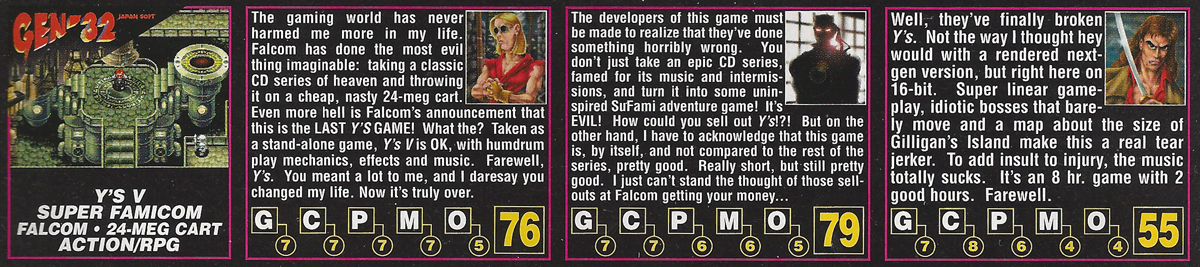
This did not sit well with the Ys faithful. In North America, much of the outrage was confined to pockets of fans, as Ys V was never localized and few magazines reviewed it. The exception was GameFan. Nick “Rox” Des Barres, Casey “Takuhi” Loe, and Dave “E. Storm” Halverson were ardent Ys followers, and they had much to say about Ys V’s direction.


GameFan’s review wasn’t my introduction to Ys, but it was my introduction to just what the series meant to people. Before this I’d known it only through the Super NES version of Ys III, and I had only a vague sense of how groundbreaking the early Ys games were in the way they looked and sounded. Nick's confession that Ys had changed his life and Takuhi's exclamations of “It’s EVIL! How could you sell out Ys?!” made more of an impact than pages of praise for classic Ys games.

The Five Greatest TurboGrafx-16 Games I Didn't Play

I never owned a TurboGrafx-16 during the system wars of the early 1990s. I doubt I was alone in this. The console was a constant third-placer in the market, and, to be honest, most of us didn’t want one that badly. Sega Genesis kids might’ve begged for a Super NES as their second system while Super NES kids begged just as doggedly for a Genesis, but the Turbo rarely entered the picture unless mom and dad spoiled you with three current game systems. Even when Toys R Us clearanced out the consoles for fifty bucks, I decided that a Super NES game was a better investment. I can't remember which game it was, possibly Alien 3 or Cybernator, but I preferred it to the poor ol' TurboGrafx.

No, I didn't have a TurboGrafx-16 back then. But I owned a TurboGrafx fold-out pamphlet, and for a little while that was almost as good. At some point in 1990, NEC reps showed off the console at the air-base commissary where my parents shopped, and I got to sample Bonk’s Adventure for a few minutes. My mother was adamant that I wouldn’t get a TurboGrafx, not when I’d just gotten an NES, but she couldn’t deny me some of the fine literature they were handing out.

A credible piece of marketing for adults and kids, the entire pamphlet is preserved at Chris Bieniek’s excellent Video Game Ephemera. The booklet does a good enough job of emphasizing the TurboGrafx’s capabilities while downplaying its negatives, such as the lone controller port or the asking price of the CD system. Yet the best part is the poster formed by the back of the entire booklet. It’s a huge panorama of TurboGrafx games presented like a slice of the Sears Wish Book and filled with adorably outdated taglines like “CD Challenge!” and “So-Real Sports!”

Some part of me must've known that I’d never get a TurboGrafx until nearly a decade later, when I paid an eBay charlatan twenty-five bucks for a stained system with a broken controller. The best I would get in 1990 was this free reading material, so I pored dreamily over the expanse of games. It didn’t take too long for me to pick out my favorites, the five ones I’d definitely try if ever I laid hands on a TurboGrafx of my own.

Now I can play them and measure them against my youthful expectations, and because I can’t leave well enough alone, I’m going to do just that.


R-TYPE
Then: In the dim, distant days when arcades still mattered, R-Type was a blockbuster, a shooter touchstone for anyone capable of grasping the intricacies of holding down a button to make an energy bullet larger. The booklet’s careful to show things any R-Type player would recognize: we all knew the hideous scorpion eye fetus from the end of the first level, and we knew those huge mechanical claws, the ones that looked like futuristic gynecological stirrups and always seemed ready to close in and crush unwary ships. They never did.  

R-Type was a highlight of the TurboGrafx-16’s first years. It replicated the arcade version very well, and it would stay an exclusive throughout the system wars. The Genesis never had an R-Type, and the Super NES had the slower, uglier Super R-Type and the superior-but-different R-Type III. NEC positioned their star prominently, and R-Type very nearly became the pack-in for the system instead of Keith Courage. No one really liked Keith Courage.  

Now: R-Type is still an enjoyable shooter, but the TurboGrafx port’s fallen behind the times. You can get nice, arcade-perfect R-Type very easily on modern systems, and the TurboGrafx version suffers from terrible flicker as the system tries to process a game it was never built to handle. In fact, you can see this in that larger screenshot—a good chunk of the player’s R-9 starfighter is missing. That bothered us a lot less twenty-three years ago.

Might Have Been: Golden Axe: The Duel

[Might Have Been tracks the failures of promising games, characters, and companies. This installment looks at Golden Axe: The Duel, released for the arcade and Sega Saturn in 1995.]  

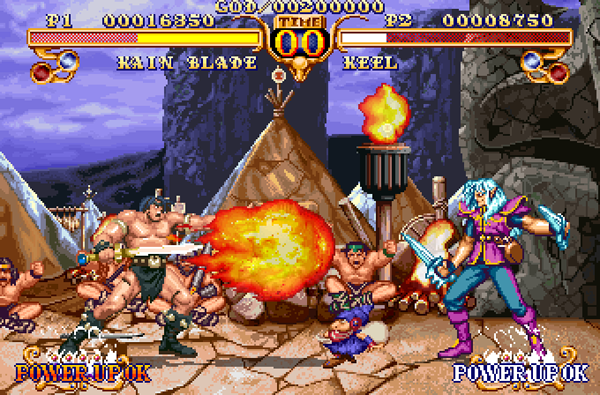
Golden Axe: The Duel brings back fond memories. They’re not actually memories of the game; I’m sure I played it on the Sega Saturn in its day, but never with immense devotion or in notable circumstances. No, it just reminds me of a time when just about everything was a fighting game. Claymation dinosaurs? That was a fighting game called Primal Rage…and another called Dino Rex. DC Comics’ superheroes? That was a fighting game called Justice League Task Force. Spheres stuck together in humanoid shapes? That was a fighting game called Ballz, though it was rarely called that without a snicker or a roll of the eyes.

It made a great deal of business sense for Sega to make a Golden Axe fighting game. The barbarian-fantasy brawling of Golden Axe ruled mightily over arcades in the late 1980s, but those days were long gone by 1994. Belt-scrolling brouhahas like Golden Axe were rarities compared to Street Fighter II and many other one-on-one fighters. So if an executive stomped into Sega’s arcade division and told them that Golden Axe was going to be a fighting game, nobody could’ve argued for long.


Not that Golden Axe: The Duel is poorly made. The pulp-fantasy trappings of earlier Golden Axes fit into a fighter pretty well, and Sega dressed it all up with detailed characters, rousing music, and some backgrounds that remain impressive today. Mechanically speaking, however, the designers jumped eagerly on what came before. The special moves and six punch-and-kick buttons are Street Fighter boilerplate, with some Samurai Shodown complexity in the most elaborate attacks. To this they added one fine Golden Axe tradition: kicking blue munchkins until they drop potions. The little scamps, now resembling Dark Crystal muppets, scurry in and out of the fight, and belting them releases vials to fuel your super-move meter.

Sega didn’t try any harder in filling out the character lineup. The descendants of the original game’s Barbarian Guy, Amazon Woman, and Dwarf are on hand alongside a robed wizard, a hulking forest giant, a dagger-wielding elf in Clockwork Orange makeup, and a girl in beastly furs (who’s basically Cham Cham from Samurai Shodown). Like the play mechanics, the warriors are casually engaging but unmemorable. They’re not offensively generic or annoying. They’re just there, like co-workers you rarely even see in the hall.

Guilty Gear's Jam Session

You know what’s a good website? The Cutting Room Floor. It’s all about stuff hidden in video games: unused characters, deleted scenes, altered graphics, and even messages from irate programmers. I mentioned the site a few entries back, and it’s worth recommending again as the sort of place where you can lose an entire afternoon and not feel all that bad about it. You were going to waste that afternoon playing Paladin’s Quest or Skitchin' or Bullet Witch or Digger T. Rock: Legend of the Lost City anyway.

I’m dismayed that I don’t have anything to contribute to The Cutting Room Floor. The best I can do is to dig up something that’s easily noticed by the handful of people who played and remembered Guilty Gear: Dust Strikers.


Like Guilty Gear Isuka and Guilty Gear: Judgment, Dust Strikers is a small, irrelevant, and seldom-praised corner of the Guilty Gear landscape. It drops most of the franchise’s nutty heavy-metal anime warriors into chaotic, multi-tiered battlegrounds much like Super Smash Bros. Melee, and it attempts all of this on the DS. It’s cramped and unsatisfying, and I suspect the developers knew this. They tried to make it up to us with a bunch of really simple mini-games.


One of these bonus attractions finds Jam Kuradoberi, shrieky martial artist and restaurateur, balancing food and some unsanitary cats that fall from above. The retail version of the game uses a cheerful, pint-sized version of Jam, but this wasn’t always the case.


As shown in early screenshots of Dust Strikers, Jam’s mini-game featured her with more conventional proportions, plus an expression indicating either confusion or RealDoll-like placidity. It’s pretty clear why this was changed: full-size Jam takes up too much space that would otherwise fit more falling objects. I have no doubt that the original sprites for mini-game Jam are hidden in the Dust Strikers ROM, but I also have no technical aptitude for finding them.

That’s my contribution to the detective work exemplified by The Cutting Room Floor. Yes, you can read much more interesting things there now. Go ahead. I’ll be over here with Digger T. Rock.

Star Quest: The Wings of Randy Wilson

We have an absurd amount of anime at our disposal online. Even beyond the numerous shows that companies stream for free, there are those devoted nerds who track down obscure releases and offer them for mockery and edification. You can see many of these relics on YouTube or at the anime convention panels that specialize in such things. Heck, we can even download an amazing Prince of Tennis fandub once suspected lost to the ages. That’s historical preservation for you.


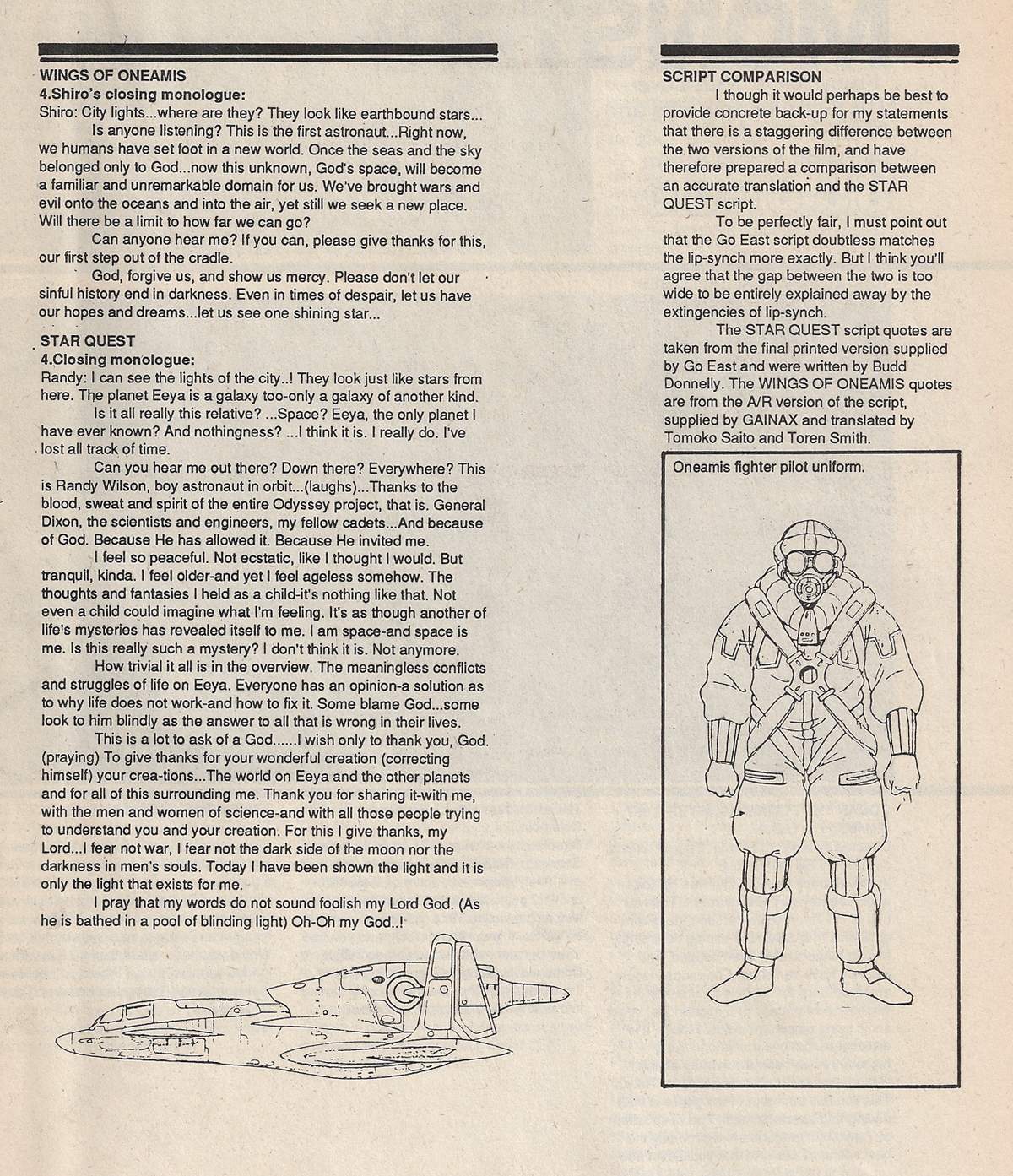
However, there’s one especially mysterious release that, to my knowledge, never found its way online: Star Quest. Its story begins with Gainax’s uncompromisingly ambitious Royal Space Force: The Wings of Honneamise, which was a really big deal back in 1987. My opinion of the film is not entirely praise, but there’s no denying the imaginative vision that Gainax brought to the movie. It’s the tale of another world’s first manned spaceflight, and just about every scene gives off the fascinating air of a reality that’s not quite ours but every bit as flawed. Honneamise caught the attention of many fans when it debuted in 1987, and a North American outfit called Go East Productions snapped it up and renamed it Star Quest.

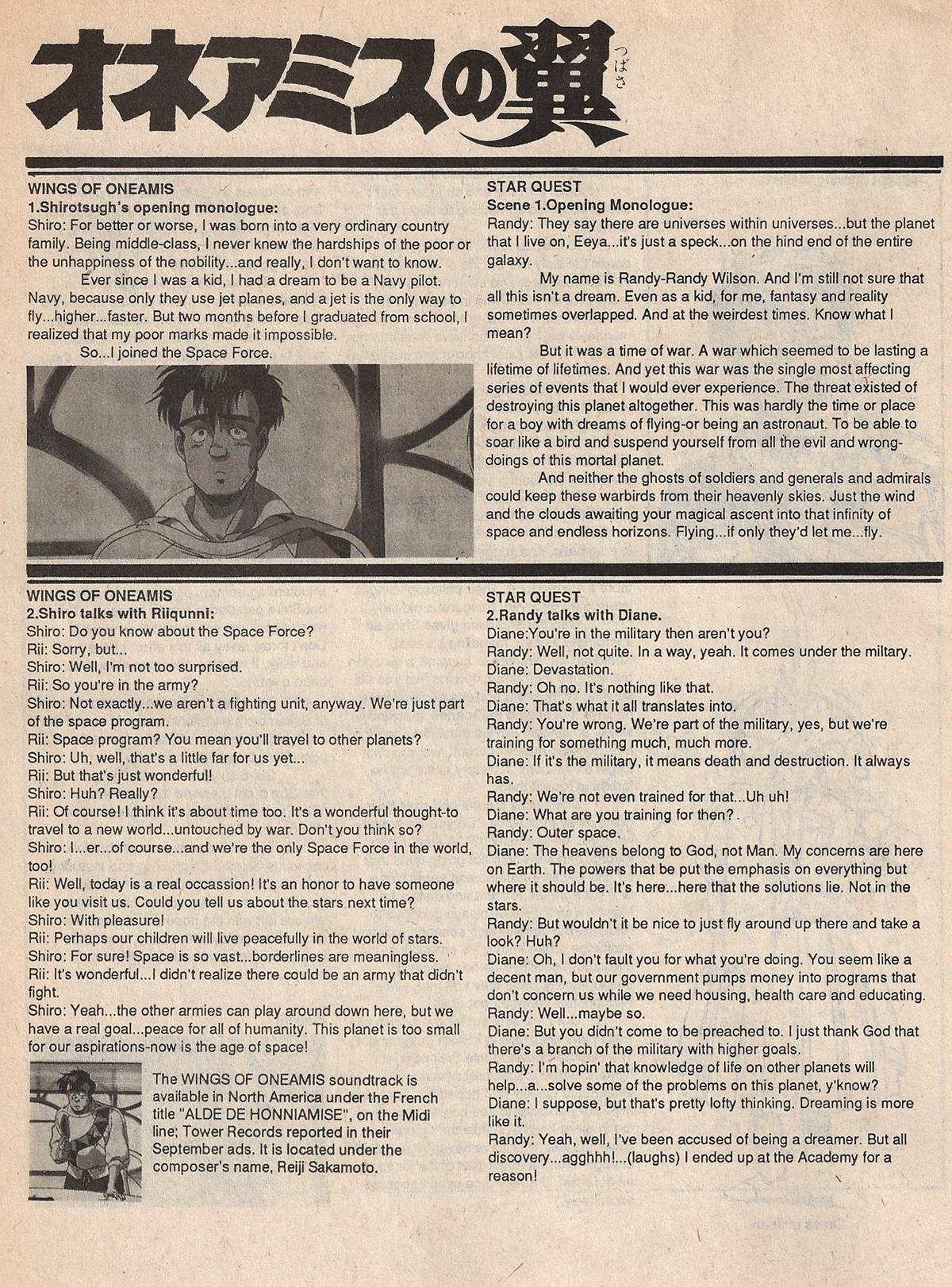
Star Quest involved more than a title change, of course. Go East dubbed the film with a noticeably different script, changing a good deal of the dialogue and most of the names into a strange mix of Westernized titles and fantasy neologisms. Honneamise avoids any obvious Japanese or American names, cheating only by nicknaming its protagonist Shirotsugh Lhadatt “Shiro.” The Star Quest dub dispenses with most of this. Shirotsugh becomes Randy Wilson, pious street preacher Riquinni becomes Diane, and General Khaidenn becomes General Dixon. Oddly, the planet itself gets a name in this new dub: Eeya. Eeya indeed.

According to esteemed anime historian Carl Horn, Star Quest premiered on February 19, 1987 at Mann’s Chinese Theatre (now known as TCL Chinese Theatre) and never again appeared in public. Longtime anime collectors reportedly have copies of the film, but no clips or other records are available online. Contemporary reviews of Star Quest are also hard to find, but there’s an interesting account in the second issue of Anime-Zine. An article by Toren Smith recounts the plot of Honneamise and spends two pages explaining some of the differences between the original script and Star Quest.


Smith’s examples reveal a considerably different tone to the movie. Star Quest breaks the film’s mood almost instantly, with the main character describing his planet of Eeya just before he gives his name as Randy Wilson. For a denizen of a planet with an unimpressive space program, he sure knows a lot about its astrogeographical location. Likewise, Randy’s orbital homily at the end of the film is a lot longer and preachier than Shiro’s speech in Honneamise.

Go East Productions is nearly as puzzling as Star Quest. Horn’s old Usenet post links the company to My Little Pony, but it’s hard to find any firm details about the group (which shares a name with several unrelated outfits). Both Horn and Smith credit the Star Quest script to Budd Donnelly, whose IMDB page links him to ‘70s B-movies like Cinderella 2000 but not Star Quest. It’s a forgotten film, and by all available accounts it deserves that fate.

Yet Star Quest seems an interesting relic in the history of bastardized anime. It’s not just a meddlesome dub. It’s a full-scale rewrite of a film that, in its original version, tries to encompass the whole of human progress and civilization. How did Star Quest handle that? How did it approach the attempted rape that, in my opinion, wrecks the movie? How did it translate scenes of a rival nation’s leaders, who speak in a subtitled fictional language? It may be that we’re all better off not knowing, and of course that’s why we want to find out.

Sega, Strider, and Sex

It won’t be long before academia and pop culture expand and entwine so much that courses are taught in video-game history. When the lecture turns to the great System Wars of the late ‘80s and early ‘90s, professors will detail the numerous reasons Sega pulled ahead of Nintendo for a few years. The Sega Genesis had several things the old Nintendo Entertainment System didn’t, they will say. The Genesis had sharper graphics, games astonishingly close to the arcade versions, and compellingly aggressive advertising. If they’ve done their research, they’ll also mention that the Genesis had sex appeal.

This was considerably important to Sega’s target market: the teenage boys who had outgrown Nintendo and didn’t know it yet. Their hormones stewed in secret disdain for the largely sanitized NES library and the kid-safe pages of Nintendo Power. Young gamers might see something suggestive on the NES covers of Battle Chess or Swords and Serpents, but those were rare finds in the Nintendo-bordered aisles of Toys R Us or Kay-Bee. Nintendo defined more childhoods than Sega ever could, but Nintendo rarely pushed things past the level of a PG-rated movie.


Sega possessed no such scruples. The covers of Genesis games embraced sexuality whenever they could, and Sega proper led the charge with the Vallejo-grade adornments of Golden Axe II and Alisia Dragoon, the horror-movie luridness of Night Trap, and whatever was going on with Altered Beast. Like the comics and imported anime that youngsters embraced in the 1990s, Sega’s games strove to show that they were not kid stuff.

Yet there’s one piece of Sega packaging more sexual than any other: the back cover of Strider.


There’s no need for literary analysis. Strider's pitch quickly casts both hero and player as “a crunching hulk of muscle.” What’s Strider crunching? That’s not clear, but he’ll stiff-arm his way through enemies that end up “shuddering heaps.” Next come the "alluring Amazones” who will “turn your mind manic,” and then it’s on to the snarling musclemen, grappling with our hero in a biceps-bursting embrace. My hat goes off to the writer of this, as it snuck risqué material into an innocent product even more slyly than the original VHS cover of Disney’s The Little Mermaid.

Amusingly enough, Strider itself isn’t a very suggestive game. It’s a weird one, to be sure, but the closest it gets to sexuality is a cadre of jungle amazons and their odd semi-German battle cries.


There’s a story behind that, in fact. According to the ever-informative The Cutting Room Floor, Strider’s amazons at first walked around with one breast uncovered, as consistent with ancient Greek depictions of their kind. Capcom quickly changed this, of course.

Capcom’s solution was to affix leaves over the exposed breasts, and the whole thing seems really obvious once you know the story. The leaves don’t really fit with the amazons’ palette, and they actually disappear during animation frames that wouldn’t reveal anything in the first place. The Genesis version makes it even more apparent by giving the women slightly redesigned outfits instead of leaf-tops.

I find it amazing that someone, perhaps even Strider director Kouichi Yotsui, considered showing this in the first place. Strider ended up in arcades around the world, and I can only imagine what would’ve happened if the first round of cabinets had shipped with actual nudity in the game. Cynical conjecture suggests that the game would’ve sold better, perhaps prompting Capcom to make Strider sequels a little more often. Yet it would never have made it into the Genesis version. Even Sega’s sex appeal had limits.

Pandora's Despair

[What follows spoils pretty much every ending in Pandora’s Tower. If you want a more even look at the game, you’ll find my review here. I also agree with IGN’s take, but I think we’re supposed to pretend that nothing worthwhile ever comes from IGN.]  

Pandora’s Tower sets its tone quite early. Timid farmgirl Elena and her reticent soldier boyfriend Aeron head into a wasteland, hoping to revoke a curse that’s turning Elena into some tentacle-sprouting nightmare. Their hunchbacked guide Mavda lays it all out: in other to get better, Elena must wolf down the flesh of the creatures who dwell in a ring of towers suspended above an ominous chasm. So Aeron heads out to slay some monsters and bring back their purple innards. Elena, shakily recovered after her first taste of monster spleen, says that she wants to come along. Aeron shakes his head. Off to the kitchen Elena goes.


That is no real exaggeration. For most of the game, Elena stays at an outpost that she and Aeron find near the chained-up towers. She does the laundry, cooks the meals, sweeps the floor, sews the curtains, and generally keeps house while her man is off killing lizard-knights and giant barnacle cannons. Each beastly organ he brings home is devoured by Elena—reluctantly at first, and later with alarming rapacity. On top of fetching these grotesque cures, Aeron helps keep up Elena’s spirits with compliments and gifts. She responds with childish extremes, her anime-mannequin face brightening at the sight of a new dress or recoiling in horror if Aeron presents an animal fang or something else mildly unpleasant. Elena seems an embarrassing and simplistic stereotype of femininity, a coquettish phony girlfriend for the insecure young man. It’s not helped by her actress, who was apparently told to play the character as though she’s not a person but rather a half-blind kitten.

This chauvinism dominates most of Aeron’s interactions with Elena, and developer Ganbarion evidently intended some of that. Company director Chikako Yamakura states that she thought up Pandora’s Tower as a game for male players ages thirteen to twenty-ish, and the central idea became “a woman who was pure being somehow spoiled or corrupted and then becoming pure once more.” The game bears this out time and time again, repeating positioning Elena as a delicate country blossom in need of constant tending. Her relationship with Aeron is measured by a glowing line of links at the edge of the screen, and it can be raised by any insipid kindness and lowered by even mild setbacks. Poor Elena. Thank heavens she has a man to fend for her.


Yet there’s more to Elena and Pandora’s Tower. At first her affliction is just a nasty bit of body horror; if she’s left without monster flesh for too long, she’ll sprout tendrils and degrade into some barely human aberration. At her last stage, she’s melting into some legless creature and seeping ichor all about. She’s broken down to the last shred of her being, and watching her fight for it is the most disturbing scene in the game.

It’s also the most intriguing. It reveals Elana’s curse as more than just a gruesome motivator or pitiable flourish. It’s a degrading affliction she faces every moment. From there the game easily becomes allegory for something far more understandable than a distressed damsel. It could be the slow agony of cancer treatments, with Mavda peddling lengthy and uncertain remedies. It could be some other illness that leaves Elena fragile and domestic. Or it could be the vaguer bindings of depression.

Flash Hiders: Safety First


Flash Hiders and Battle Tycoon rarely draw notice in the history of fighting games. The two titles were the now-defunct Right Stuff’s attempts at snatching a piece of the genre’s sugary and super-saturated pie in the 1990s. Neither succeeded, but I suspect they were ahead of the curve. Every modern fighting game has a console-oriented story mode with RPG-ish customization, and Right Stuff explored that territory with the original Flash Hiders in 1993. More can be read in this GameSetWatch piece I wrote years ago, even though I now see some typos and at least one factual error: Patchet is a were-polar-bear, not a werewolf.

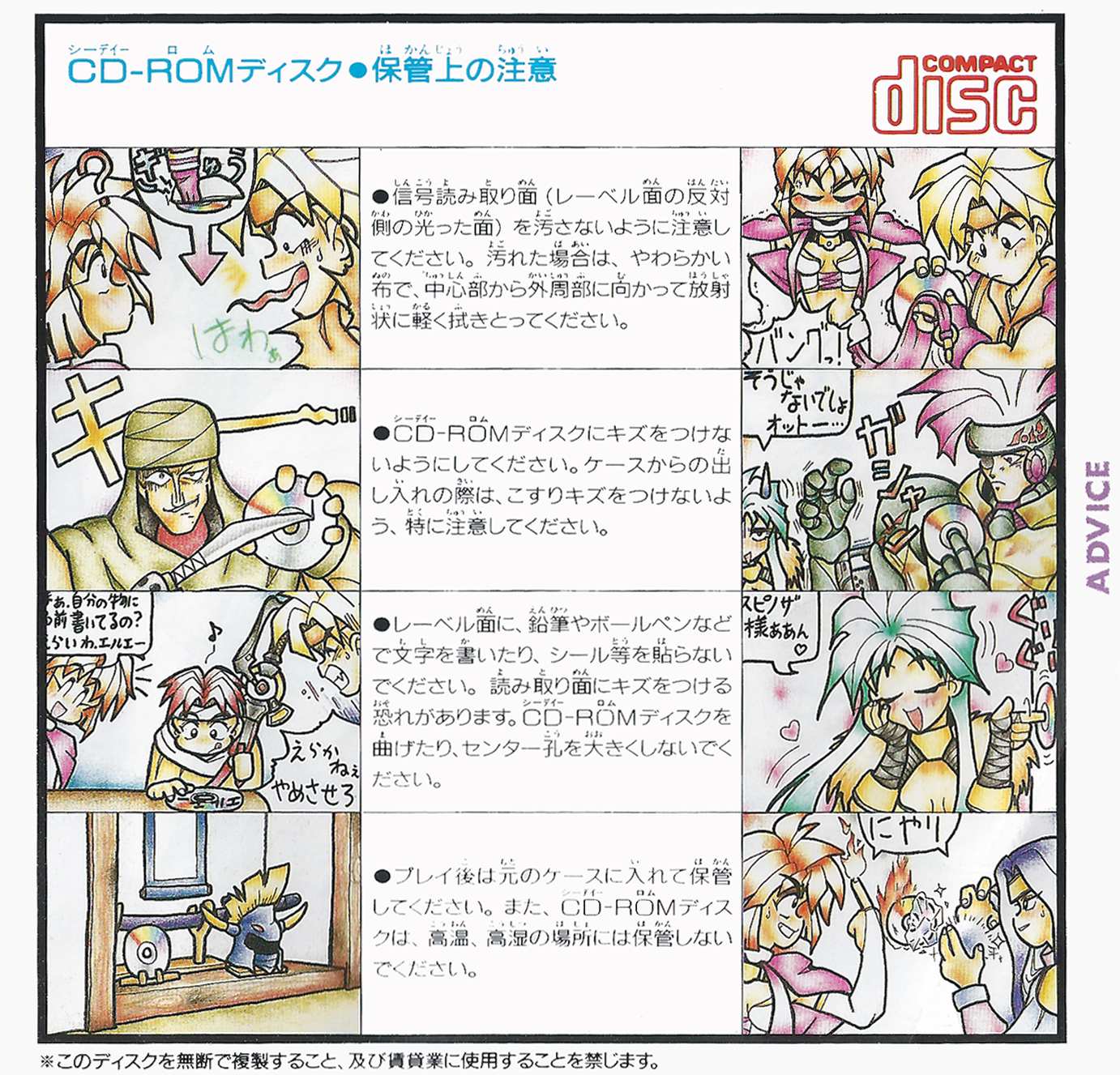
I like Flash Hiders, and I also like its manual. Game instructions usually include guidelines for handling a cartridge or CD, and every so often the publisher might add little comics of the game’s characters failing to heed such advice. This is a lost art today, but it was common in the Japanese market of the early 1990s, when CDs were a new technology and there was always the chance that some consumers would try to play a game by breaking the disc apart and picking their noses with the shards.

My favorite game-safety guides are the ones from Phantasy Star III and IV, but the last page of the Flash Hiders manual is also very helpful. It offers plenty of illustrated advice for first-time CD-ROM owners.